Not all garage floor coatings survive a Connecticut winter. Here's what actually happens to epoxy and polyaspartic when Hartford County puts them to the test.
If you’re weighing epoxy versus polyaspartic for your garage floor, you’re probably doing it because something already went wrong — a floor that peeled, a coating that turned yellow, or a DIY kit that looked fine for six months and then didn’t. That experience is more common than it should be, and it usually has less to do with which coating was used and more to do with how it was installed.
This page is about helping you understand the real differences between these two systems — how they perform, where each one holds up, and why Hartford County’s climate specifically changes the equation. By the end, you’ll know exactly what to look for and what questions to ask.
Epoxy has been the industry standard for garage floors for decades, and for good reason — it’s tough, it bonds well to concrete, and when it’s installed correctly, it holds up. But it has real weaknesses. It’s sensitive to UV light, which means it yellows. It becomes brittle in cold temperatures, which means it can crack. And it takes three to five days to cure before you can park a car on it.
Polyaspartic is a newer chemistry — technically a type of aliphatic polyurea — and it was developed specifically to address those limitations. It cures in hours, not days. It’s 100% UV stable, so it won’t yellow. And it stays flexible, which matters enormously when your concrete is expanding and contracting through a New England winter.
The most useful way to think about this comparison is across four categories: durability, curing time, UV resistance, and how each coating responds to temperature extremes. On all four, polyaspartic has a measurable edge — but the gap is wider in some areas than others.
On durability, polyaspartic coatings test at roughly four times the abrasion resistance of standard epoxy. That’s not marketing language — it reflects the difference in material chemistry. Polyaspartic also maintains close to 98% of its gloss after five years of normal use, while epoxy depending on UV exposure and traffic starts showing visible wear and color shift within 12 to 18 months in most garage environments.
Curing time is where the practical difference hits hardest. A traditional epoxy installation typically means your garage is out of commission for three to five days before you can park on it. Polyaspartic systems are walkable the same day and drive-ready within 24 hours. If you have two cars, a home gym setup, tools, or anything else living in that garage, the difference between one day and five days is significant.
UV resistance matters more than most people expect. Garages with windows, south-facing doors, or even indirect light exposure will yellow an epoxy topcoat over time. It’s not a product defect — it’s just how the chemistry behaves. Polyaspartic doesn’t have that problem. It’s UV stable by design, which is why we use it as a topcoat in every high-performance professional system.
One honest caveat worth mentioning: polyaspartic is not the better choice in every single scenario. In environments with heavy battery acid exposure — think certain commercial or industrial settings — epoxy actually holds up better. For the vast majority of residential garages in Hartford County, that’s not a relevant factor, but it’s worth knowing the full picture.
What most professional installers use today isn’t a pure choice between the two anyway. The industry-standard approach for high-performance garage floors is a polyurea base coat combined with a polyaspartic topcoat — a hybrid system that uses each material where it performs best. The polyurea bonds aggressively to the concrete. The polyaspartic provides the UV-stable, abrasion-resistant surface layer. That combination is what separates a floor that lasts 15 years from one that starts failing in three.
A comparison written for Phoenix or Miami doesn’t apply here. Hartford County has a genuinely demanding climate for floor coatings — and that’s not an exaggeration to sell you something, it’s just the reality of living in inland Connecticut.
The freeze-thaw cycle is the biggest factor most homeowners don’t think about. Water infiltrates tiny cracks in unprotected or improperly coated concrete, freezes, expands, and then thaws — over and over again throughout the winter. Hartford County’s inland position means harder, longer winters than Connecticut’s shoreline towns, where the Long Island Sound moderates temperatures. The result is more freeze-thaw cycles per season, more stress on the concrete, and more strain on whatever coating is sitting on top of it. Polyaspartic’s flexibility allows it to move with the concrete through those cycles. Epoxy, which becomes brittle in cold temperatures, resists that movement — and eventually cracks or delaminate.
Road salt is the second factor. If you’re driving on I-84, I-91, Route 44, or any of Hartford County’s secondary roads between October and April, your car is arriving home coated in calcium chloride and magnesium chloride. Those chemicals are among the most corrosive substances an unprotected or epoxy-coated garage floor encounters. Polyaspartic’s chemical resistance is specifically built to handle that kind of exposure — automotive fluids, de-icing chemicals, oil, antifreeze.
Then there’s moisture. Towns like Hartford, Windsor, Wethersfield, Rocky Hill, and Glastonbury sit near the Connecticut River, which creates elevated water tables and higher moisture vapor pressure beneath garage slabs. Clay-heavy soil — common throughout much of Hartford County — retains moisture and pushes vapor upward through the concrete. When a coating is applied over a slab with elevated moisture emissions and no vapor barrier, it bubbles. It delaminate. It fails, often within a year or two, regardless of how good the coating itself was. This is why moisture testing before any installation is non-negotiable, and why a proper moisture vapor barrier is part of every job we do.
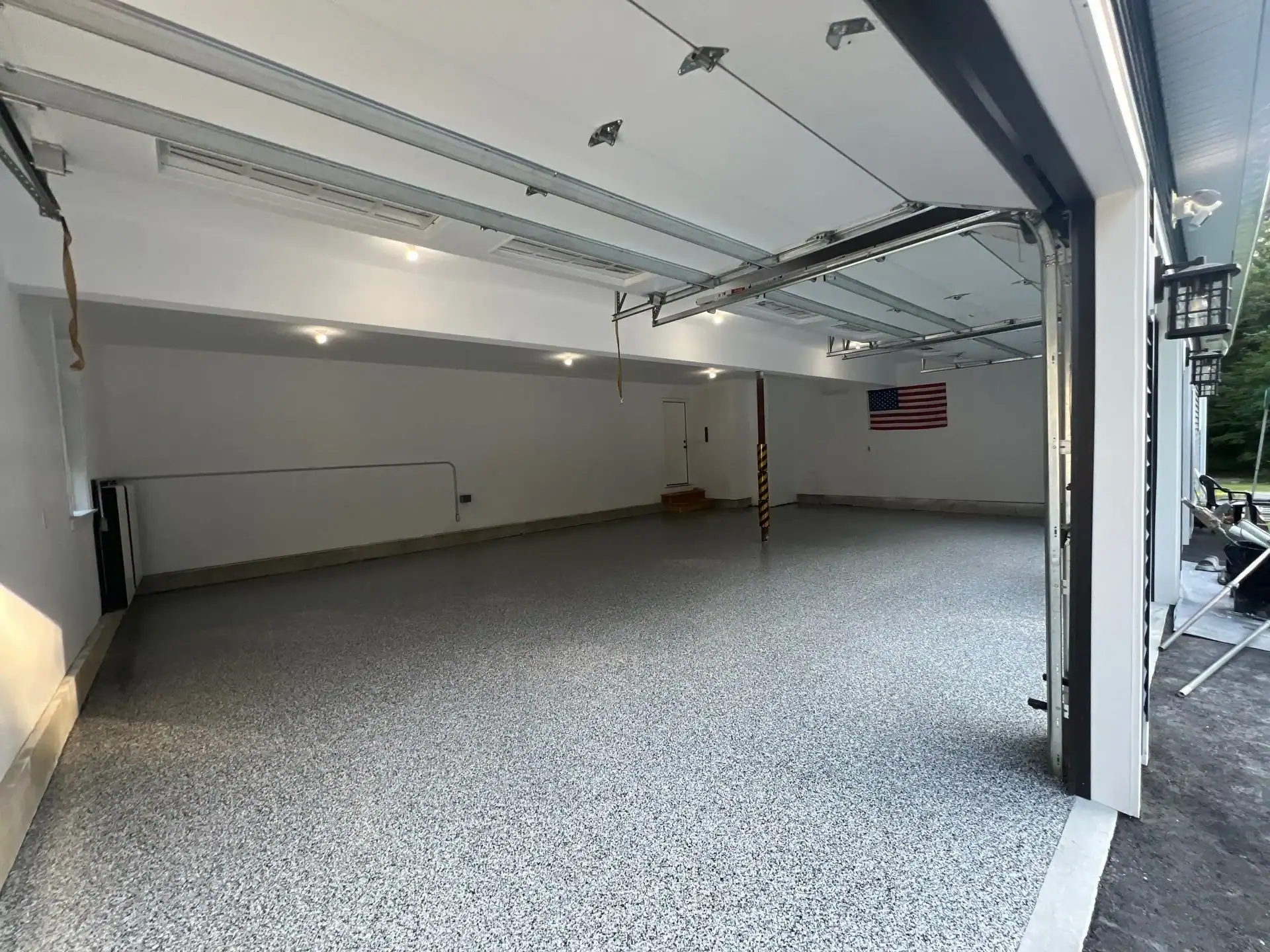
For most Hartford County garages — older slabs, road salt exposure, freeze-thaw conditions, and moisture-rich soil — polyaspartic, installed over a polyurea base coat with a proper vapor barrier underneath, is the right answer. Not because it’s the most expensive option, but because it’s the one that actually performs under the conditions your garage faces every single year.
Want live answers?
Connect with a American Poly Floor expert for fast, friendly support.
The coating itself is only part of the story. The reason so many garage floors fail — whether they were epoxy or polyaspartic, professionally installed or DIY — is almost always the same: the preparation wasn’t done right.
Surface preparation is the single most important factor in how long a floor coating lasts. Diamond grinding, not acid etching, is the professional standard. It creates a precise mechanical profile in the concrete — a texture that gives the coating something to grip permanently. Acid etching, which is what most big-box store kits rely on, opens pores but doesn’t create that profile. The bond is weaker from the start, and it shows up within a year or two when the coating starts to lift.
Walk into any Home Depot or Lowe’s in West Hartford or Glastonbury and you’ll find epoxy floor kits on the shelf. They’re not expensive, the instructions look manageable, and the before-and-after photos on the packaging are genuinely appealing. The problem is that what’s in that kit is a water-based or low-solids formulation — not the 100% solids commercial-grade material that professional systems use. The difference in performance isn’t subtle.
Beyond the material quality, the kits don’t come with the preparation steps that actually determine whether a coating lasts. There’s no diamond grinding. There’s no moisture test. There’s no vapor barrier application for slabs with elevated emissions. You’re applying a lower-grade product over a surface that hasn’t been properly prepared, in a climate that’s going to stress that coating harder than almost anywhere else in the country.
The result is predictable. The floor looks good for a season, sometimes two. Then it starts to peel at the edges, or bubble in the middle, or lift near the garage door where temperature swings are most extreme. It’s not because the homeowner did something wrong — it’s because the product and the process weren’t designed for what Hartford County actually puts a garage floor through.
Many of the homeowners we hear from have already been through this once. They followed the instructions, they did the prep the kit called for, and they still ended up with a floor that failed. That experience makes sense when you understand what the kit was and wasn’t designed to do. It also makes the case for why professional installation — with proper grinding, moisture testing, a vapor barrier where needed, and a commercial-grade coating system — produces a completely different outcome.
Older housing stock throughout towns like Avon, Simsbury, Farmington, and Southington adds another layer of complexity. Concrete slabs from the 1960s through the 1980s have higher porosity, decades of potential oil and grease contamination from vehicle parking, and surface conditions that require more thorough preparation than a newer slab. A DIY kit applied to a 40-year-old slab without proper grinding and cleaning isn’t going to hold. A professionally prepared surface with the right primer system will.
One of the most practical differences between epoxy and polyaspartic is what happens after the coating goes down — specifically, how long before your garage is yours again.
With a traditional epoxy system, you’re typically looking at three to five days before vehicle traffic is safe. That’s not a contractor being overly cautious — it’s the chemistry. Epoxy cures through a chemical reaction that takes time, and putting a car on it too soon can damage the surface before it’s fully hardened. For a household that uses the garage daily, that’s a real disruption. Bikes, tools, a second vehicle, a workout setup — all of it needs somewhere else to go for most of a week.
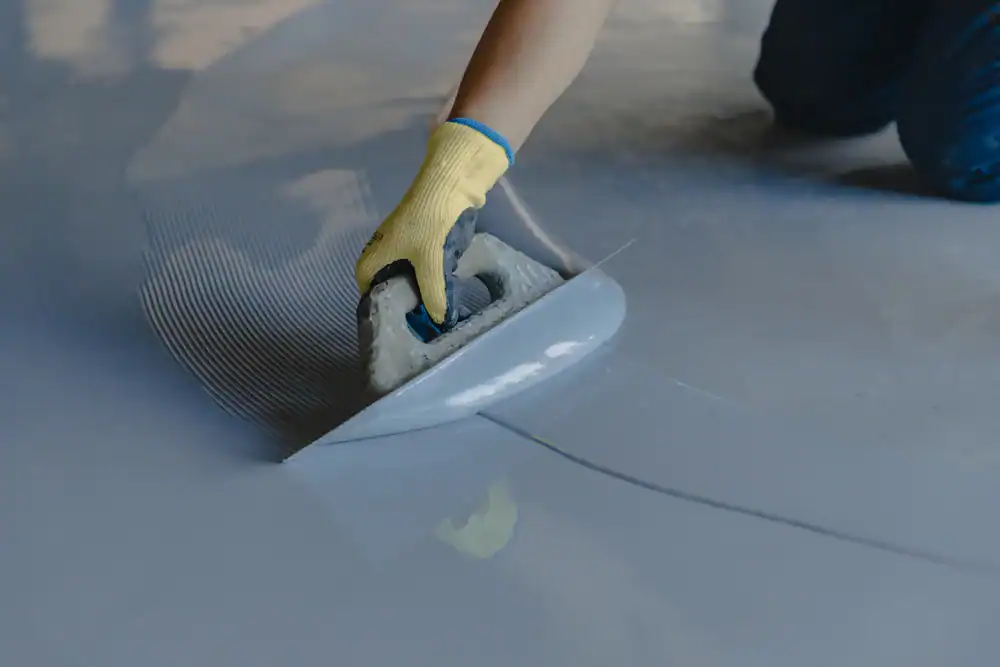
Polyaspartic cures dramatically faster. The set time is measured in minutes, not hours. Walk on it the same day. Park on it the next morning. That’s not a claim we make to sound impressive — it’s how the material works, and it’s one of the reasons polyaspartic has become the professional standard for residential garage floors where homeowners want minimal disruption.
The tradeoff is that polyaspartic’s fast cure time is also why it requires professional application. The window for working with the material is short. Mix ratios have to be exact. Application technique matters. A contractor who’s used to working with slower-curing epoxy and tries to apply polyaspartic the same way will produce a floor with adhesion problems, surface inconsistencies, or incomplete cure. The speed that makes polyaspartic so convenient for the homeowner is what makes it unforgiving for an under-trained installer.
We coordinate PODS storage for customers who need a place to put garage contents during installation — it’s one less thing to figure out on a project that’s already disrupting your routine. Most installations in Hartford County are completed in a single day, start to finish, including cleanup. That’s a meaningful difference from a multi-day process that leaves your garage unusable and your driveway cluttered for the better part of a week.
The warranty behind the work matters here too. We back every installation with a 15-year peace of mind warranty — the longest offered by any local contractor we’re aware of. That’s not a number chosen for marketing purposes. It reflects the confidence that comes from using certified materials, trained installation, and a preparation process that doesn’t cut corners.
The short version: for most Hartford County garages, a polyaspartic system — installed over a polyurea base coat with a moisture vapor barrier where the slab requires it — outperforms standard epoxy on every dimension that matters in a New England climate. It handles road salt, survives freeze-thaw cycles, won’t yellow, and cures fast enough that your garage is functional again the next day.
That said, the coating choice matters less than most people think. What really determines whether a floor lasts is the preparation — the grinding, the moisture testing, the vapor barrier, the material ratios. A well-prepared surface with a quality coating system will outlast a poorly prepared one regardless of which product was used.
We’re based right here in East Hartford and have been doing this work for homeowners across West Hartford, Glastonbury, Simsbury, Avon, Farmington, and the surrounding towns in Hartford County. Reach out for a free quote and we’ll tell you exactly what your slab needs — no pressure, no upsell, just a straight answer.
—
**Frequently Asked Questions**
**Which is better for Connecticut garages: epoxy or polyaspartic?** For most Hartford County garages, polyaspartic is the stronger choice. The freeze-thaw cycles in towns like Hartford and Glastonbury, combined with road salt exposure and moisture conditions from clay-heavy soils and Connecticut River proximity, all favor polyaspartic’s flexibility, chemical resistance, and UV stability over traditional epoxy. That said, the preparation process matters just as much as the coating itself — even the best material will fail on a poorly prepared slab.
**How long does polyaspartic take to cure compared to epoxy?** Polyaspartic is walkable the same day and ready for vehicle traffic within 24 hours. Epoxy typically requires three to five days before you can park on it. For most homeowners, that difference is a significant factor in the decision.
**Why do DIY epoxy kits fail so often?** Two reasons, usually. First, the products in big-box store kits are water-based or low-solids formulations — not the 100% solids commercial-grade material we use professionally. Second, the kits don’t include the preparation steps that determine whether a coating lasts: diamond grinding, moisture testing, and vapor barrier application where needed. In Hartford County, where older slabs and high moisture conditions from the Connecticut River are common, those skipped steps are almost always what causes the failure.
**Do I need a moisture barrier under my garage floor coating?** In many Hartford County garages, yes. Clay-heavy soil and proximity to the Connecticut River create elevated moisture vapor pressure beneath slabs in towns like Hartford, Windsor, Wethersfield, and Rocky Hill. We test every slab before installation — if vapor emissions are elevated, we apply a moisture vapor barrier before any coating goes down. Skipping this step is one of the most common causes of bubbling and delamination, even on otherwise well-installed floors.
**Is polyaspartic worth the extra cost over epoxy?** In most cases, yes — particularly in Connecticut. The longer lifespan, the UV stability, the chemical resistance to road salt and de-icing chemicals, and the faster return to use all add up to a lower total cost over time. A floor that doesn’t need to be recoated in four years is cheaper than a less expensive floor that does.
**What’s the difference between polyurea and polyaspartic?** Polyurea is the broader material family — polyaspartic is a specific type of polyurea. In professional floor coating systems, polyurea is typically used as the base coat because of its exceptional bonding strength to concrete. Polyaspartic is applied as the topcoat because of its UV stability and surface hardness. The combination of both is what makes modern high-performance garage floors significantly more durable than older single-product epoxy systems.
Summary:
Article details:
Share: