Summer in Hartford County is brutal on garage floors. Here's what the heat and humidity actually do to your prep — and why it matters before anything gets coated.
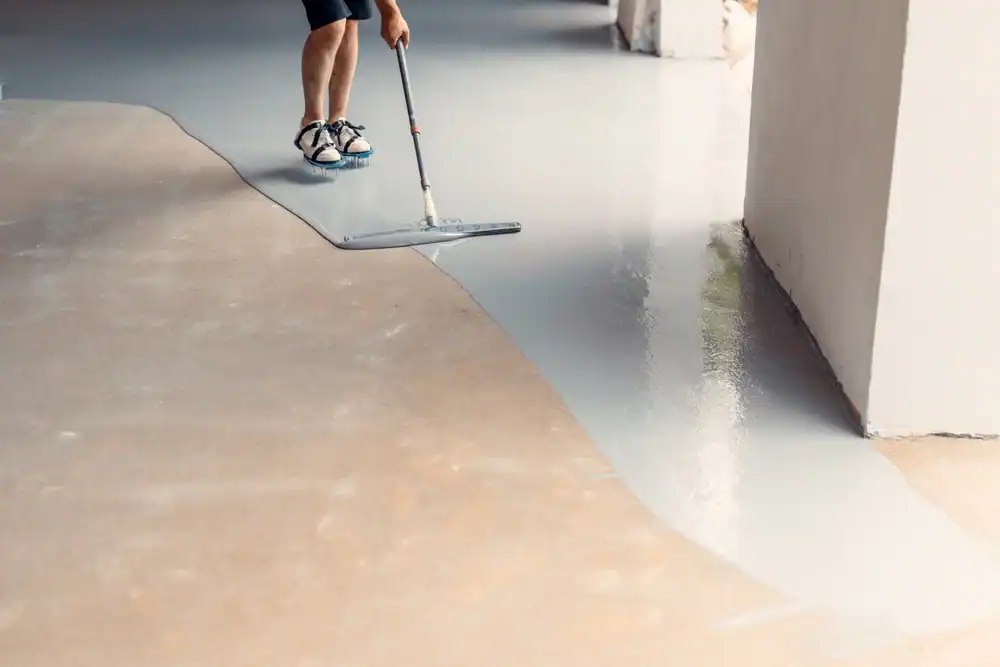
You’ve probably seen a garage floor coating peel up at the edges, bubble in the middle, or lift completely off the slab within a year or two. Maybe it happened to yours. Maybe you’re trying to avoid it happening again.
Here’s what most people don’t find out until after the fact: the coating itself usually isn’t the problem. The problem is what happened — or got skipped — before the coating ever went down. In Hartford County, where summer humidity sits around 74% and afternoon thunderstorms can roll in without much warning, the prep window is a lot more unforgiving than most contractors will tell you upfront.
Concrete floor preparation is always the most important part of any flooring installation. But in summer — especially in Hartford County — it becomes the most complicated part too.
When ambient temperatures climb into the upper 80s and the air is thick with humidity, the concrete slab itself starts working against you. Surface temperatures in an unshaded garage can run 15 to 20 degrees hotter than the air outside. That heat accelerates how fast a coating cures on the surface, which sounds like a good thing until you realize the coating is skinning over before trapped air and moisture underneath have had a chance to escape. What you’re left with is pinholes, bubbles, and a bond that’s already compromised before you’ve even finished the job.
This isn’t a fringe scenario. It’s what happens when summer installation gets rushed or when the prep process doesn’t account for the actual conditions inside a Hartford County garage in July.
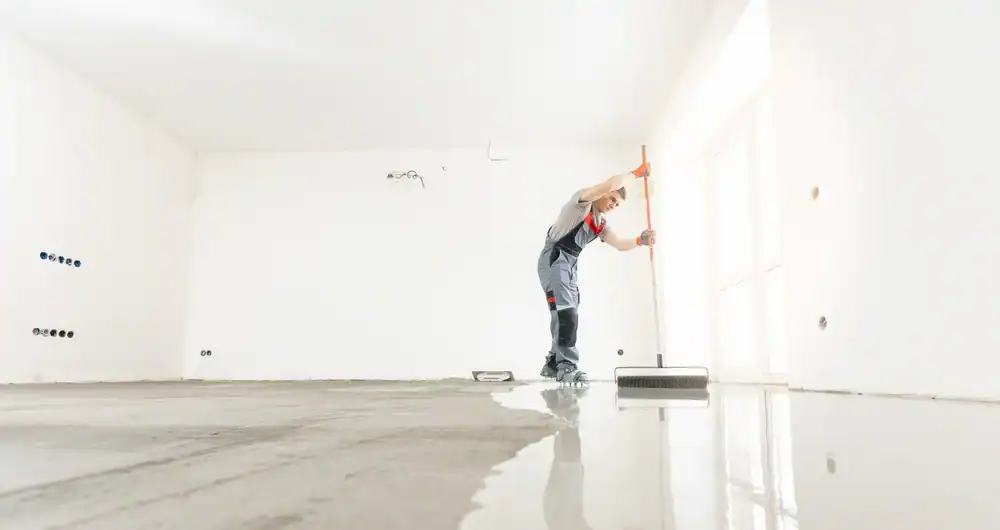
The most common thing we hear from homeowners who’ve had a floor fail is some version of this: “The floor looked completely dry.” And it probably did. That’s the problem.
Visual dryness tells you almost nothing about what’s happening inside the slab. Concrete is porous, and moisture vapor moves through it constantly — upward, from the soil beneath, through the slab, and into whatever coating sits on top. In Hartford County, where the ground gets 51 inches of rain per year — about a third more than the national average — that upward pressure is real and ongoing, even when the surface looks fine.
Professional moisture testing uses two primary methods. The first is the calcium chloride test, which measures how much moisture vapor is escaping from the slab over a 24-hour period. Industry standards set the acceptable limit at 3 pounds per 1,000 square feet per day. Exceed that, and most coatings aren’t going to bond properly. The second method uses an in-situ probe inserted directly into the slab to measure relative humidity inside the concrete itself. Most coatings require that number to be at or below 75 to 80 percent.
Hartford County has specific conditions that push both of those numbers higher than you’d see in drier markets. The clay-heavy soils common throughout central Connecticut — in towns like West Hartford, Newington, and Wethersfield — drain poorly and hold moisture close to the foundation. Slabs built before the 1980s, which make up a significant portion of the housing stock here, were often poured without any under-slab vapor barrier at all. Those slabs have been absorbing and releasing moisture for decades. By July, when the water table is near its annual peak and the soil around the foundation is saturated from spring rain, the moisture vapor emission rates in older Hartford County garages can run two to four times the acceptable threshold — even when the floor looks bone dry.
We test every floor before anything else happens, because there’s no responsible way to skip this step in our climate.
There’s a window for applying epoxy that most people don’t know exists. Concrete cures best when the ambient temperature is somewhere between 70 and 80 degrees Fahrenheit. Once you get above 85 or 90 degrees at the surface, things start going wrong in ways that aren’t always visible right away.
Hot concrete causes the epoxy to set too quickly on top while staying soft underneath — a false set that looks fine initially but leads to delamination down the road. High humidity creates another specific problem called amine blush, which is a waxy film that forms on the surface of curing epoxy when moisture in the air reacts with the coating. It’s invisible to the naked eye, but it prevents the next layer from bonding correctly.
There’s also the dew point rule, which professional installers follow but rarely explain to customers. Epoxy should never be applied when the concrete surface temperature is within five degrees of the dew point. In Hartford County on a humid July afternoon — especially in the Connecticut River Valley, where Hartford, East Hartford, and Glastonbury sit in a natural heat trap that keeps temperatures and humidity higher than the surrounding upland towns — that margin disappears fast. A morning that starts at a workable 72 degrees can shift into problem territory by early afternoon.
This is why timing matters as much as technique. We schedule summer installations to take advantage of cooler morning conditions, monitor surface and ambient temperatures throughout the day, and in many cases recommend polyaspartic coating systems over standard epoxy for summer work. Polyaspartic systems cure in hours rather than days, which dramatically shrinks the window of exposure to Connecticut’s volatile summer weather. Standard epoxy can take 24 to 48 hours before foot traffic and up to a week for full cure — that’s a long time to hope the humidity cooperates.
Want live answers?
Connect with a American Poly Floor expert for fast, friendly support.
Once moisture testing is done and the surface has been properly prepared, the next question is what to do when the numbers are elevated — which, in Hartford County, they often are.
The answer isn’t to wait indefinitely or to coat over the problem and hope for the best. The answer is a vapor barrier primer, applied before the coating system goes down. This is a specialized primer that stops moisture vapor from migrating upward through the slab. It doesn’t just slow it down — it stops it. For a lot of Hartford County slabs, especially older ones without any under-slab protection, it’s not optional. It’s the reason the coating lasts.
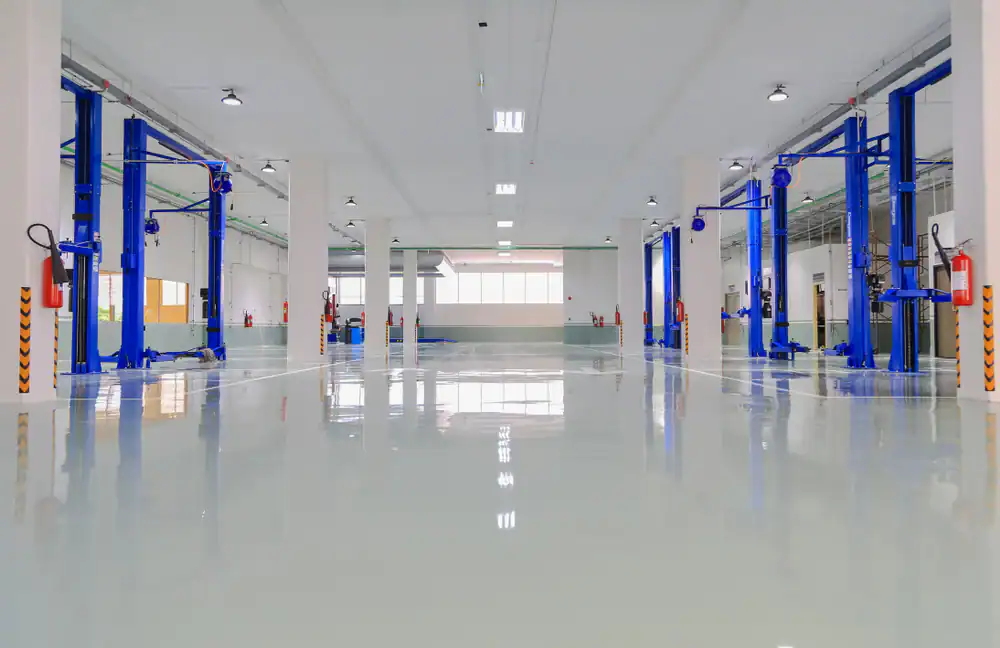
Road salt plays a bigger role in this than most people realize. Hartford County roads get treated aggressively every winter — sodium chloride, calcium chloride, the works. That salt gets tracked into garages on tires and boots, and over time it works its way into the concrete. Salt is hygroscopic, meaning it actively attracts and holds moisture. A slab that’s absorbed years of road salt is going to have higher moisture vapor emission rates than a comparable slab in a region with milder winters, even if both slabs are the same age and built the same way.
Add to that the clay soils throughout central Connecticut towns, which hold water close to the surface and create consistent hydrostatic pressure beneath the slab, and you have a situation where moisture management isn’t a nice-to-have — it’s the whole ballgame. Skipping the vapor barrier on a slab like that is essentially guaranteeing a future failure. The moisture will find its way up, it will get trapped under the coating, and eventually the coating will lift.
We’ve seen this play out in garages across Hartford County — in Simsbury, in Glastonbury, in Enfield — where a previous installer skipped the vapor barrier to save time or money, and the homeowner ended up with a floor that lasted one winter before it started bubbling. The coating itself was fine. The prep wasn’t. That’s the distinction that matters, and it’s the one that most people don’t fully understand until after something goes wrong.
Our vapor barrier systems are applied as part of the standard process on any slab where moisture testing shows elevated readings. It’s not an upsell. It’s what makes the 15-year warranty possible — a warranty that specifically covers delamination and moisture failure, not just surface cosmetics.
Surface preparation doesn’t end with moisture testing. Before any coating goes down, the concrete itself has to be mechanically opened up so the epoxy has something real to bond to. This is where the difference between professional installation and a DIY kit becomes most visible — literally.
Most box-store epoxy kits include an acid etching solution. You pour it on the floor, let it fizz, rinse it off, and the instructions tell you the surface is ready. What acid etching actually does is create a mild surface profile — shallow enough that on older concrete, contaminated concrete, or concrete that’s been previously coated, it barely scratches the surface. The epoxy sits on top rather than bonding into the pores, and the result is a coating that looks fine for a season before it starts peeling at the edges.
Diamond grinding is a different process entirely. We use industrial grinding equipment connected to dust collection systems to mechanically profile the concrete — opening the pores, removing contamination, stripping any previous coatings, and creating a surface rough enough that the epoxy can actually penetrate and form a bond. The technical term is a concrete surface profile, or CSP. The difference in bond strength between a properly ground surface and an acid-etched one is significant enough that most professional installers won’t use acid etching as a standalone prep method at all.
For Hartford County slabs specifically, grinding is especially important. Older concrete that’s been exposed to decades of road salt, freeze-thaw cycling, and moisture infiltration tends to have surface contamination that acid etching can’t fully address. The grinding process removes that compromised layer and gives the coating a clean, open substrate to work with. It’s also the step that takes the most time and the most equipment — which is exactly why it gets skipped when someone is trying to cut corners. We don’t skip it. Every floor gets ground, every time, regardless of how it looks going in.
The short version of everything above: summer in Hartford County is genuinely hard on garage floor installations, and the prep process is where most of that difficulty has to be managed. Moisture testing, surface grinding, vapor barrier application, and careful attention to temperature and timing aren’t extra steps — they’re the steps. Everything else is just coating.
If your floor has failed before, or if you’re planning a new installation and want to make sure it holds up through Connecticut winters and summers for years to come, the conversation starts with understanding what your slab actually needs — not what’s fastest or cheapest to apply.
We’ve been doing this work in Hartford County and across Connecticut for over 30 years. If you’re ready to talk through what proper preparation looks like for your specific floor, reach out and we’ll take it from there.
Summary:
Article details:
Share: