Thinking about coating your garage floor? Here's what separates a surface that lasts from one that peels after the first Connecticut winter.
You’ve probably noticed the cracks spreading a little further each spring. The salt stains that won’t scrub out. The concrete dust that somehow ends up on your car, your shoes, and eventually your kitchen floor. If you’ve been thinking about doing something about your garage floor, you’re not alone — and you’re probably wondering whether garage floor paint epoxy is actually worth it or just another home improvement expense that overpromises and underdelivers. That’s a fair question. The honest answer depends a lot on what you’re actually getting — and in the climate across Hartford County, New Haven County, Middlesex County, and New London County, the gap between the right solution and the wrong one is wider than most people realize.
The term “garage floor paint epoxy” gets used loosely, and that’s part of the problem. Walk into any hardware store in Glastonbury, Cheshire, Wallingford, or Groton and you’ll find shelves of products with “epoxy” on the label. What’s inside those cans is usually a water-based paint with a small percentage of epoxy mixed in — not a true two-component epoxy system. It looks similar, costs a fraction of the price, and fails in a fraction of the time.
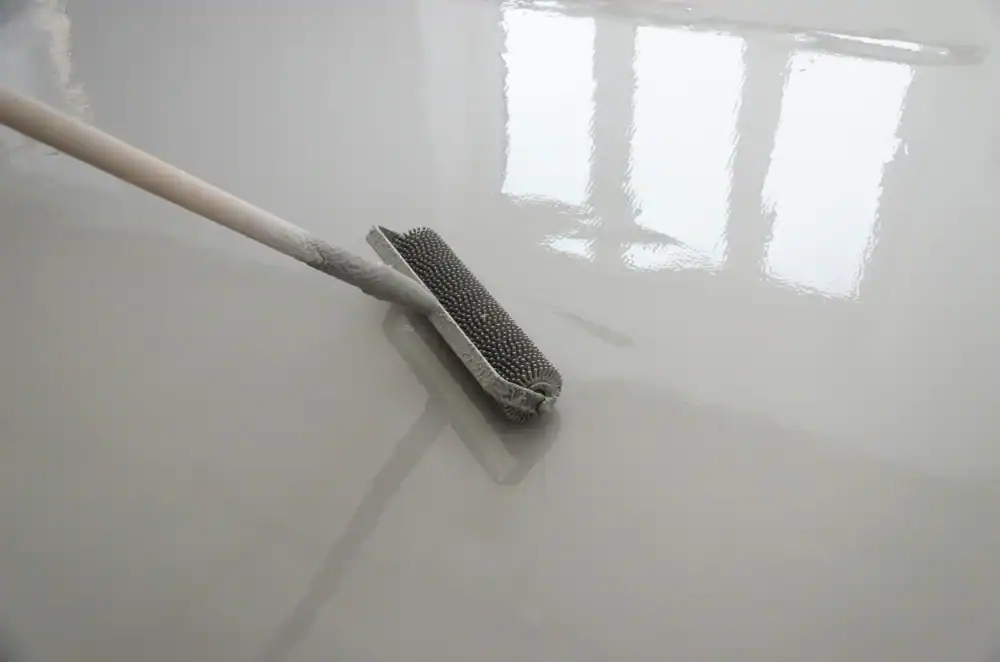
A real epoxy coating is a chemical reaction between two components — a resin and a hardener — that bonds to the concrete at a molecular level. When it cures, it creates a surface that’s dramatically harder, denser, and more resistant to the things that destroy standard paint: hot tires, road salt, oil spills, and the constant freeze-thaw stress that Connecticut winters deliver reliably every year.
The confusion between the two is understandable. But the performance difference isn’t subtle. Standard garage floor paint in Hartford County, New Haven County, Middlesex County, and New London County typically starts peeling or chalking within 18 to 24 months. A properly installed professional epoxy system, with a polyaspartic topcoat, can last 15 to 20 years.
If you’ve already tried a kit from a home improvement store, you probably already know this story. You prepped the floor, followed the instructions, applied the coating on a dry weekend in late spring — and by the following March, it was peeling up in sheets. You’re not the only one. It happens constantly across our service area, and the reason almost always comes down to two things: surface preparation and material quality.
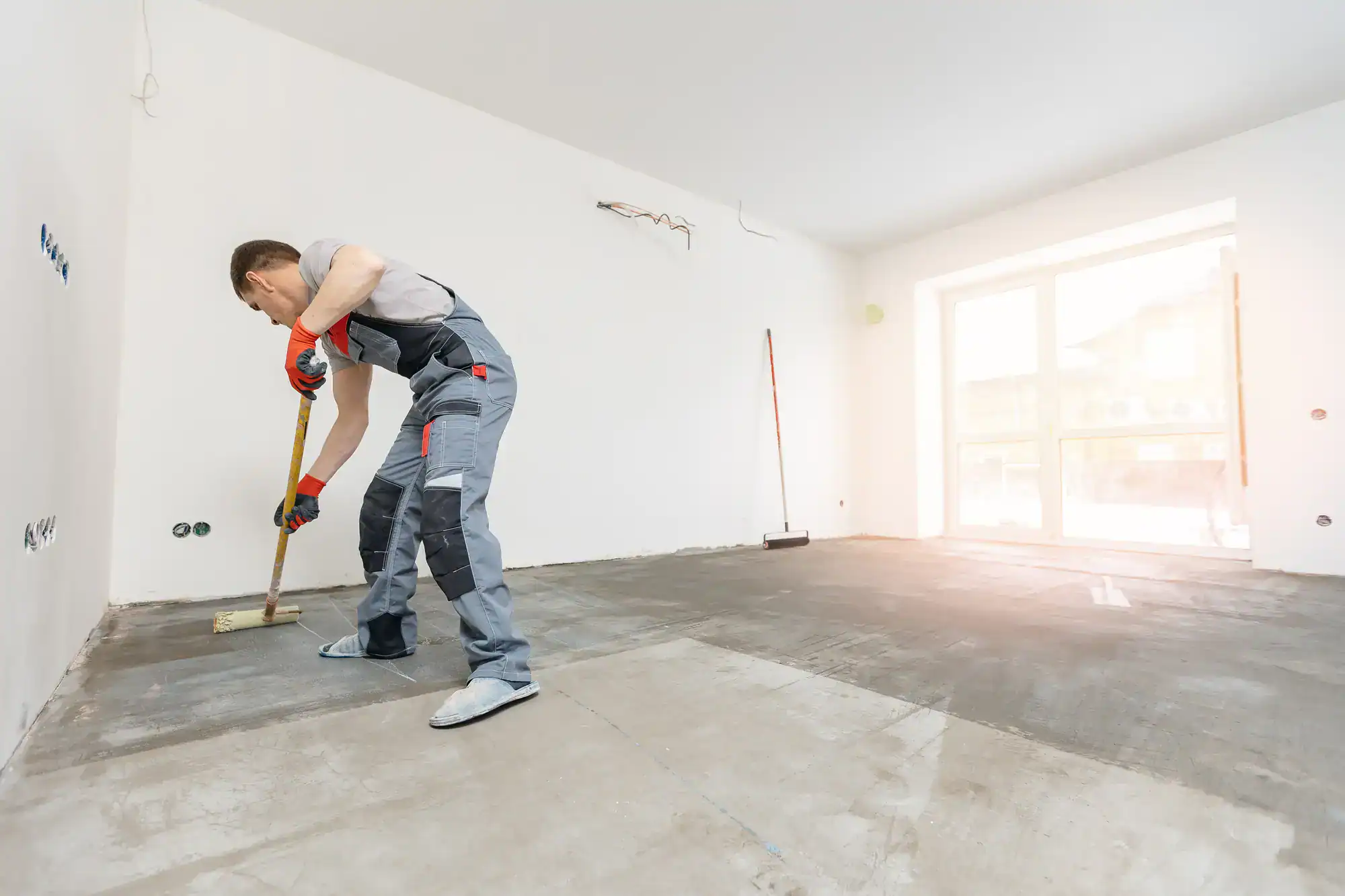
DIY kits instruct you to clean the floor and apply an acid wash before coating. Acid washing looks like preparation, but it doesn’t create the surface profile that epoxy needs to bond permanently. We use diamond grinding — industrial equipment that removes the weak top layer of concrete and opens the pores to the correct depth for adhesion. That difference alone accounts for the majority of early coating failures. Without it, even a decent product will eventually lift.
The material itself is the other half of the equation. Consumer epoxy kits are low in solids content, which means they cure to a thin film — roughly one-third the thickness of a commercial-grade coating. In Connecticut, where a floor might see 50 freeze-thaw cycles in a single winter, that thinness matters. The coating flexes, fatigues, and eventually gives way.
There’s also the moisture problem, which is especially relevant in towns like Windsor, Wethersfield, and Cromwell — communities that sit near the Connecticut River over clay-rich soils with elevated water tables. Moisture vapor rises through concrete slabs constantly, and if a coating is applied without testing for it and addressing it with a vapor barrier primer, the pressure builds beneath the coating until it bubbles and lifts. No DIY kit includes that step, and most homeowners have no way to test for it on their own.
The short version: the kit didn’t fail because you did something wrong. It failed because it wasn’t designed for what Connecticut puts a garage floor through.
Most people researching garage floor epoxy coating eventually come across the word “polyaspartic” and aren’t sure what to make of it. It’s worth understanding, because the distinction matters — particularly in this part of Connecticut.
Traditional epoxy is a durable, proven coating. But it has real limitations. It’s sensitive to UV light, which means it yellows over time in any garage with windows or sunlight exposure. It becomes brittle as it ages, which is a problem when the concrete beneath it is constantly moving — and in the clay soils common throughout Hartford County, New Haven County, Middlesex County, and New London County, the slab is always moving slightly. When the coating can’t flex with it, it cracks.
Polyaspartic coatings were developed to solve exactly those problems. They cure faster — most residential garages are walkable within 24 hours and ready for vehicles within 72 hours. They’re UV-stable, so they don’t yellow. And they maintain flexibility over time, which is why they hold up in the freeze-thaw conditions that define Connecticut winters from November through March.
For homeowners in coastal communities like Groton, Waterford, East Lyme, and Stonington in New London County, the environment adds another layer of demand. Salt air from Long Island Sound is corrosive year-round, not just during winter road treatment. Polyaspartic and polyurea systems create a denser, less porous surface than standard epoxy, which is why we choose them as the preferred system for any floor that’s going to face that kind of ongoing chemical exposure.
We use polyaspartic topcoats as the finishing layer on every residential garage installation. It’s not an upgrade — it’s just the right material for what homeowners across our service area are actually dealing with.
Want live answers?
Connect with a American Poly Floor expert for fast, friendly support.
The process matters as much as the product. A lot of contractors — and every DIY kit — skip or shortcut the steps that determine whether a coating lasts two years or twenty. Here’s what our professional installation actually involves, and why each step exists.
It starts with diamond grinding. We use industrial grinders connected to dust collection systems, which keeps the job site clean and ensures the concrete surface is properly profiled before anything goes down. From there, we test the slab for moisture vapor emissions. If readings are elevated — which they frequently are in homes near the Connecticut River or in coastal areas — we apply a moisture vapor barrier primer before the epoxy base coat. That single step prevents the bubbling and delamination that ruins so many installations.
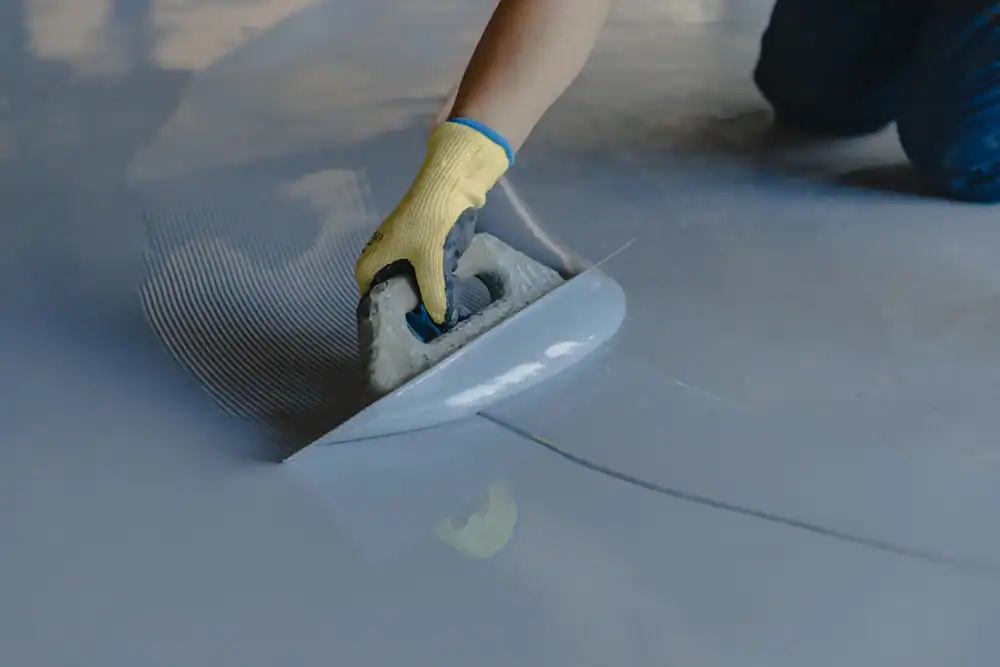
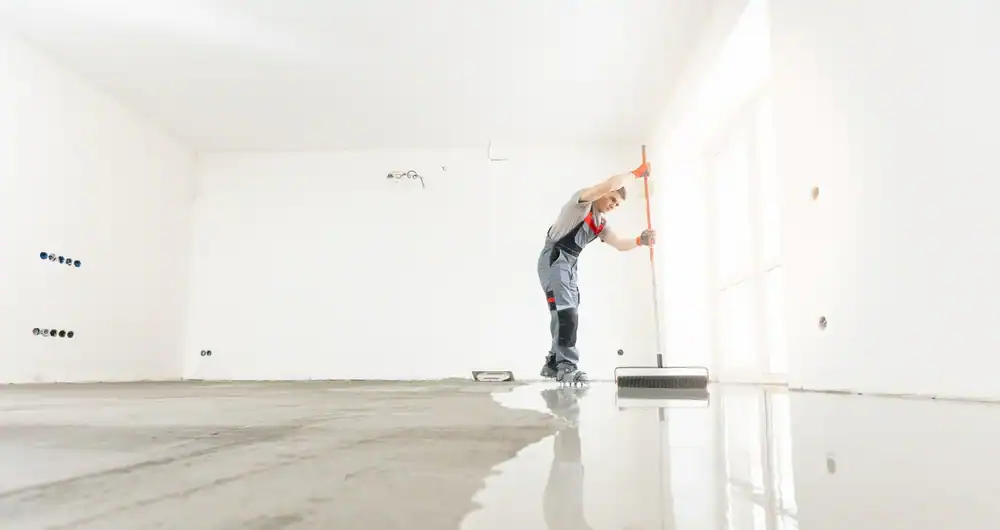
After prep, we apply the base coat, color coat, and polyaspartic topcoat in sequence. Each layer is engineered to work with the next. The result is a coating system that’s roughly three times thicker than anything sold in a hardware store and backed by a 10-year insurance-backed warranty on our premium system.
This is one of the most common questions we hear, and it’s a reasonable one. Your garage isn’t just a place to park — it’s a daily-use space, and the idea of losing access to it for a week gives a lot of homeowners pause.
The reality is more manageable than most people expect. Most residential garage projects are complete in two to three days. Because we use polyaspartic topcoats rather than traditional epoxy, the cure timeline is significantly faster. You can walk on the floor within 24 hours of the final coat. You can park your car on it within 72 hours. Full cure — the point at which the coating has reached its maximum hardness and chemical resistance — takes approximately one week.
Compare that to a DIY application, which often requires waiting several days between coats, needs warm and dry conditions to cure properly, and still frequently fails within the first year. Our professional process is faster, more predictable, and doesn’t leave you hoping the weather cooperates.
For homeowners in Old Saybrook, Clinton, and Westbrook — where humidity levels near the shoreline can complicate DIY curing conditions — working with us means understanding how to manage those variables in ways that ensure proper installation even when conditions aren’t ideal. The same applies to unheated garages in inland Hartford County and New Haven County communities during shoulder seasons, where we use winter-rated resins and supplemental heat to ensure proper installation even when temperatures drop.
Most residential floor coating work in Connecticut does not require a permit. The project is contained, non-structural, and typically classified as a surface treatment. If you’re ever unsure, your local building department can confirm — but in the vast majority of cases, you’re ready to schedule without any additional steps.
A professional garage floor epoxy installation in our service area typically runs between $2,000 and $4,500 for a standard two-car garage, or roughly $5 to $12 per square foot depending on the system, the condition of the concrete, and any repair work required. That’s a real investment, and it’s fair to ask whether it’s justified.
Here’s one way to think about it. A DIY kit costs $100 to $300. In Connecticut’s climate, it lasts 18 months to two years before it needs to be stripped and reapplied — if it doesn’t peel on its own first. Over 15 years, you’re looking at multiple reapplications, multiple weekends of labor, and a floor that never quite looks right. The math on that adds up faster than most people realize, and it doesn’t account for the concrete damage that accumulates on an unprotected or poorly coated surface over time. Spalling, widening cracks, and surface erosion are all more expensive to address the longer they’re left unprotected.
A professionally installed system, backed by a 10-year insurance-backed warranty on our premium system, removes that cycle entirely. You do it once. It holds. The floor stays clean with a mop and water — no scrubbing, no resealing, no repainting.
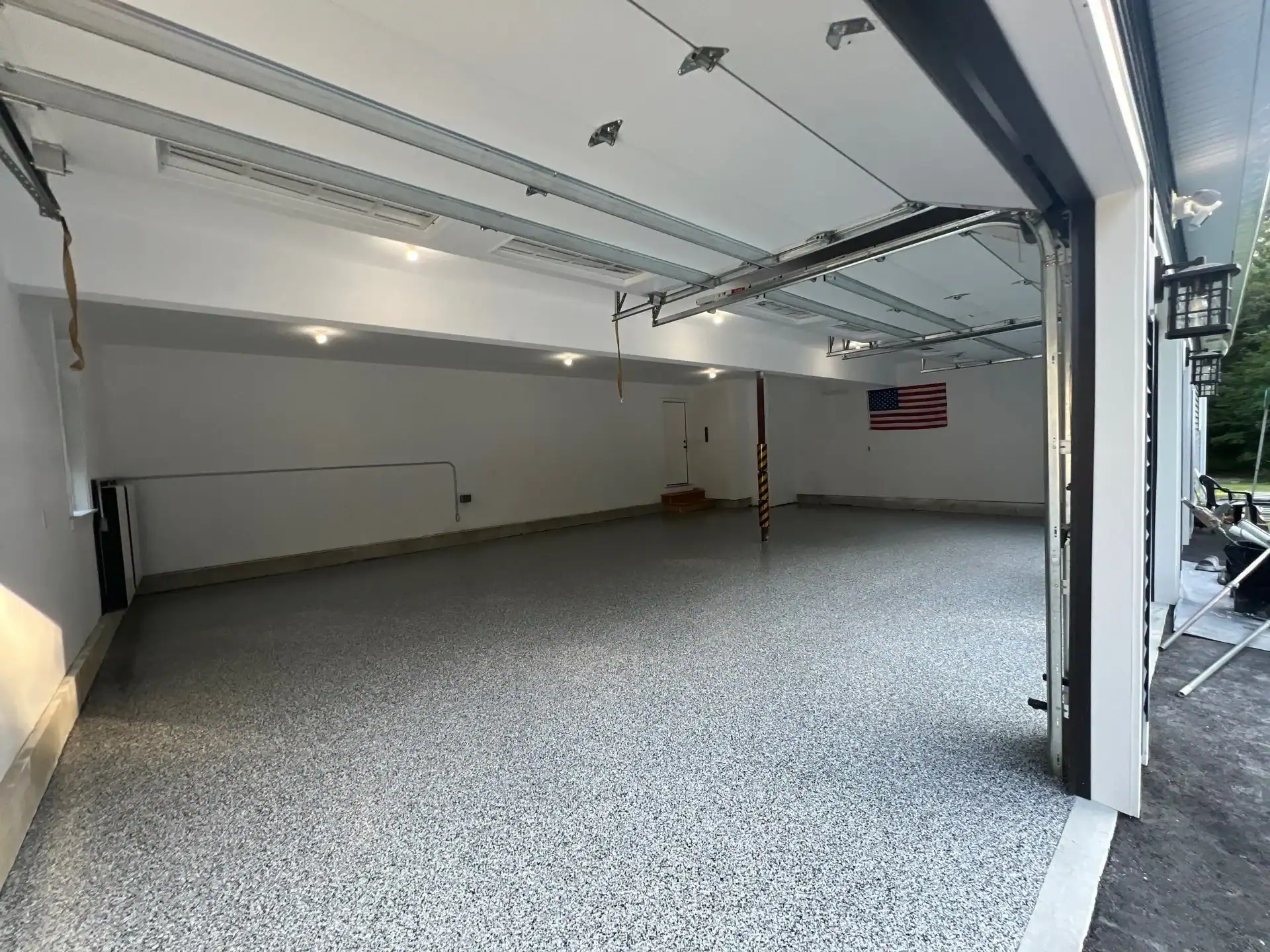
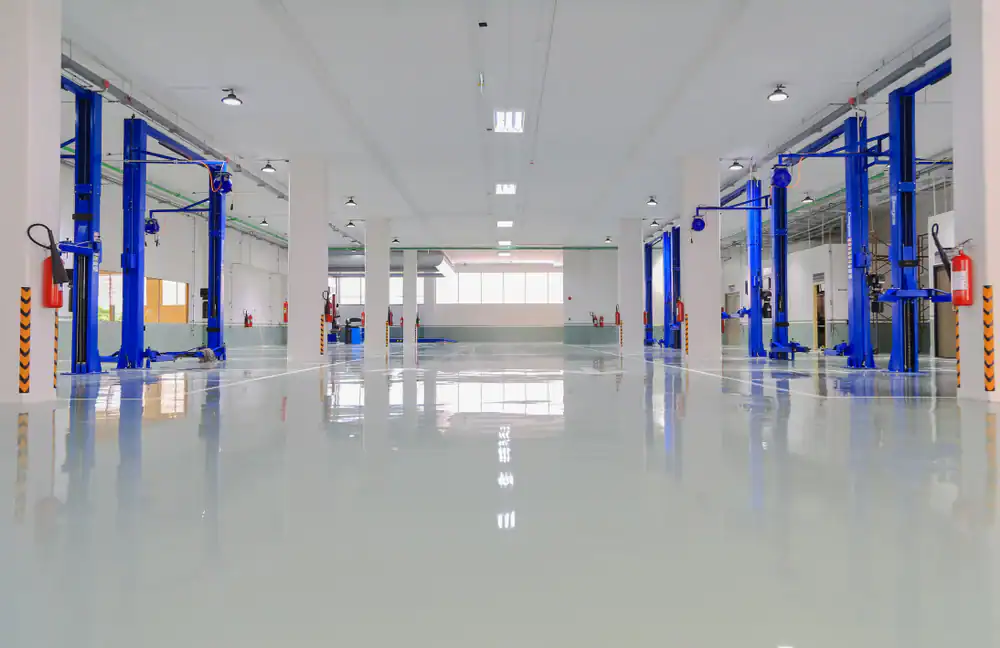
For homeowners in Guilford, Madison, and Milford who’ve invested in their homes and want the garage to reflect that, the transformation is also just genuinely satisfying. A showroom-quality floor changes how you use the space. People describe finally wanting to spend time in their garage, being comfortable showing it to guests, and not tracking concrete dust into the house. Those aren’t small things.
We’re a veteran-owned business based in East Hartford. We’ve installed thousands of floors across Hartford County, New Haven County, Middlesex County, and New London County, and we’ve watched enough Connecticut winters come and go to know exactly what holds and what doesn’t. Our 4.8-star rating from more than 148 customers reflects that — not because we’re the cheapest option, but because we do the work correctly and stand behind it.
The core question — paint or epoxy, DIY or professional — comes down to what you actually want from your floor. If you want something that holds up through Connecticut winters, resists road salt, doesn’t yellow, and doesn’t need to be redone every couple of years, a professional polyaspartic epoxy system is the answer. Standard paint and hardware store kits aren’t built for what this climate demands.
The preparation method, the material quality, and the coating thickness are what separate a floor that lasts 15 years from one that peels by spring. Those aren’t things you can replicate with a weekend and a kit from a hardware store.
If you’re in Hartford County, New Haven County, Middlesex County, or New London County and you want a straight answer about what your floor needs, we’re worth a conversation. No pressure, no overselling — just an honest assessment of what you’re working with and what it would take to fix it properly.
Summary:
Article details:
Share: