Your garage floor says more about your home than you think. Here's how Connecticut homeowners are turning bare concrete into something worth showing off.
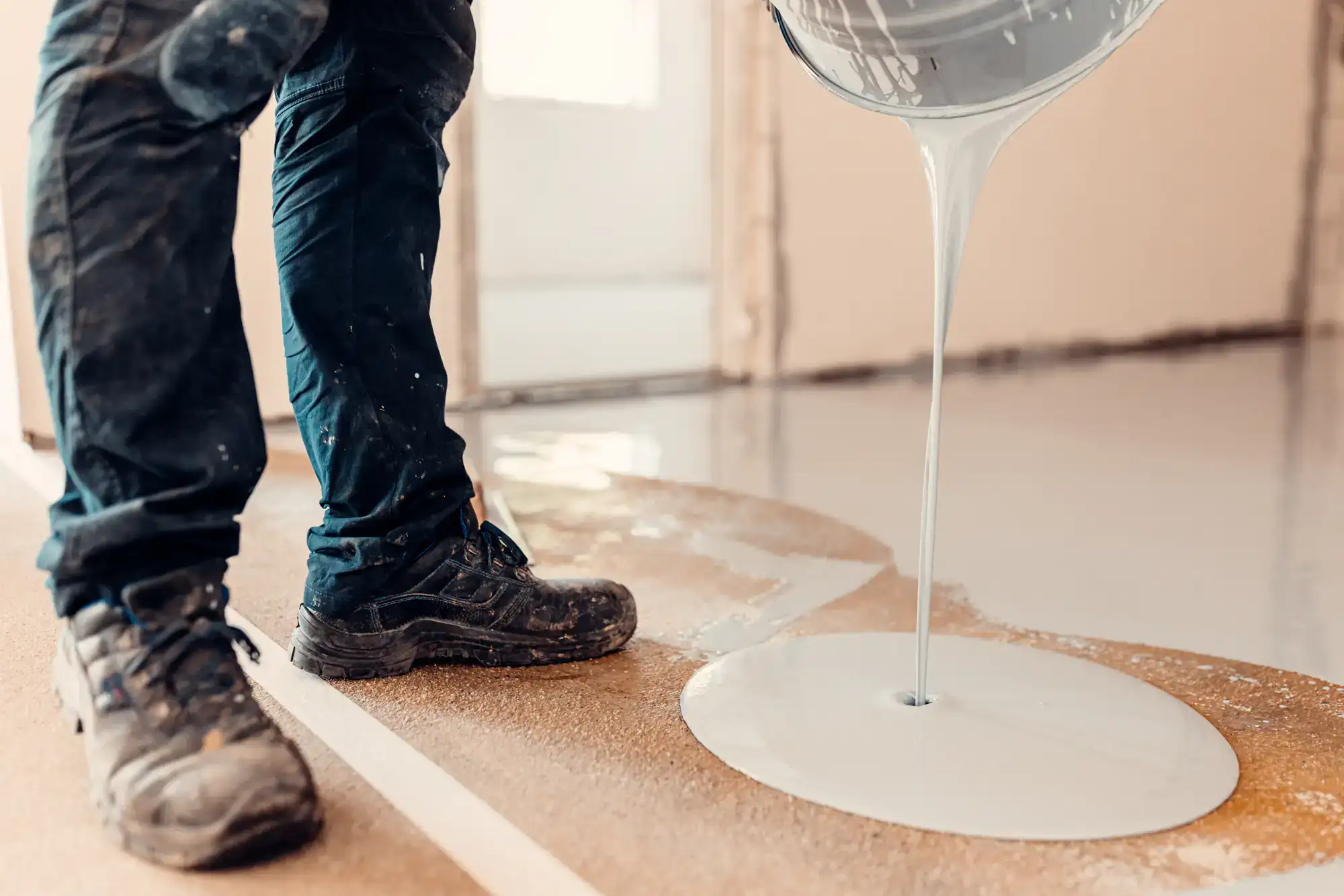
There’s a version of your garage that doesn’t embarrass you. One where the floor is clean, the surface is bright, and the whole space actually reflects the effort you’ve put into everything else. That version isn’t far off — and it starts with the floor.
Epoxy garage floors have come a long way from the gray speckled look you might picture. Today’s finishes range from metallic swirls that look like liquid metal to custom flake systems in any color combination you want. If you care about your car, your home, or both, this is worth understanding before you make any decisions.
Most people think of epoxy as a protective coating — something practical you put down so the floor doesn’t crack and stain. That’s accurate, but it’s only half the picture. The other half is design, and it’s where things get genuinely interesting.
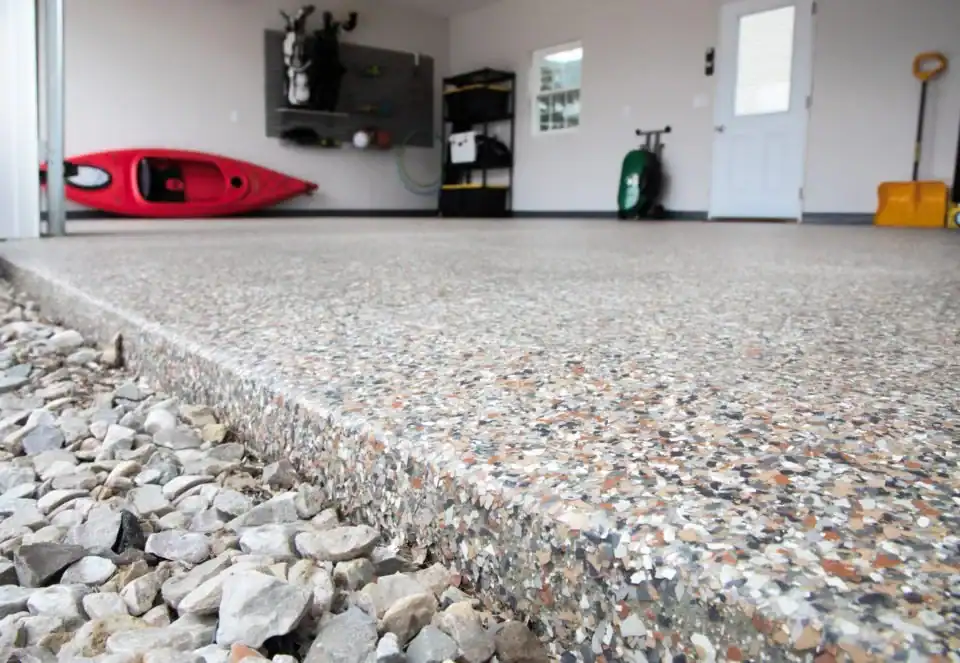
A luxury epoxy garage floor isn’t just durable. It’s finished. It has depth, visual texture, and a look that holds up under the kind of scrutiny you’d give a showroom. Metallic finishes create a three-dimensional effect that shifts with the light. Decorative flake systems add color and grip without looking industrial. Solid-color high-gloss coatings make a garage feel like an extension of the house rather than a place to store things you don’t know what to do with.
The floor you choose sets the tone for everything else in the space.
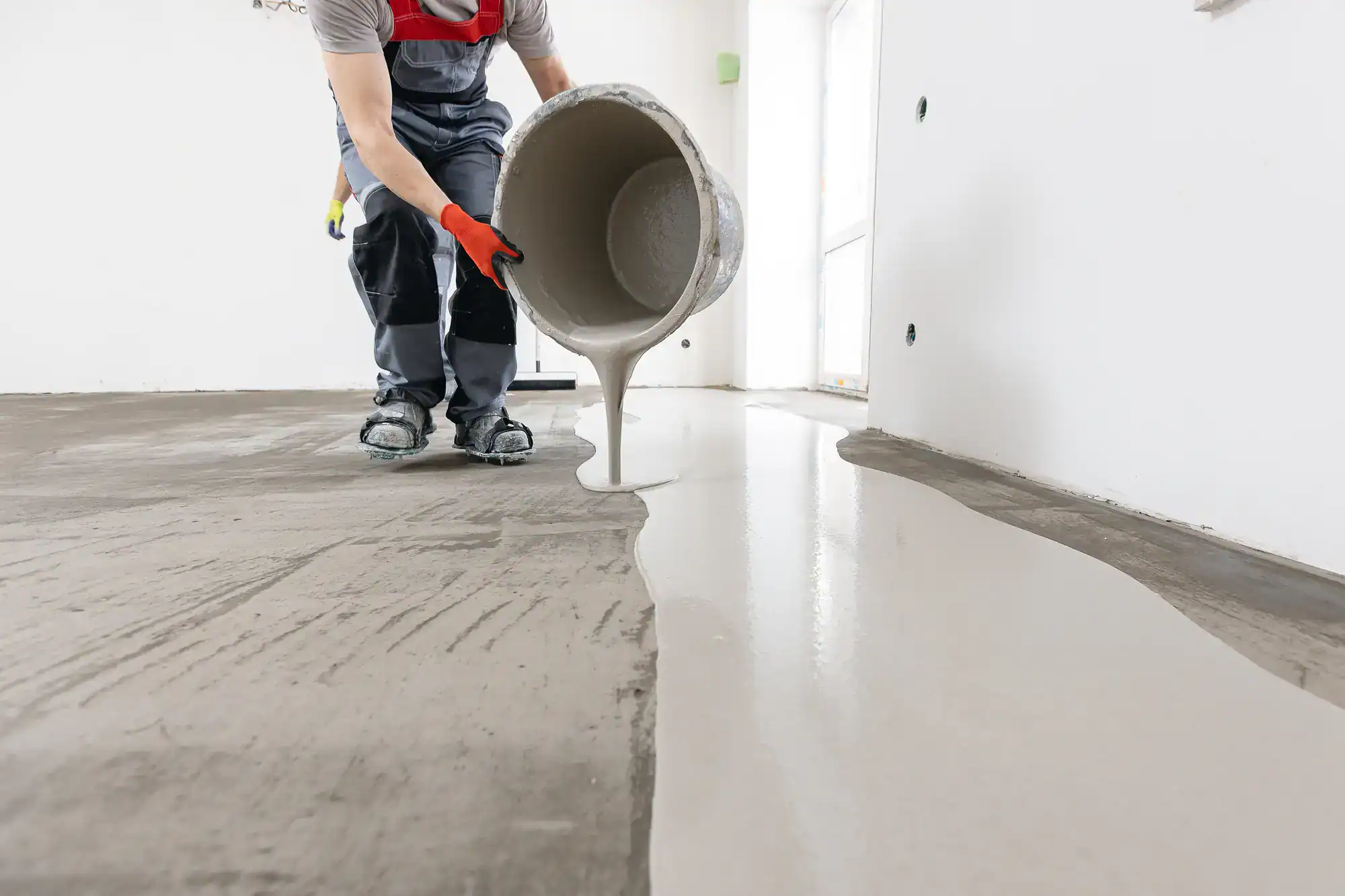
The finish is the part you see. The prep is the part that determines whether it lasts. This is where most installations — especially DIY attempts — fall apart, and it’s worth understanding why.
Professional epoxy garage floor installation starts with diamond grinding. That’s a mechanical process that opens the concrete’s surface at the right depth, removes contaminants, and creates what’s called a CSP-3 surface profile — the minimum standard for a coating system to bond properly. The big-box kits skip this step entirely. They rely on acid etching, which only reaches CSP-1 or CSP-2 and leaves the surface too smooth for a real bond. That’s why over 60% of DIY epoxy floors fail within the first two years. It’s not bad luck — it’s physics.
After grinding, moisture testing comes next. Connecticut’s soil holds a lot of water, and that moisture moves upward through concrete slabs — especially in the Connecticut River Valley communities of Middlesex County, where ground moisture is a year-round reality. If that vapor isn’t addressed before the coating goes down, it will eventually push the epoxy off the slab from underneath. A moisture-blocking primer applied at this stage is what separates a 15-year floor from one that starts bubbling by spring.
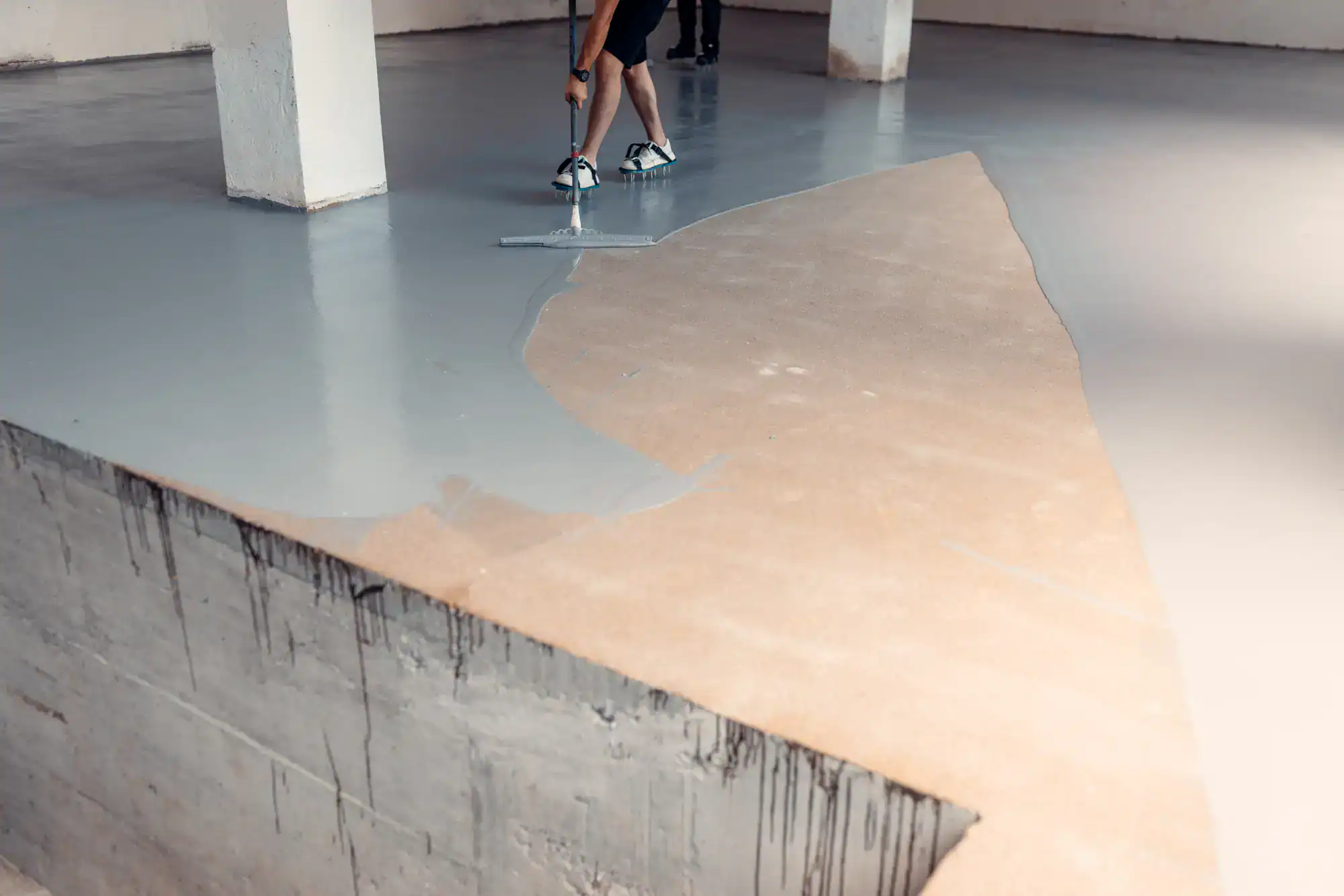
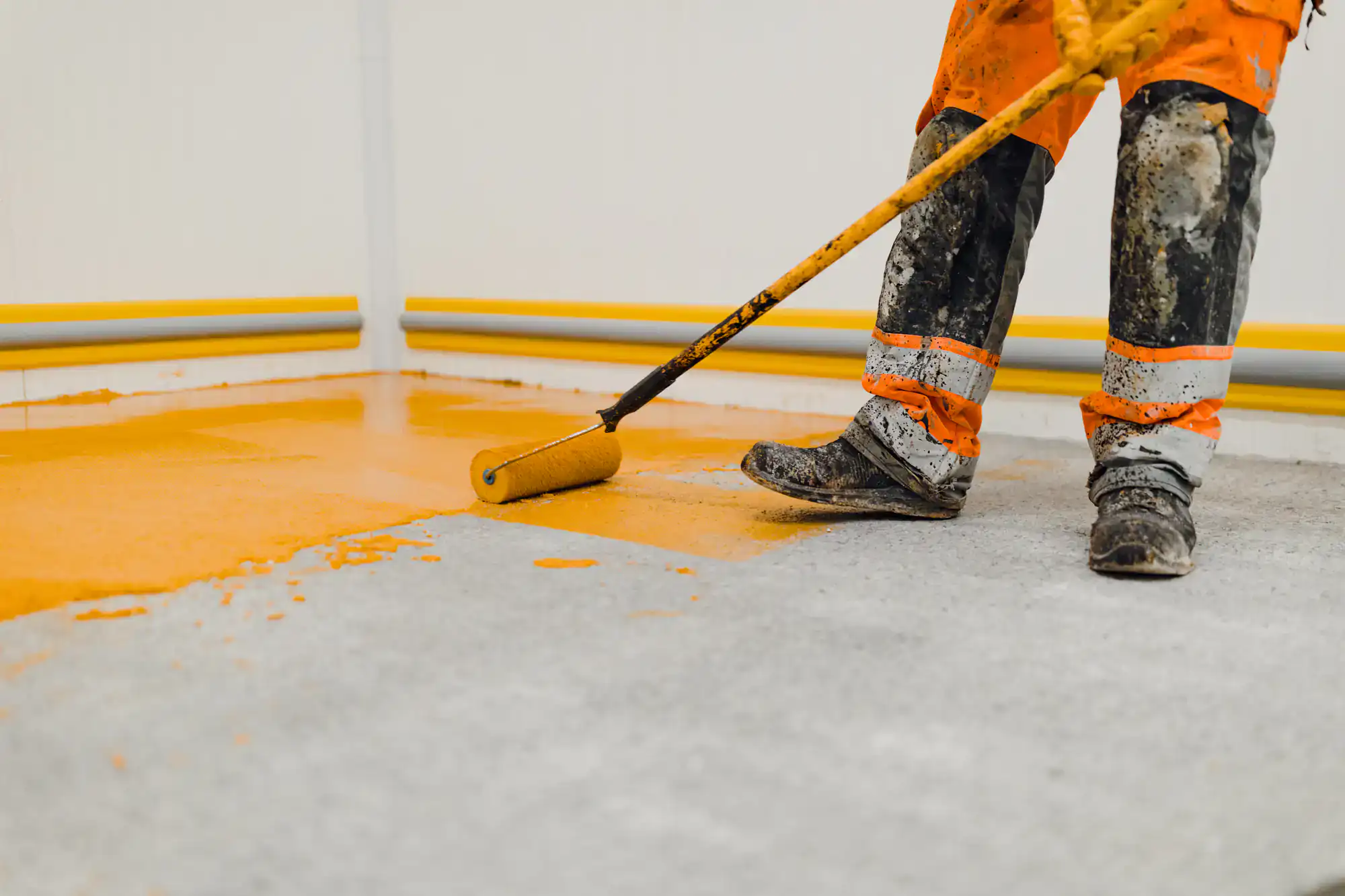
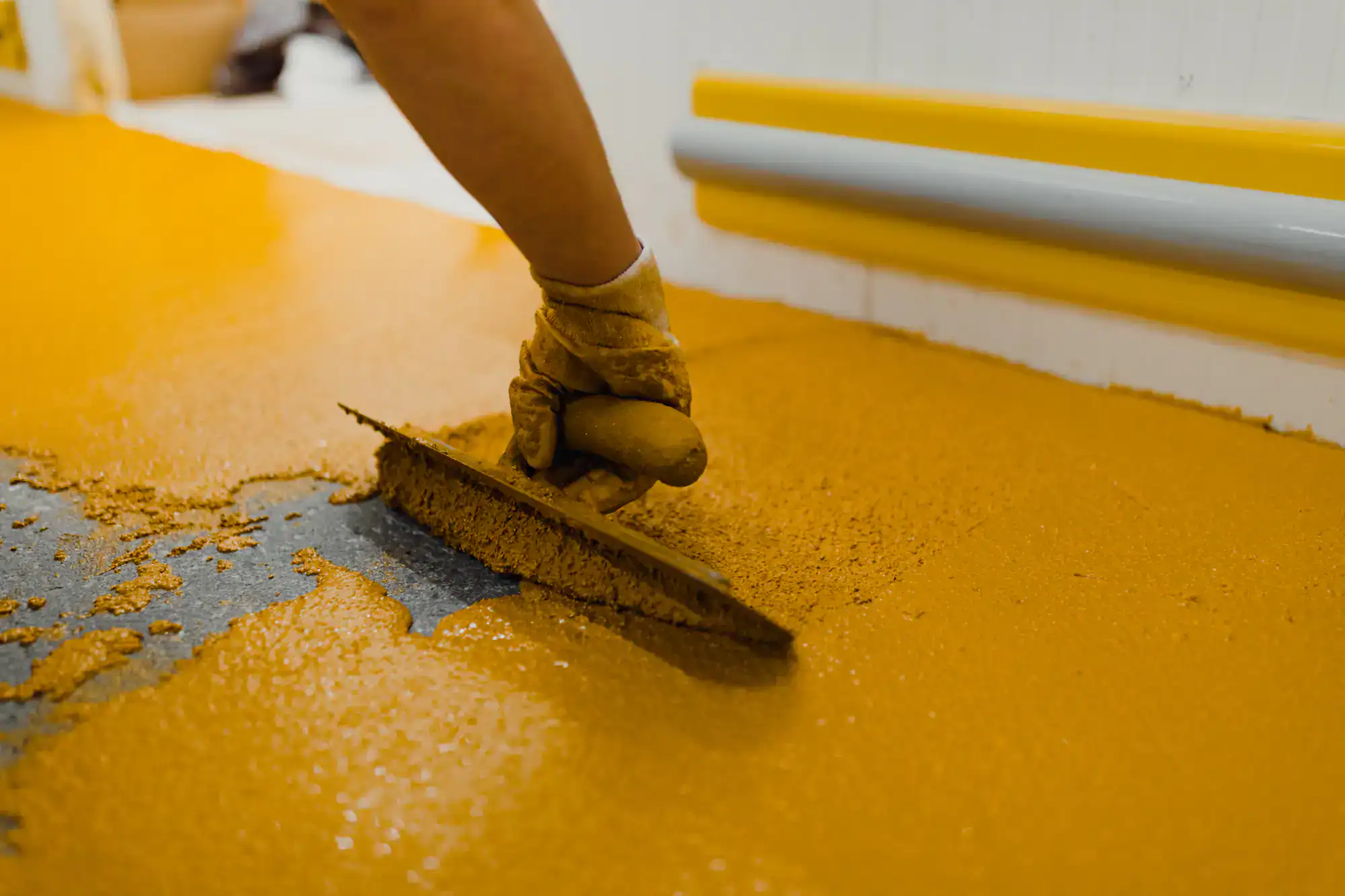
Then comes the actual coating system: a high-solids epoxy base coat, a decorative layer — whether that’s metallic pigment, broadcast color chips, or a solid shade — and a polyaspartic topcoat to seal and protect everything. That topcoat is UV-stable, which matters because standard epoxy yellows in sunlight. It also handles temperature extremes better than epoxy alone, which is critical in a Connecticut garage that sees below-zero January nights and ninety-degree August afternoons.
The whole process typically takes one to two days. With a polyaspartic system, you can drive on the floor within 24 hours.
If you live in West Hartford, Glastonbury, Simsbury, or Farmington in Hartford County, you already know what winter does to concrete. The road salt that keeps your commute safe gets tracked into your garage on your tires every single day from November through March. It soaks into bare concrete, crystallizes beneath the surface, and pushes outward — a process called subfluorescence — that causes the spalling and flaking you see on older slabs. The freeze-thaw cycles do the rest, widening cracks with each expansion and contraction.
In New London County, the problem compounds. Coastal communities like Mystic, Stonington, and Waterford don’t just deal with road salt — they deal with salt air off Long Island Sound year-round. That airborne salt accelerates corrosion in ways that inland homeowners don’t experience, and it means unprotected concrete deteriorates faster and more aggressively than the same slab would in Farmington or Middletown.
The shoreline communities of New Haven County — Madison, Branford, Guilford — face the same compound exposure. And in Middlesex County, the Connecticut River creates a moisture-rich microclimate that makes vapor mitigation less of an optional step and more of a baseline requirement.
A coating system that works in a mild climate isn’t automatically the right choice here. The moisture barriers, the high-solids epoxy base, the polyaspartic topcoat — these aren’t upsells. They’re the components that make the system perform in the specific conditions you actually live with across Hartford, New Haven, Middlesex, and New London counties. We’ve installed thousands of floors across these four counties, and the ones that hold up for 15 to 20 years are the ones where every step was done right, for this climate, from the start.
Want live answers?
Connect with a American Poly Floor expert for fast, friendly support.
A finished garage floor isn’t just an upgrade for your own enjoyment — though it genuinely is that. It’s also one of the more efficient ways to add perceived value to your home in a competitive Connecticut real estate market.
Real estate professionals across Hartford, New Haven, Middlesex, and New London counties consistently identify the garage as a high-visibility space at resale. A stained, cracked floor signals deferred maintenance. It gives buyers a reason to negotiate down and wonder what else hasn’t been addressed. A clean, finished epoxy floor signals the opposite — that the homeowner takes care of things. That distinction can translate to $5,000 to $10,000 in perceived value, which is a meaningful return on an installation that typically runs $1,400 to $2,300 for a standard one-car garage.
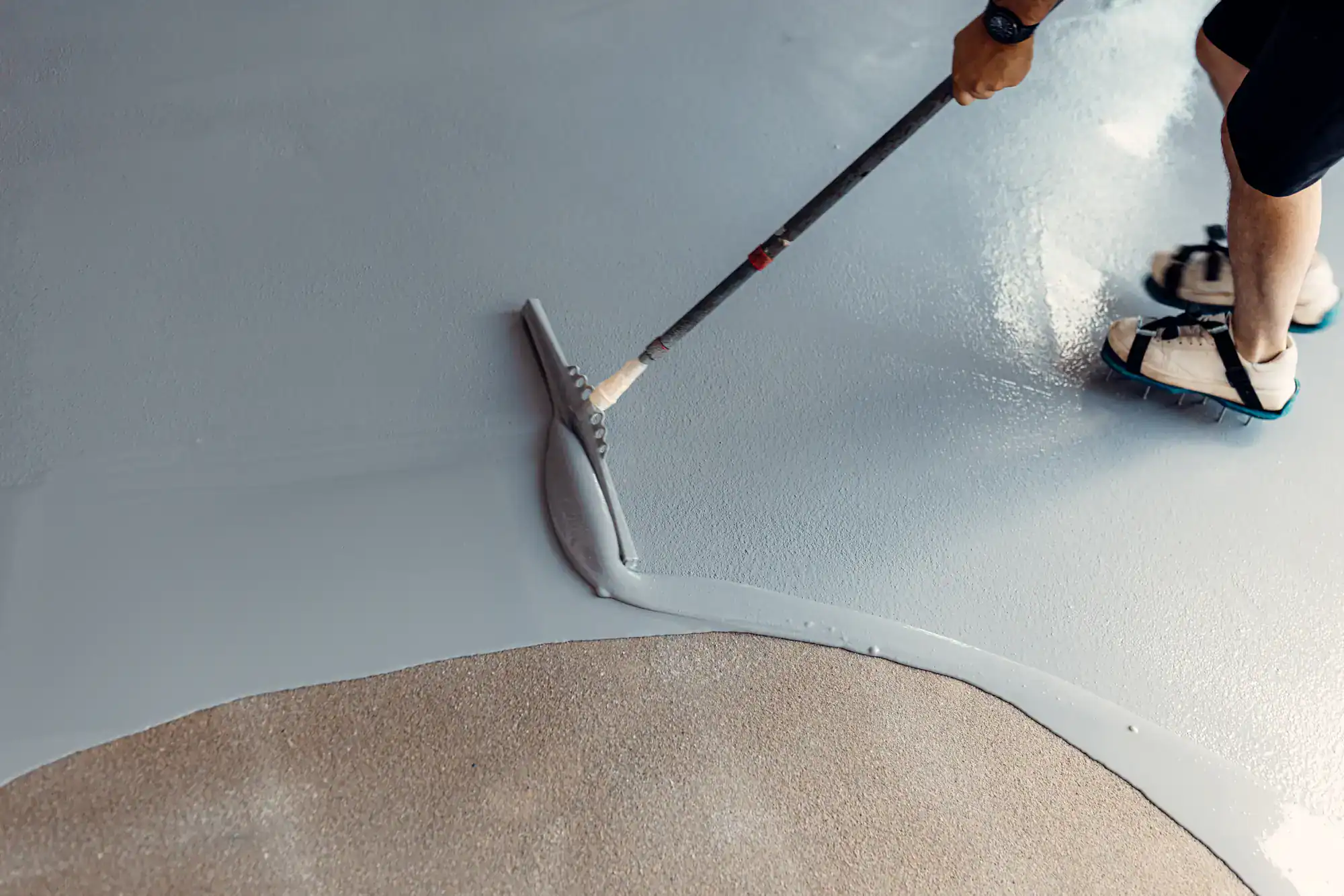
This is the question most homeowners sit with for a while before they call us. The DIY kits are right there at the hardware store, they’re $100 to $500, and the instructions make it look manageable. We understand the appeal.
Here’s what the kits don’t tell you: they use water-based formulas with around 50% solids content, applied at roughly 3 mils of thickness. Our professional systems use 90 to 100% solids epoxy, applied at 9 mils or more. That’s three times the coating depth, with nearly double the material density. And because the DIY process relies on acid etching rather than diamond grinding, the surface profile never reaches the level the coating needs to bond properly. The result is a floor that looks fine for a few months and then starts peeling under hot tires or lifting at the edges by the following spring.
The failure rate for DIY epoxy floors within two years is above 30%. When that happens, you’re not starting from scratch with a clean slab — you’re starting with a slab that now has failed coating on top of it, which has to be removed before anything new can go down. The cost of fixing a failed DIY job is often higher than professional installation would have been in the first place.
For homeowners in places like Madison or Essex, where property values are high and the homes are well-maintained, a failed garage floor coating is a visible problem. It’s the kind of thing that shows up in listing photos and sticks in a buyer’s memory. Our professional installation with a 15-year warranty — covering delamination, moisture failure, and coating breakdown — removes that risk entirely.
**How long does installation take, and how soon can I use my garage?** Most residential garage floor installations take one to two days. With a polyaspartic system, you can walk on the floor the same day and drive on it within 24 hours. Traditional epoxy systems are walk-on ready at 24 hours and drive-on ready at 72 hours. Either way, you’re not losing a week of garage access.
**Can epoxy be installed on a cracked or badly stained floor?** Almost always, yes. Crack repair and concrete restoration are part of the prep process, not add-ons you have to negotiate separately. The floors that look the most beyond repair are often the ones that respond best to professional installation — because the prep work addresses the underlying damage before the coating ever goes down. If you’ve been putting off calling because you think your floor is too far gone, it probably isn’t.
**Does the floor get slippery when it’s wet?** Decorative flake systems — which are the most popular residential option — add natural texture and meaningful slip resistance. Anti-slip additives are also available if you want additional traction. A properly finished epoxy garage floor is not a slip hazard.
**How does Connecticut’s climate affect how long the floor lasts?** It depends on the system. A thin, improperly prepped coating will struggle with Connecticut’s freeze-thaw cycles and road salt exposure — that’s well-documented. Our professional system with a moisture-blocking primer, high-solids epoxy base, and UV-stable polyaspartic topcoat is specifically built for the conditions you face in Hartford, New Haven, Middlesex, and New London counties. We’ve installed floors in Groton, Glastonbury, Old Saybrook, and Branford that have held up through years of coastal humidity, salt exposure, and New England winters without peeling, cracking, or yellowing. The system works when it’s installed correctly.
**What’s the warranty?** We back our residential installations with a 15-year warranty covering delamination, moisture failure, and coating breakdown. That’s not a manufacturer’s limited warranty with fine print — it’s our warranty, on our work, for 15 years. We’re confident in it because the prep work makes failure unlikely.
Your garage floor has probably been on your to-do list for a while. Maybe you’ve pressure-washed it and watched the stains come right back. Maybe you tried a kit and watched it peel. Maybe you’ve just been parking on cracked, dusty concrete and telling yourself you’ll deal with it eventually.
Eventually is a good time to start. A professionally installed epoxy garage floor changes how you feel about the space — and how you use it. It’s easier to clean, better looking, and built to handle everything Connecticut winters throw at it for the next 15 to 20 years.
If you’re in Hartford County, New Haven County, Middlesex County, or New London County and you’re ready to have an honest conversation about what your floor actually needs, reach out to us. We’ll come look at it, tell you what we see, and give you a straight answer.
Summary:
Share: