Most epoxy floors don't fail because of the coating. They fail because of what happened — or didn't happen — before the coating went down.
Most people who call us have already had a floor fail. Maybe it was a DIY kit from the home improvement store. Maybe it was a contractor who gave a good price and a vague promise. Either way, the floor bubbled, peeled, or started lifting within a season or two — and now they want to know why.
The answer is almost always the same: moisture. Not visible water. Not a flood. Just vapor, moving silently upward through the concrete slab, building pressure beneath an impermeable coating until something gives. In Hartford County, where annual rainfall runs 34% above the national average and basement humidity stays between 70% and 79% year-round, this isn’t a rare edge case. It’s the rule.
Here’s what’s actually going on — and what it takes to get a floor that lasts.
Waterproofing, in the context of epoxy floors, doesn’t mean stopping a flood. It means blocking the constant upward movement of moisture vapor through your concrete slab — a process called moisture vapor transmission. Concrete is porous. It breathes. And in Hartford County, where the ground stays wet much of the year, that breathing brings moisture up through the slab continuously, whether you can see it or not.
When an epoxy coating goes over concrete that hasn’t been sealed against vapor, that moisture has nowhere to go. Pressure builds. The coating blisters, then bubbles, then peels. It can happen in weeks. It can take a year. But in Hartford County’s climate, it will happen — unless the slab is properly treated first.
These are two separate problems, and mixing them up leads to real mistakes. Foundation waterproofing addresses water coming in through your walls — cracks in the foundation, seepage after heavy rain, hydrostatic pressure pushing through the block or poured concrete. That’s a structural issue, and it needs to be fixed by someone who specializes in it. Epoxy won’t solve it. Nothing applied to the floor surface will solve it.
What we handle is the other problem: moisture vapor rising through the slab itself. Even a perfectly dry-looking basement floor in Glastonbury or Wethersfield can have internal relative humidity levels above 90% when tested properly. The surface looks fine. The concrete underneath is saturated. That’s why visual inspection alone is completely unreliable — and why any contractor who skips moisture testing before coating is guessing.
Before we apply any coating, we test the slab using ASTM F2170, the industry standard for measuring relative humidity inside concrete. If the reading comes back above 75% — which is common in Hartford County basements — we apply a vapor barrier primer that seals the slab from the inside out. That primer bonds to the concrete and stops moisture vapor from migrating upward. Everything that goes on top of it can then bond properly and stay bonded.
This step adds time and cost. It’s also the reason our floors are still intact after ten or fifteen years when others are being torn up and redone. Most Hartford County basements need it. We don’t skip it.
Active flooding is a different situation entirely. If your basement in Newington or South Windsor takes on water after a heavy rain — actual standing water, not just dampness — that needs to be addressed before any floor coating conversation starts. Epoxy applied over a slab with active water intrusion will fail. Guaranteed. The water will find its way under the coating and push it off the concrete.
We offer emergency response services for flooded basement situations, and we’ll tell you honestly whether the floor is ready to coat or whether you need to deal with the drainage or waterproofing issue first. That’s not us turning away work. That’s us making sure the work we do actually holds.
Once the active intrusion is resolved and the slab has had time to stabilize, we can test and coat it properly. The vapor barrier handles the residual moisture that will always be present in a Hartford County basement — even a dry one. What it can’t handle is a slab that’s still actively taking on water from outside. That distinction matters, and we’ll always be straight with you about which situation you’re in.
For most Hartford County homeowners, the issue isn’t flooding — it’s the slow, invisible vapor that’s been building under their floor since the day it was poured. That’s the problem a proper epoxy installation solves.
Want live answers?
Connect with a American Poly Floor expert for fast, friendly support.
Basement flooring in Hartford County isn’t like basement flooring in Arizona. The moisture conditions here — 51 inches of annual rainfall, clay-heavy soils in the Connecticut River valley, groundwater that stays elevated through most of the year — eliminate a lot of options that work fine in drier climates. What looks good in a showroom doesn’t always survive a Hartford County winter.
The most common failure we see is vinyl or laminate installed directly over a concrete slab without a moisture barrier. It looks great for a season, then the edges start curling, the seams separate, and mold starts growing underneath. Epoxy, applied correctly over a properly prepared slab, doesn’t have those problems. It’s seamless, non-porous, and doesn’t give moisture anywhere to hide.
There are a few realistic paths for basement flooring in this part of Connecticut. Vinyl plank flooring is popular because it’s affordable and looks finished, but it requires a vapor barrier underneath and still carries real risk in basements with any moisture history. Ceramic tile works better for moisture resistance, but grout lines collect dirt, the surface is cold and hard, and installation over an uneven slab is complicated. Carpet in a Hartford County basement is almost always a mistake — it holds moisture, grows mold, and has to be replaced every few years.
Polished concrete is a clean option that eliminates the coating question entirely, though it still requires proper surface prep and sealing to resist staining and dusting. It’s a good fit for some spaces, but it doesn’t offer the chemical resistance or the decorative flexibility of a coated floor.
For most Hartford County basements, a properly installed epoxy or polyaspartic system is the most durable, lowest-maintenance choice available. You get a seamless surface that resists moisture from above and below, cleans easily, and doesn’t need to be replaced every few years. The upfront investment is higher than vinyl. The ten-year cost comparison isn’t close.
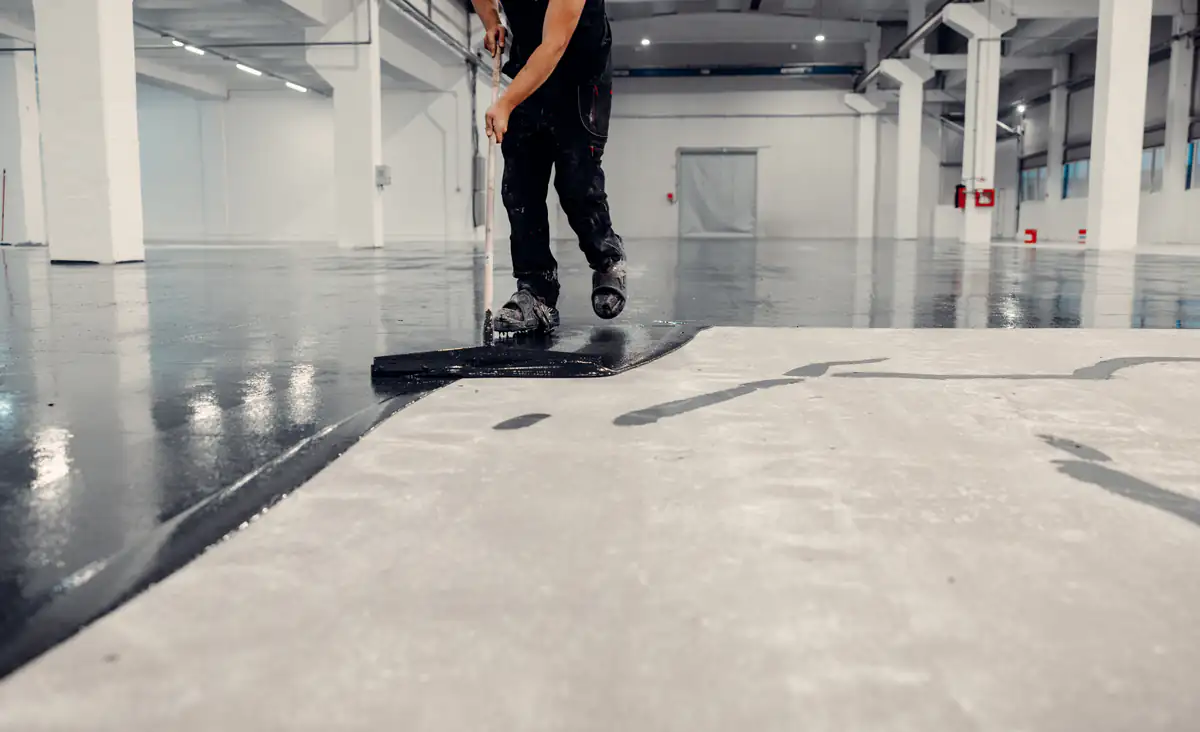
The key word is “properly installed.” A vapor barrier primer goes down first. The concrete gets diamond ground — not acid etched — to open the pores and create a real mechanical bond. Any cracks or damaged sections get repaired before the coating goes on. Then the coating system goes down in multiple layers, with proper cure time between them. That’s what makes the difference between a floor that lasts and one that becomes a project.
Luxury vinyl plank has gotten popular in the last few years, and for good reason — it’s attractive, relatively affordable, and easy to install. In above-grade spaces with stable humidity, it performs well. In Hartford County basements, it’s a gamble.
The problem is that vinyl is installed in pieces, with seams. Moisture vapor moving up through the slab finds those seams. Over time, the adhesive breaks down, the edges lift, and the planks start shifting. In a basement along the Connecticut River valley — places like Rocky Hill, Wethersfield, or East Hartford — where clay soils hold groundwater close to the surface for months at a time, this process can happen faster than most people expect.
We’ve seen vinyl installations that looked fine for the first summer and were already showing edge curl and bubbling by the following spring. The homeowner thought they’d saved money. By the time they called us, they’d spent more removing the failed vinyl than a properly installed epoxy system would have cost to begin with.
If your basement has any moisture history at all — and most do — a seamless, vapor-barrier-backed coating system is going to outlast a seamed floor product. The seams are where basements win.
There are situations where vinyl makes sense in a basement: upper-level basements with excellent drainage, spaces with documented low humidity readings, finished living areas where aesthetics outweigh durability concerns. We’ll tell you honestly if that’s your situation. But we won’t recommend it as a moisture solution, because it isn’t one.
The contractor question comes down to process. Ask anyone you’re considering what they do before the coating goes on. If the answer doesn’t include concrete moisture testing, diamond grinding, and crack repair, keep looking. Those steps aren’t optional in Hartford County — they’re what determine whether your floor is still intact in five years.
Ask about the warranty. A one-year warranty on an epoxy floor tells you something. A fifteen-year warranty with specific coverage for delamination and moisture failure tells you something different. Ask what the warranty actually covers, not just how long it runs.
We’re a veteran-owned, locally based business out of East Hartford, and we’ve been doing this work across Hartford County — from Avon and Simsbury to New Britain and Enfield — long enough to know what Connecticut floors need. Our commercial portfolio includes installations at Costco, Amazon, and Foxwoods Casino. Our residential work carries the same materials and the same process. If you’re ready to stop guessing about your floor, reach out to American Poly Floor and we’ll start with an honest assessment of what you’re actually working with.
Summary:
Share: