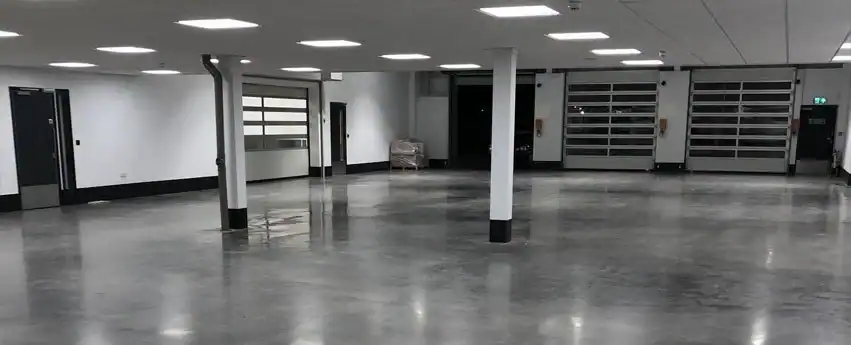
What does it actually take to floor a warehouse that runs 24/7? The standards are higher than most contractors will tell you.
If you’ve ever walked a fulfillment center or distribution facility and noticed the floor — smooth, seamless, bright, and holding up under constant forklift traffic — you were looking at a system, not just a coating. That floor didn’t happen by accident, and it wasn’t installed by the lowest bidder.
Industrial epoxy flooring done right is one of the more technically demanding things a flooring contractor can take on. The margin for error is small, the performance requirements are real, and the cost of getting it wrong shows up fast. We’ve installed these systems across Hartford County’s industrial corridor, and we’ve also seen what happens when contractors cut corners. This page covers what that system actually looks like, what separates a floor that performs from one that doesn’t, and why Hartford County’s specific conditions make contractor selection more important than most people realize.
Most people think of epoxy as a product. In industrial applications, it’s better understood as a layered system — primer, build coat, topcoat — each serving a distinct function. The primer bonds to the concrete. The build coat creates thickness and load-bearing capacity. The topcoat handles chemical resistance, abrasion, and surface texture. Skip or shortcut any layer, and the whole system is compromised.
The concrete underneath matters just as much as what goes on top of it. Industrial floors carry real loads — forklifts, pallet jacks, heavy machinery — and the coating has to be mechanically bonded to a properly prepared surface to handle that stress. Surface contamination, moisture vapor, or inadequate profile will cause delamination regardless of how good the product is.
This is where a lot of industrial epoxy installations go wrong. The product gets blamed, but the failure was in the prep. We’ve rebuilt floors in Hartford County facilities where the original contractor never tested for moisture or properly ground the concrete. The cost to fix it was three times the cost to do it right the first time.
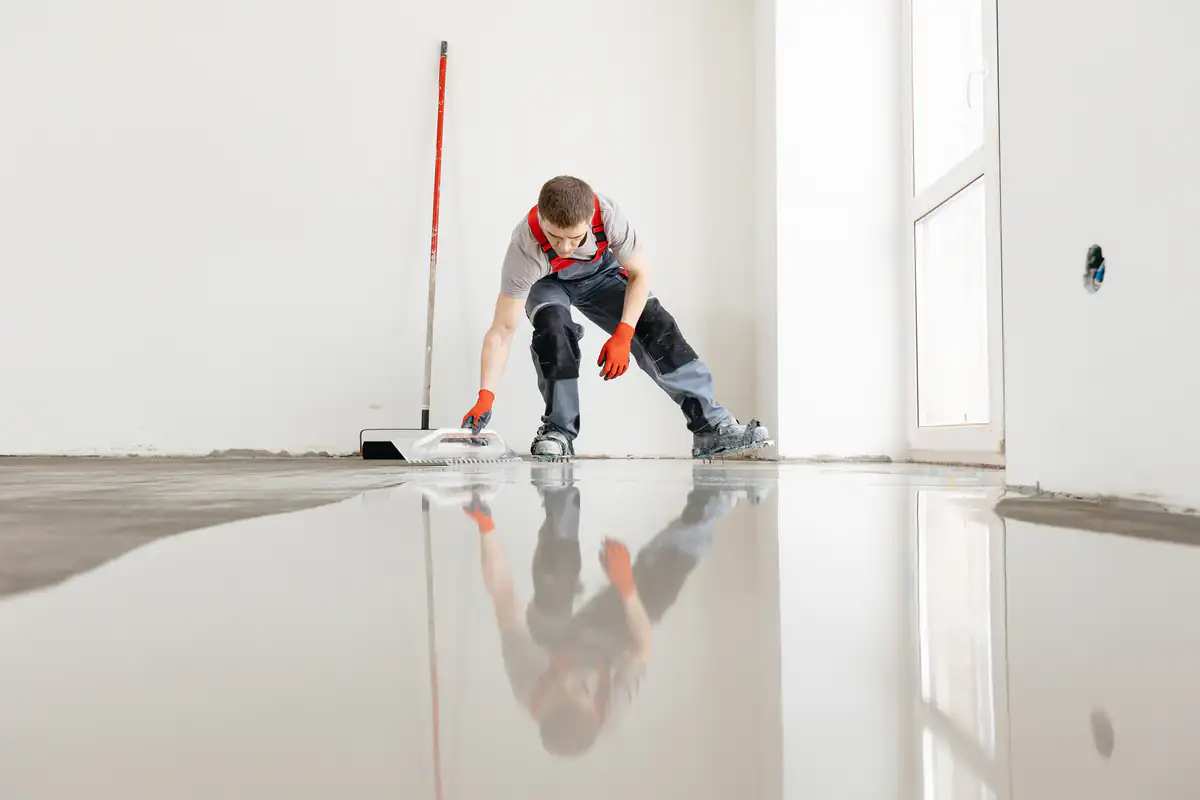
When a facility runs automated picking systems, conveyor equipment, or AGVs, floor flatness isn’t a preference — it’s a functional requirement. Even small surface variations can create problems for equipment that moves on fixed paths or relies on consistent floor contact. This is why poured, self-leveling epoxy has become the standard specification for high-demand industrial environments, including the kind of fulfillment operations that Amazon runs.
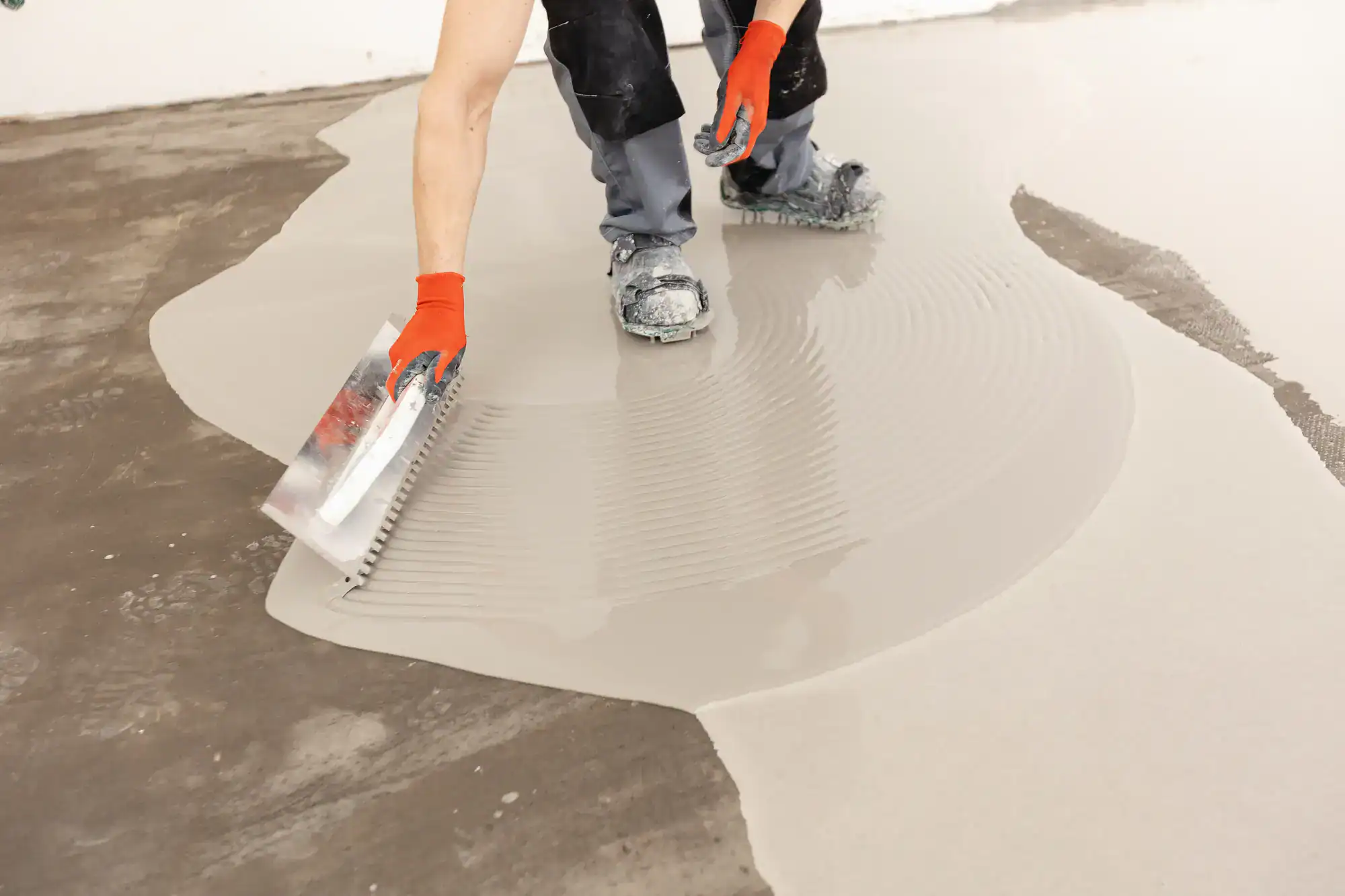
Poured flooring flows across the slab and finds its own level, eliminating the high spots, ridges, and surface irregularities that rolled or broadcast systems leave behind. The result is a monolithic, seamless surface with no joints, no seams, and no edges that can lift or delaminate under traffic. Thickness is controlled precisely during installation, typically in the 188–250 mil range for warehouse applications with constant forklift activity.
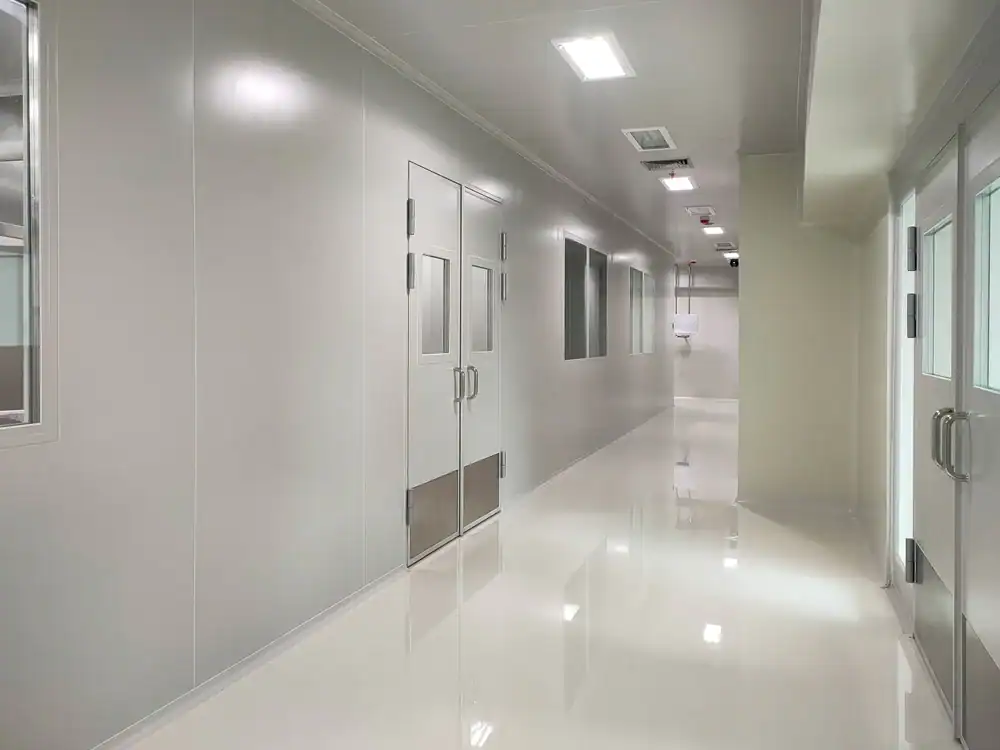
Beyond flatness, the seamless nature of poured systems matters for hygiene and maintenance. There are no gaps where moisture, chemicals, or debris can accumulate. For food processing, pharmaceutical, or cannabis facilities in Hartford County — all of which are active and growing sectors here — that’s a regulatory requirement, not just a preference.
The installation process for poured systems is more involved than a standard rolled application. The concrete has to be diamond ground to a specific surface profile, moisture tested, and primed before the poured layer goes down. Temperature and humidity during installation affect flow, leveling, and cure time, which is why Connecticut’s shoulder seasons — spring and fall — require experienced contractors who know how to manage those variables.
We’ve installed poured self-leveling systems in demanding industrial environments across Hartford County, including facilities that operate around the clock. The process takes planning, the right equipment, and experience with large-format pours — it’s not something a general contractor picks up on the side.
The term “100% solids” refers to what’s left on the floor after the epoxy cures. In a 100% solids formulation, every molecule of the applied material stays on the surface — nothing evaporates. In water-based systems, anywhere from 40% to 60% of the applied volume off-gasses during cure, leaving a significantly thinner, less dense film than what was originally applied.
For light residential use, a water-based epoxy might be adequate. For a warehouse floor carrying daily forklift traffic, chemical spills, and heavy point loads, it isn’t. The physics are straightforward: a thicker, denser film bonds more aggressively to the substrate, resists abrasion more effectively, and holds up under the kind of mechanical stress that industrial floors face every day. Professional-grade 100% solids epoxy achieves compressive strengths exceeding 10,000 PSI — stronger, in many cases, than the concrete it’s bonded to.
There’s also the VOC question. Solvent-based epoxies can achieve similar film thickness, but they produce fumes that are disruptive and potentially hazardous in occupied facilities. 100% solids systems are low-VOC, which matters when you’re working in a facility that can’t fully shut down during installation.
One thing worth understanding: 100% solids epoxy is harder to work with than water-based alternatives. It has a shorter pot life, requires precise mixing ratios, and demands experienced installers who know how to manage application in real-world conditions. In Hartford County’s climate — where temperatures and humidity shift significantly across seasons — that experience is what separates a floor that cures correctly from one that doesn’t.
When we spec a system for an industrial client, 100% solids is the baseline for any application involving regular forklift traffic, chemical exposure, or heavy machinery. It’s not an upgrade — it’s the minimum appropriate specification for that environment.
Want live answers?
Connect with a American Poly Floor expert for fast, friendly support.
Connecticut’s geology creates a specific challenge that doesn’t get enough attention in flooring conversations: moisture vapor transmission. Ground-level and below-grade slabs in Hartford County — many of them in buildings that are 30 to 60 years old — push water vapor up through the concrete continuously, especially during the freeze-thaw cycles that run from late fall through early spring.
That vapor has nowhere to go when a coating is applied on top. It builds pressure beneath the film, and eventually it wins. The coating bubbles, lifts, and delaminates. The floor fails. The contractor gets blamed, but the real cause was skipping moisture testing and vapor barrier installation before the epoxy went down.
This is one of the most common failure modes we see in Hartford County industrial facilities, and it’s entirely preventable.
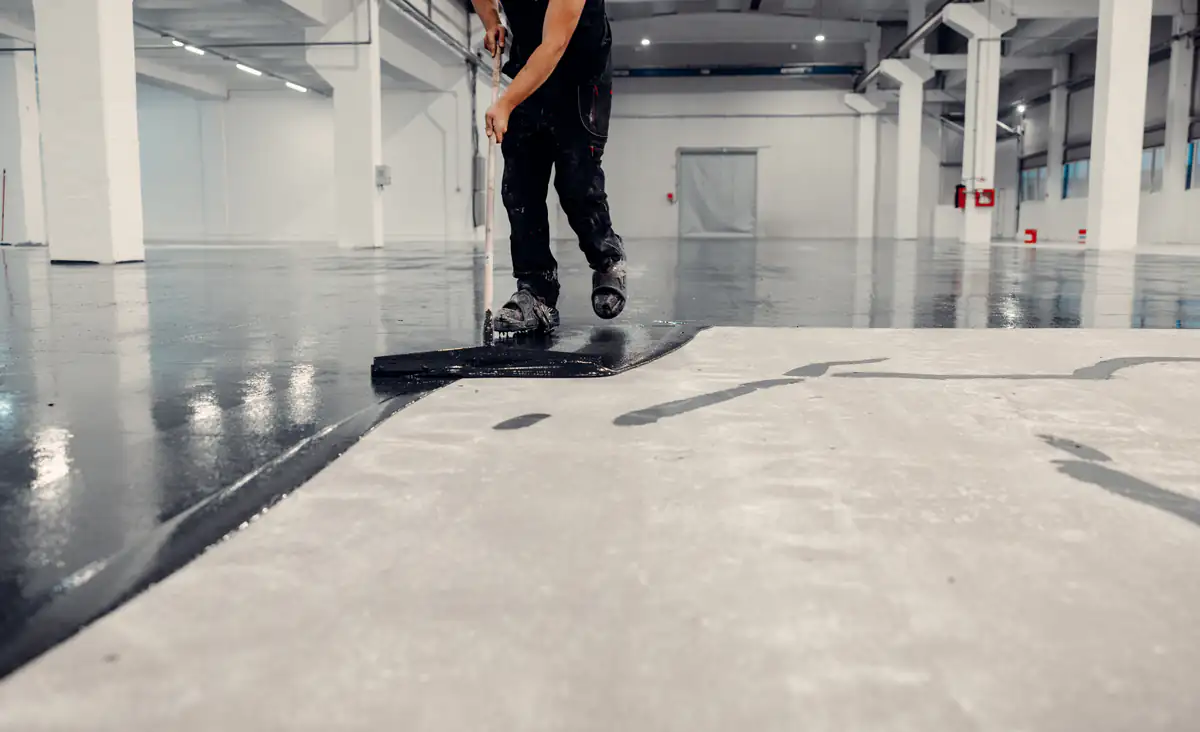
Moisture testing isn’t optional in Connecticut — it’s the step that determines what system gets installed. There are two primary methods: the calcium chloride test (ASTM F1869), which measures moisture emission from the slab surface over 60–72 hours, and the relative humidity probe test (ASTM F2170), which measures vapor pressure inside the slab at depth. Both have their place, and experienced epoxy flooring professionals use them to understand not just whether moisture is present, but how severe the transmission rate is.
The results determine the primer. When moisture vapor transmission exceeds safe thresholds for standard epoxy adhesion, we apply a specialized vapor barrier primer before any build coat. This primer chemically reacts with the moisture at the surface, creating a permanent barrier that stops vapor transmission without requiring the slab to be fully dry. It’s not a workaround — it’s an engineered solution to a real problem.
In East Hartford, where our shop is based, and across the I-84 and I-91 corridors where most of Hartford County’s warehouse and distribution facilities are concentrated, moisture issues are the rule rather than the exception. Older industrial buildings near the Connecticut River, facilities with high water tables, and any structure with a ground-level slab that’s never been properly sealed are all candidates for moisture mitigation before coating.
Skipping this step is the single most common reason industrial epoxy floors fail prematurely in this region. A contractor who doesn’t lead with moisture testing before quoting a system either doesn’t know this or is hoping you don’t. Either way, it’s a problem.
**How long does industrial epoxy flooring last in a Connecticut warehouse?**
A properly installed industrial epoxy system — meaning correct surface prep, moisture mitigation, and a 100% solids multi-layer application — lasts 10 to 20 years under normal industrial conditions. The wide range reflects real differences in traffic volume, chemical exposure, and maintenance. A floor in a light-assembly facility will outlast one in a high-traffic distribution center, all else being equal. We back our industrial work in Hartford County with a 15-year warranty that covers delamination and moisture failure — the two most common ways floors fail in this region due to Connecticut’s freeze-thaw cycles and groundwater conditions.
**Can epoxy handle forklift traffic and heavy pallet loads?**
Yes, when the system is specified correctly. The key variables are thickness and formulation. Industrial systems applied at 188–250 mils using 100% solids epoxy achieve compressive strengths above 10,000 PSI, which is more than sufficient for standard forklift and pallet jack loads. For facilities with very heavy point loading — large press equipment, for example — we may spec a thicker mortar-based system underneath the epoxy topcoat for added impact resistance.
**How disruptive is industrial epoxy installation for an active facility in Hartford County?**
This is the question we hear most from facility managers along the I-84 corridor, and the honest answer is: it depends on how the project is planned. Diamond grinding is loud and produces dust, so production areas adjacent to the work zone need to be managed. Cure time for industrial systems is typically 12–24 hours to light foot traffic, with full cure in 5–7 days. For facilities that can’t afford extended shutdowns, we offer phased installation and off-hours scheduling — nights and weekends — so operations don’t have to stop entirely. Fast-cure polyaspartic topcoat options can compress the return-to-service window significantly for time-sensitive situations.
**Why does surface preparation matter so much for industrial floors?**
Because the coating is only as strong as its bond to the concrete, and that bond is only as good as the surface it’s bonded to. Diamond grinding opens the concrete’s pores and creates a mechanical surface profile that allows the epoxy to penetrate and lock in. Acid etching — common in budget installations and DIY kits — doesn’t create adequate profile for industrial-grade systems. Contaminated, poorly prepped, or moisture-affected concrete will cause delamination regardless of product quality. The prep work is where industrial epoxy installations succeed or fail, and it’s the part that takes the most time, equipment, and experience to do correctly.
**What industries in Hartford County most commonly need industrial epoxy flooring?**
Hartford County’s industrial base spans aerospace and defense manufacturing (Pratt & Whitney, Collins Aerospace), logistics and distribution along the I-91 corridor, healthcare facilities within the Hartford HealthCare system, food processing, cannabis production, and aviation maintenance at Bradley International Airport in Windsor Locks. Each of these environments has specific flooring requirements — some need chemical resistance, some need FDA-compliant seamless surfaces, some need ESD (electrostatic discharge) control. The right system depends on the specific use, not just the square footage.
Industrial epoxy flooring is one of those things where the gap between a good installation and a bad one isn’t visible on day one. It shows up six months later, or eighteen months later, when the floor starts to lift and the contractor is nowhere to be found.
The questions worth asking before you commit to anyone: Have they done facilities like yours? Can they show you named clients? What does their warranty actually cover, and is it backed by anything? Do they test for moisture before they quote a system, or after they’ve already started?
If you’re managing or upgrading an industrial facility in Hartford County — whether that’s a warehouse off I-84, a manufacturing plant in East Hartford, or a food processing operation anywhere in the county — we’re worth a conversation. Thirty-plus years of experience, a client list that includes Amazon and Costco, and a 15-year warranty that covers the failures other contractors don’t want to talk about. Reach out and let’s look at what your floor actually needs.
Summary:
Article details:
Share: