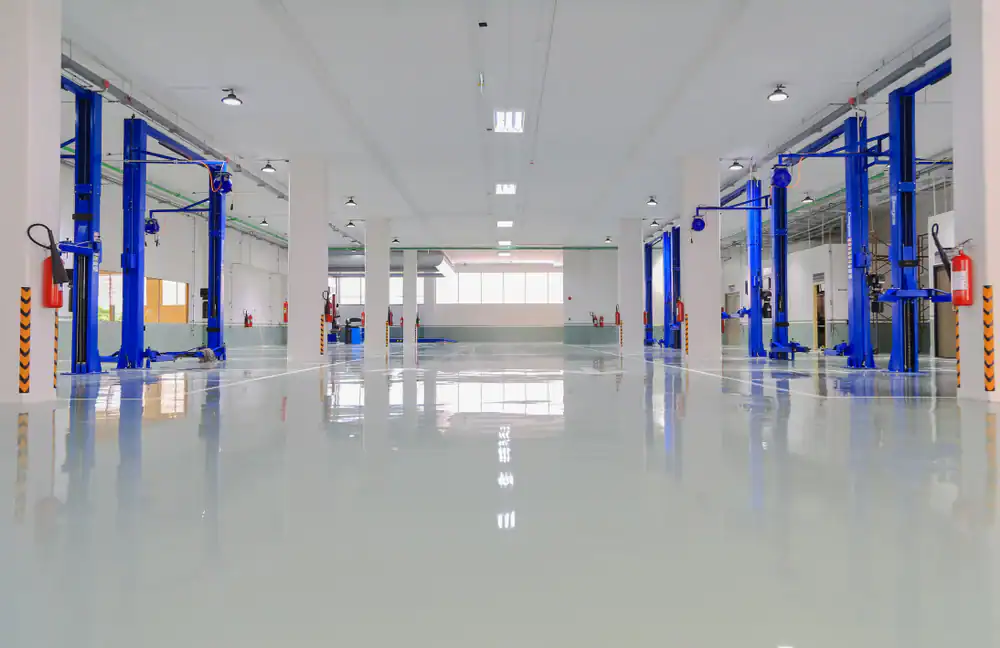
Not all commercial epoxy floors are created equal. Here's what Hartford County business owners need to know before they commit to a coating.
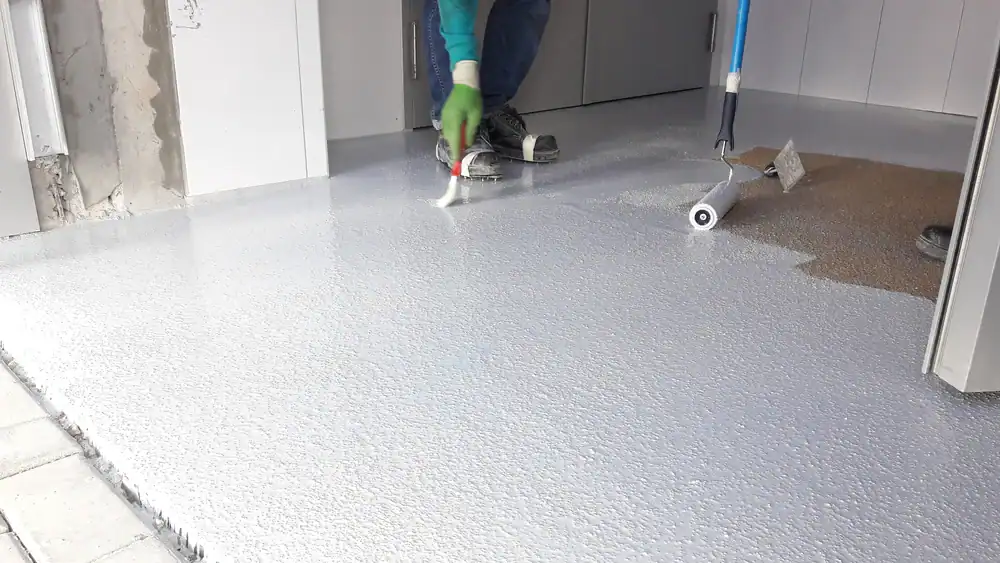
If your commercial garage floor is cracked, stained, or shedding concrete dust every time a vehicle rolls through, you already know it’s a problem. What you might not know is how quickly the right coating can fix it — or how badly the wrong one can make things worse. Commercial epoxy flooring isn’t complicated, but there’s a real difference between a floor that holds up for fifteen years and one that starts peeling before the next winter. This page covers what that difference actually looks like, what the installation process should involve, and what to ask any contractor before you let them near your concrete.
There’s a version of epoxy that comes in a kit from the hardware store, and there’s a version that gets installed in Amazon fulfillment centers and Costco warehouses. They share a name. That’s about it.
Commercial and industrial garage floors face a completely different set of demands than a residential garage. Forklift traffic, chemical spills, vehicle fluids, heavy foot traffic, and the constant pressure of daily operations require a system that’s built to absorb punishment — not just look good on day one. The mil thickness alone tells the story: residential coatings typically run two to five mils. Commercial and industrial systems are applied at ten to sixty mils depending on the application. That’s not a minor difference. It’s the difference between a surface coating and a structural floor system.
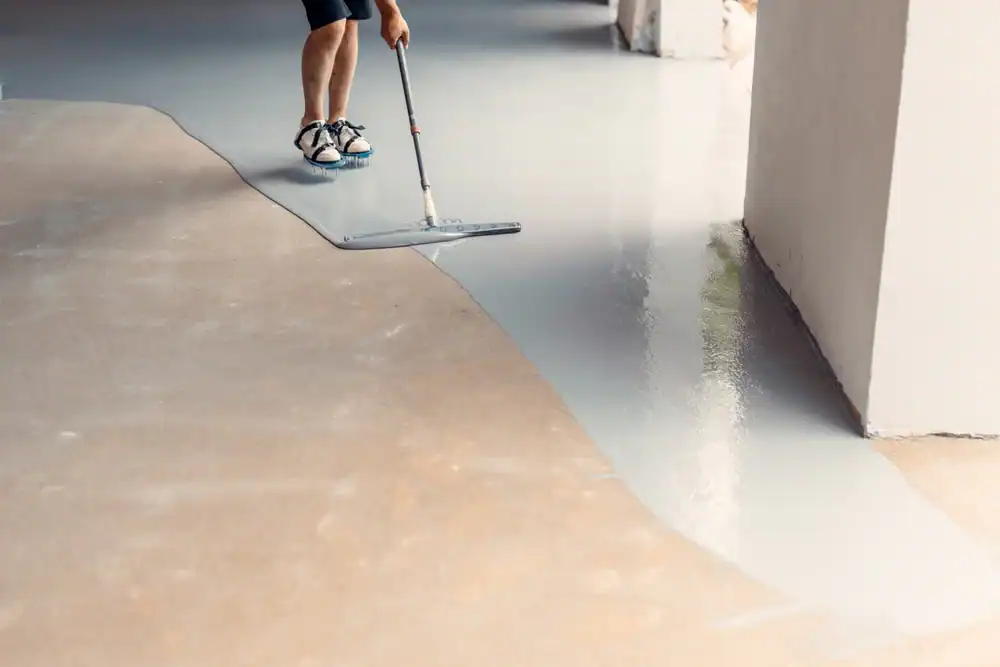
The most common reason commercial epoxy floors fail has nothing to do with the product. It comes down to surface preparation — specifically, what happens to the concrete before a single drop of coating is applied. Up to eighty percent of epoxy failures trace back to this step being skipped, rushed, or done incorrectly. That’s consistent across the industry, and it’s something we see firsthand when businesses call us to fix a floor that another contractor installed.
The standard we hold ourselves to starts with diamond grinding. Not acid etching — diamond grinding. Acid etching is faster and cheaper, which is why budget contractors lean on it. But it doesn’t create the surface profile that commercial-grade epoxy needs to bond permanently to concrete. Diamond grinding opens the pores of the slab, removes any existing sealers or contaminants, and gives the coating something real to grip. There’s no shortcut that produces the same result.
After grinding, we test for moisture. This step gets skipped more often than it should, and in Connecticut, that’s a serious problem. Hartford County’s soil conditions — particularly the clay-heavy ground common throughout the region — create significant moisture vapor transmission through concrete slabs. That moisture, if not addressed before coating, will eventually push up through the floor and cause delamination. It’s not a question of if. It’s a question of when. We apply a vapor barrier system wherever moisture is present, which in New England is most of the time.
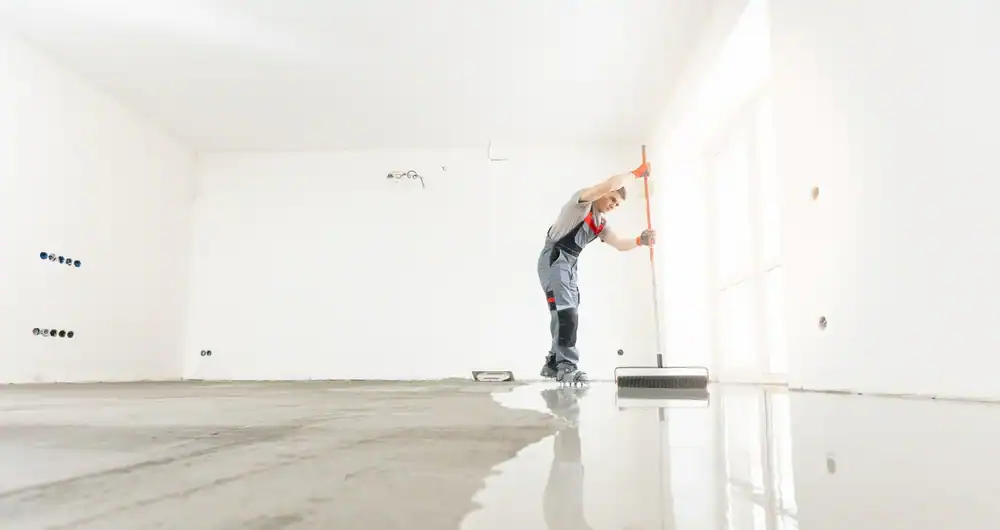
From there, we apply a multi-layer commercial-grade epoxy system using industrial-strength products — not consumer formulations. The full system, including proper cure time, is what produces a floor that holds up under daily commercial use. Rushing the cure phase is another common failure point. We don’t do it.
Hartford County winters are hard on concrete. The freeze-thaw cycle — water infiltrating micro-cracks, freezing, expanding, and widening those cracks over successive cycles — does real structural damage to unprotected slabs over time. Add road salt and de-icing chemicals tracked in by commercial vehicles from November through March, and you have a floor that’s under constant chemical and physical stress.
We’re based in East Hartford. We’ve been working on Connecticut concrete for a long time, and the climate here shapes every decision we make about how a floor gets installed. A coating system that works fine in a climate without freeze-thaw stress can fail here if it’s not specified correctly. That’s why we don’t apply a one-size-fits-all approach. The vapor barrier, the surface profile, the product selection — all of it is calibrated for what Connecticut actually throws at a floor.
For commercial garage operators along the Route 5 corridor in East Hartford and Wethersfield, or the automotive service centers running up Route 44 through Avon and Canton, this matters in a very practical way. Those facilities see high vehicle traffic, heavy chemical exposure, and floors that have often been neglected for years. Getting the prep right isn’t just good practice — it’s the only way to ensure the coating lasts. We’ve coated floors for Costco, Amazon, and Foxwoods, and the same standards we bring to those projects are what we apply to every commercial job in Hartford County.
Want live answers?
Connect with a American Poly Floor expert for fast, friendly support.
If you’ve had a floor coating fail before, you’re not alone — and you’re right to be skeptical the second time around. The commercial epoxy market has no shortage of contractors who will give you a low bid, skip the moisture test, and be unavailable when the floor starts peeling eight months later. Knowing what to look for makes the difference between a smart investment and a repeat of the same problem.
Start with the basics: licensed, insured, and willing to put it in writing. Then go deeper. Ask about our surface preparation process specifically. Ask what we do when moisture is present. Ask what the warranty actually covers — not just how many years, but what failure modes are included.
A warranty number by itself doesn’t mean much. What matters is what the warranty actually covers when something goes wrong. The industry standard for commercial epoxy warranties runs somewhere between one and five years. We back our work with a fifteen-year warranty — and it covers the things that actually cause floors to fail: delamination, moisture failure, and coating breakdown.
That specificity is intentional. Delamination — the coating separating from the concrete — is almost always the result of inadequate surface prep or a missed moisture problem. By covering it explicitly, we’re putting our installation process on the line, not just the product. If we do our job correctly, which we do, that warranty never gets used. But if something does go wrong, you’re not left trying to figure out whether your situation qualifies under vague warranty language.
For commercial property managers and business owners in Hartford County, this matters beyond just peace of mind. A floor that fails means operational disruption — vehicles that can’t be serviced, equipment that can’t move, a facility that looks unprofessional to clients and employees. The cost of a floor failure isn’t just the repair. It’s the downtime, the rescheduling, and the credibility hit. A fifteen-year warranty backed by a contractor who will still be in East Hartford when you call is genuine risk management, not a marketing line.
We’re a veteran-owned business, BBB-accredited since 2021, and carry a 4.8-star rating from over 148 Connecticut customers. Those aren’t numbers we lead with to impress anyone — they’re the track record that tells you we’ll still be accountable five years from now.
There are a few questions that cut through most of the noise when you’re comparing contractors. The first is simple: can they show you commercial work they’ve done at scale? Not a residential garage or two — actual commercial facilities with demanding specifications. The ability to name clients like Costco, Amazon, or Foxwoods isn’t something a contractor can fake. Those organizations have vendor qualification processes. Getting on their approved list means meeting real standards.
The second question is about surface preparation. Ask specifically whether they diamond grind or acid etch. If they say acid etching is fine for commercial work, that’s a red flag worth taking seriously. Ask whether they test for moisture vapor transmission before coating. In Hartford County, where clay soils and older concrete slabs are common — particularly in established industrial areas of Bloomfield, Windsor, and East Hartford — skipping that test is how floors fail.
Third, ask about disruption. Most commercial operators can’t afford to shut down for a week. A good contractor should be able to give you a realistic timeline and a clear plan for minimizing the impact on your operations. Most of our commercial garage floor projects in Hartford County are completed within one to two days. For larger facilities, we work in phases so your operation doesn’t have to stop. We also offer a PODS storage service for projects where clearing the space is a logistical challenge — it’s a small thing that makes a real difference when you’re running a business and trying to coordinate an installation at the same time.
Finally, make sure they’re local in a meaningful way. Not just licensed in Connecticut, but actually based here, familiar with Hartford County’s building conditions, and reachable when you need them. A contractor who answers the phone, shows up on schedule, and stands behind their work is not as common as it should be. That’s the standard we hold ourselves to, and it’s what we’d tell any Hartford County business owner to expect.
The short version: commercial garage floor epoxy done correctly lasts fifteen years, handles everything Hartford County winters and daily operations can throw at it, and never asks for your attention again. Done incorrectly, it peels, bubbles, and costs you twice — once for the bad floor and once to fix it.
The difference comes down to preparation, product quality, and who’s doing the work. Diamond grinding over acid etching. Moisture testing before coating. A vapor barrier when the slab calls for it. Industrial-grade materials applied at the right thickness. And a warranty that covers the failures that actually happen, not just the ones that are easy to claim.
If you’re managing a commercial facility in Hartford County — whether it’s an automotive service center off Route 44, a warehouse near I-91 in Windsor, or a dealership anywhere in between — and you want a straight answer about what your floor needs, reach out to American Poly Floor. We’ll tell you exactly what we’re looking at and what it’s going to take to fix it right.
Summary:
Article details:
Share: