Thinking about coating your garage floor yourself? Here's what most DIY guides leave out — and why it matters in Hartford County.
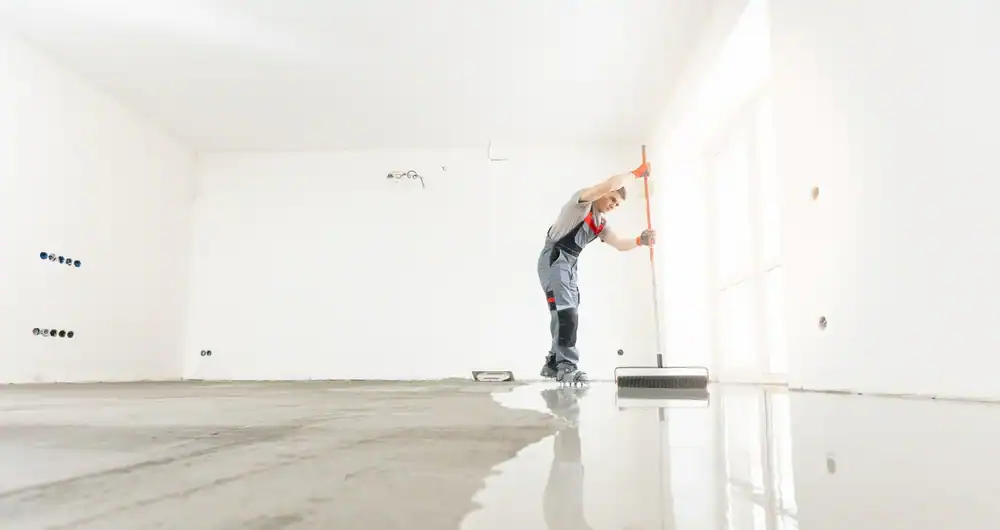
If you’ve already tried a kit from Home Depot or Lowe’s and watched it peel after one Hartford County winter, you already know the frustration. And if you’re researching before making that mistake, good — you’re in the right place. This page covers what actually separates a professional concrete garage floor coating from a DIY approach: the materials, the prep, the performance in real Hartford County conditions, and the honest cost comparison over time. By the end, you’ll have a clear picture of what to expect from each option — and what questions to ask before you spend a dollar on either.
Walk into any big-box store and the garage floor paint section looks convincing. The cans promise durability, easy application, and a clean finish. The reviews online are often positive — at least the ones written six months after installation. The problem is what happens after the first Hartford County winter, or the second, or when a car with warm tires sits on it for a few hours.
Latex and single-part “epoxy” paint products fail at a rate that should give any homeowner pause. Around 78% of them show peeling, hot tire pickup, or significant staining within three years. That’s not a fringe outcome — it’s the most common one. In Hartford County, where temperatures regularly swing above and below freezing from November through March, the timeline for failure tends to be even shorter.
The most frustrating part of a failed DIY coating isn’t the peeling itself — it’s that you did everything the instructions said. You cleaned the floor. You etched it with the included acid solution. You applied two coats. And it still came up.
Here’s what the packaging doesn’t explain: acid etching, which is the prep method included in virtually every retail kit, only achieves what’s called a Concrete Surface Profile of 1 to 2. Professional epoxy systems require a CSP of 3 to 4 for a proper mechanical bond. That gap is the difference between a coating that chemically fuses to the slab and one that’s essentially sitting on top of it, waiting for moisture, temperature, or tire heat to break the connection.
Diamond grinding — the method we use on every installation — opens the concrete surface to the depth and profile that a real bond requires. It also removes the curing compounds, sealers, and surface contaminants that acid etching leaves behind. Those invisible residues are a major reason why coatings fail even when the homeowner followed the instructions perfectly.
Then there’s the product itself. Retail paint and single-part epoxy products contain roughly 50% solids. That means half of what you apply evaporates during curing, leaving a dry film thickness of about 2 to 3 mils. A professionally installed system cures to 10 to 20 mils — five to ten times thicker. That thickness is what handles hot tires, dropped tools, oil spills, and the road salt that Hartford County vehicles track in from I-84 and I-91 every winter.
The surface profile problem and the product thickness problem compound each other. A thin coating on an under-prepped surface doesn’t have much going for it. It might look great in October. By April, after a full Hartford County winter, the story tends to be different.
The upfront math on DIY looks appealing. A kit for a two-car garage runs $150 to $400 in materials. A professional installation for the same space runs $2,800 to $4,500. That’s a real difference, and it’s reasonable to ask whether the professional option is worth it.
The honest answer depends on which number you’re actually comparing. If you compare the one-time cost of a kit to the one-time cost of professional installation, DIY wins on day one. But that’s not how it plays out in practice.
A DIY coating that fails in two years needs to be removed and reapplied. Removing a failed coating — especially one that has partially bonded and partially lifted — takes more time and effort than prepping bare concrete. Then you buy another kit, spend another weekend, and wait to see if this one holds. Over 15 years, that cycle adds up to $450 to $2,800 in materials alone, plus somewhere between three and seven weekends of your time, plus the eventual cost of having a professional grind off the accumulated layers of failed coating before they can properly refinish the floor.
A professionally installed system, done correctly the first time, lasts 15 to 20 years. When you spread the cost of professional installation across that lifespan, the per-year cost is lower than the DIY cycle — and you don’t spend a single weekend on your hands and knees with a grinder.
There’s also the question of what happens if you’re unhappy with a DIY result. You absorb that cost yourself. When we install a floor in Glastonbury or Simsbury or West Hartford and something isn’t right, our 15-year warranty covers it. That coverage doesn’t exist in a box from the hardware store.
Want live answers?
Connect with a American Poly Floor expert for fast, friendly support.
“Best garage epoxy” gets searched thousands of times a month by homeowners trying to find the right product. The honest answer is that the best garage epoxy for a Hartford County home isn’t something you can buy at a retail store — it’s a system, applied by someone who knows what they’re doing, using materials that are formulated for real performance.
We use 90 to 100% solids epoxy, which means virtually all of what gets applied stays on the floor. The result is a coating that’s dense, chemically resistant, and thick enough to handle daily vehicle traffic, road salt, oil, and the kind of use a real garage sees. The polyaspartic topcoat that goes over the base layer adds UV stability and hot tire resistance — two things most retail products can’t claim.
Hartford County has a moisture problem that doesn’t get enough attention in generic garage floor guides. The region’s geology — particularly in the Connecticut River valley communities that make up much of Hartford County — creates persistent groundwater pressure from below concrete slabs. That moisture vapor pushes upward through the slab constantly, and it doesn’t care whether you can see it or not.
A floor that looks dry can still be transmitting moisture vapor at rates that will cause any coating to bubble, blister, and delaminate within a year or two. This is one of the most common reasons professionally installed floors fail when the contractor skips the moisture test — and it’s essentially guaranteed to cause problems when a homeowner applies a retail kit over a slab that hasn’t been tested at all.
Before we coat any floor, we test the slab for moisture vapor transmission. If the numbers are elevated — which they frequently are in East Hartford, Glastonbury, Newington, and other Connecticut River valley communities — we apply a specialized vapor barrier primer that stops the transmission permanently. Not temporarily. The primer chemically seals the slab against upward moisture movement, giving the epoxy system a stable, dry surface to bond to.
This step adds time and cost to the installation. It also explains why some floors last 20 years and others fail before the first winter is over. Skipping it isn’t a shortcut — it’s a guarantee of a future problem. Hartford County’s climate makes moisture management not just a best practice but a baseline requirement for any coating that’s expected to hold up.
Once you’ve decided that professional installation is the right call, the next question is how to tell a good contractor from one who’s going to cut corners and leave you with the same problem in a different form.
The first thing to ask is how they prepare the surface. If the answer is acid etching, that’s a red flag. Diamond grinding is the standard for any system that’s expected to last. A contractor who can’t explain the difference between the two, or who doesn’t mention concrete surface profile at all, is probably not someone who thinks carefully about the prep side of the job.
Ask about moisture testing. In Hartford County, this isn’t optional. A contractor who says the floor looks dry and moves on without testing hasn’t done their homework on how Hartford County slabs actually behave.
Ask about the warranty — specifically. “We stand behind our work” is not a warranty. A real warranty covers specific failure modes (delamination, moisture failure, coating breakdown) for a defined period of time. We back our installations with a 15-year warranty that covers exactly those things, and a 10-year insurance-backed program for additional protection.
Look for commercial experience. We’ve coated floors at Costco, Amazon, and Foxwoods Casino — facilities where floor failure is not an option and where the demands on the coating system are far greater than any residential garage. That experience translates directly to residential work. If a system holds up under a Foxwoods Casino floor with thousands of visitors a day, it will hold up under your two-car garage in Simsbury.
Finally, ask whether the contractor is licensed and insured in Connecticut. The state requires Home Improvement Contractor registration for residential work. It’s a simple question, and any reputable contractor should be able to answer it immediately.
For most Hartford County homeowners, the answer is yes — but only when it’s done right. The combination of Hartford County’s freeze-thaw cycles, road salt season, and persistent slab moisture means that a coating applied without proper prep and moisture management is likely to fail regardless of how good the product is. The prep and the process matter as much as the materials.
What you’re really paying for with professional installation isn’t just a better-looking floor. It’s a floor that doesn’t need to be redone in two years, doesn’t peel when your car parks on it in January, and doesn’t trap moisture that eventually pushes the coating off from below. Over 15 to 20 years, that’s a floor you don’t have to think about.
If you’re in Hartford County and ready to stop dealing with a floor that looks bad or keeps failing, we offer free consultations and can walk you through exactly what your slab needs before any work begins.
Summary:
Article details:
Share: