Connecticut winters are hard on garage floors. Here's what actually holds up — and what to think about before you coat, tile, or resurface.
If you’ve been putting off dealing with your garage floor, you’re not alone. Most homeowners in Hartford County either live with cracked, stained concrete for years or try a box-store kit that looks decent for a few months before it starts peeling. Neither feels like a real solution.
The problem isn’t that good garage flooring doesn’t exist — it’s that most of the information out there doesn’t account for what Connecticut actually does to a floor. Road salt, freeze-thaw cycles, humidity from the Connecticut River Valley, and concrete slabs that are sometimes 50 or 60 years old — those things change the equation completely. Here’s what you need to know before you make any decisions.
There’s no shortage of garage flooring products on the market. Epoxy coatings, polyaspartic systems, interlocking tiles, rubber mats, paint — all of them have a place, and all of them have limits. The question isn’t which one looks best in a photo. It’s which one holds up after three Hartford County winters.
Epoxy is the most widely used professional coating for a reason. When it’s installed correctly — meaning the concrete is properly prepared, moisture is tested and addressed, and a multi-layer system is applied — it bonds to the slab at a molecular level and can last 15 to 20 years. Polyaspartic systems, which are often used as a topcoat over epoxy, cure faster and resist UV yellowing better than epoxy alone. For most residential garages in towns like Glastonbury, Simsbury, or West Hartford, a combined epoxy-and-polyaspartic system is the strongest long-term option. Interlocking tiles are a legitimate choice for renters or people who want something removable, but they trap moisture underneath, and in a Hartford County garage, that’s a real concern.
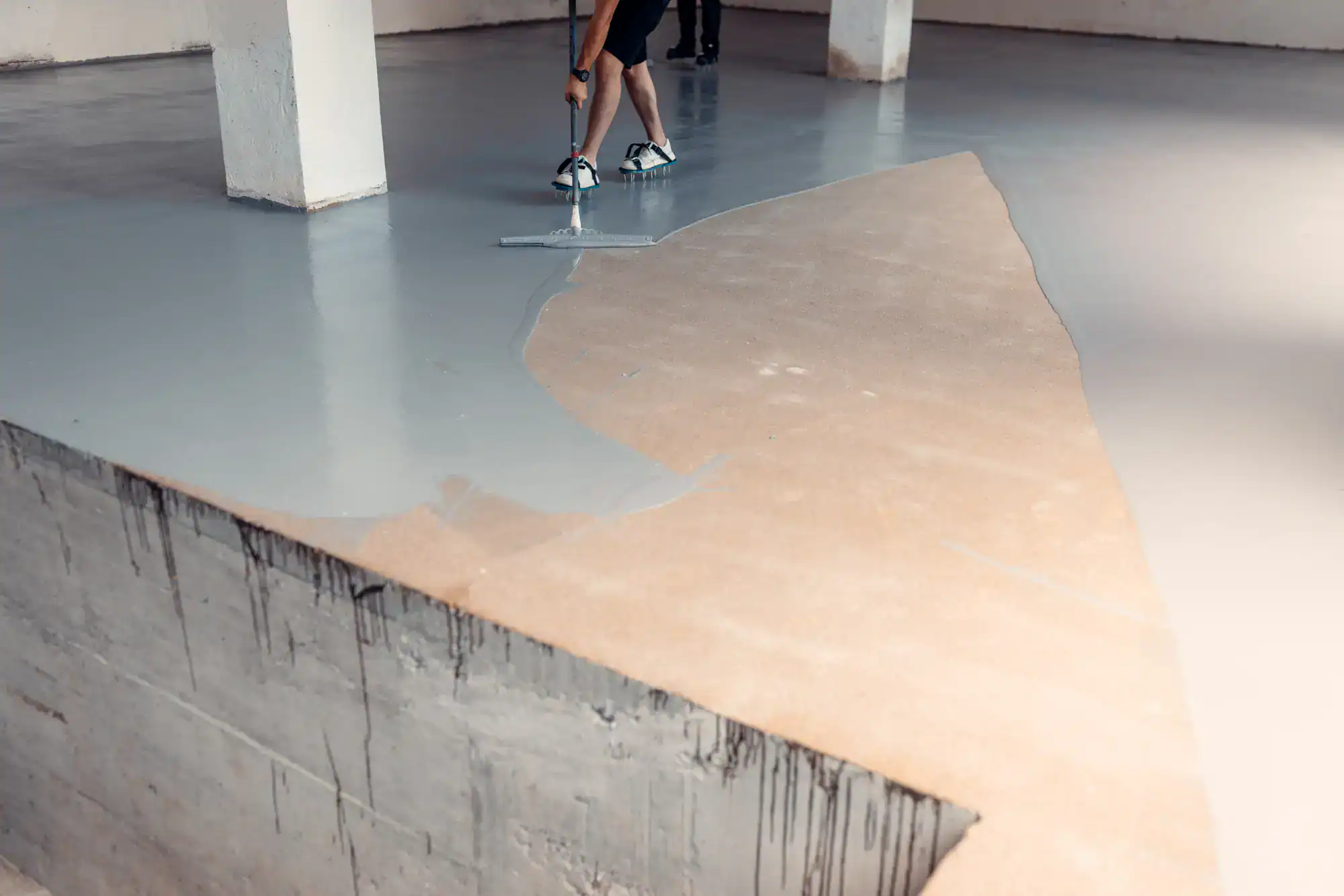
Understanding the difference between these systems matters, because the wrong choice for your specific situation can mean redoing the whole thing in a couple of years.
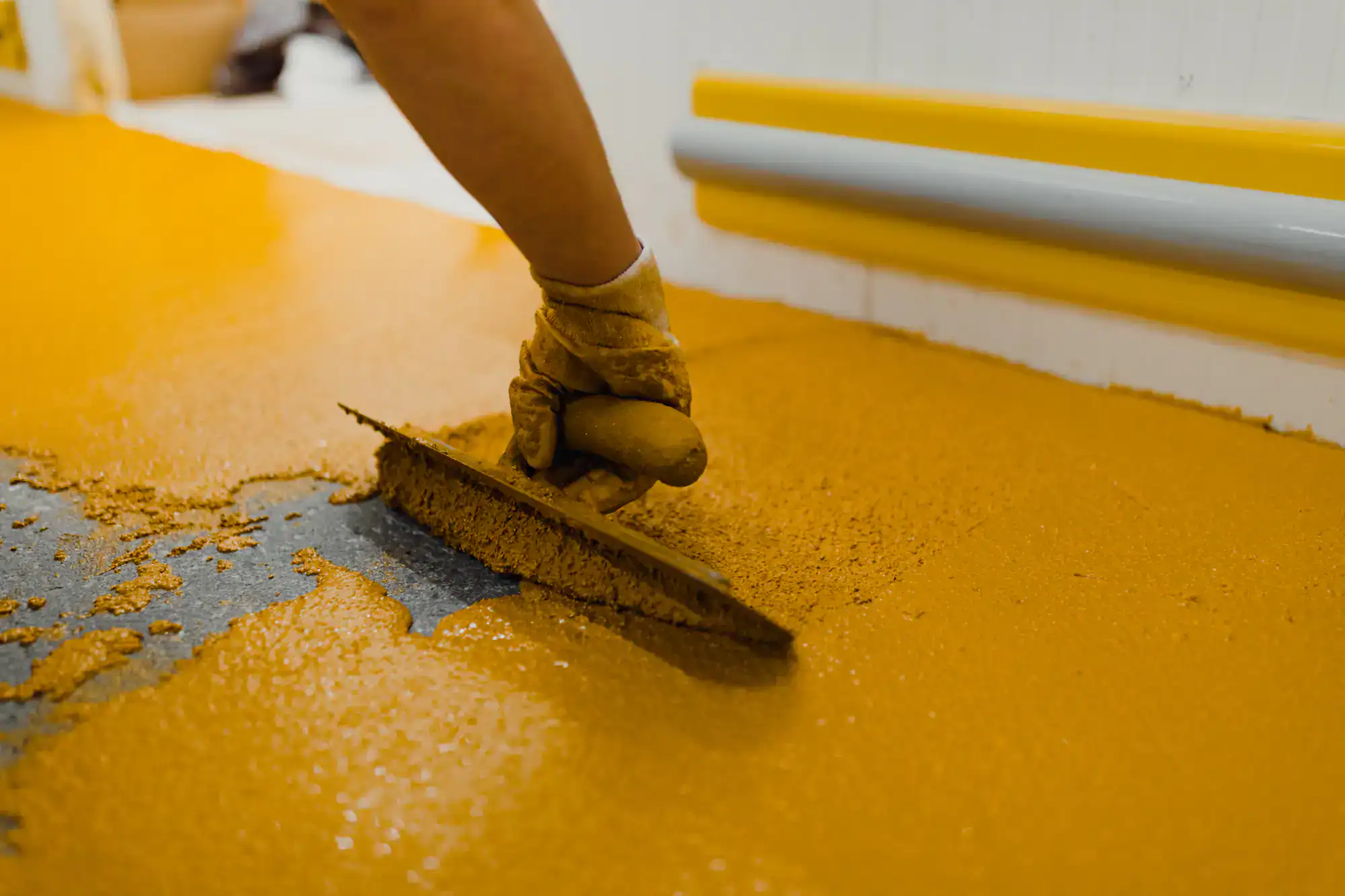
Epoxy is a two-part resin system — a base and a hardener — that chemically bonds to concrete when applied correctly. High-solids professional epoxy is not the same thing as the epoxy paint kits at the hardware store. Those kits are often water-based products with a small percentage of actual epoxy added. They sit on top of the concrete rather than bonding to it, which is why they tend to peel when the slab flexes from temperature changes or when moisture pushes up from below. A professional-grade, high-solids epoxy system is typically three times thicker than any consumer product and forms a bond that temperature swings and road salt can’t easily defeat.
Polyaspartic coatings are a type of polyurea — they cure much faster than epoxy and hold up better under UV exposure, which is why they’re commonly used as a clear topcoat. On their own, they can be applied in a single day, but they don’t build the same thickness or depth as a layered epoxy system. The strongest residential garage floor is typically an epoxy basecoat with a polyaspartic topcoat — you get the bonding strength and thickness of epoxy with the UV stability and surface hardness of polyaspartic.
Interlocking tiles — usually made from PVC or polypropylene — are a reasonable option if you’re renting, if you want something you can pull up and take with you, or if you’re working with a slab that’s too damaged to coat. They’re not a permanent solution, and they don’t seal the concrete beneath them. Moisture can still collect underneath, and in a Hartford County garage where you’re tracking in road salt from Route 44 or I-84 all winter, that trapped moisture can cause its own problems over time. They also move underfoot more than a bonded coating does, which matters if you’re using the space as a workshop or gym.
Up to 80% of epoxy floor failures trace back to one thing: inadequate surface preparation. Not the product itself, not the brand, not bad luck — the prep work. And this is where the gap between a professional installation and a DIY kit becomes most obvious.
When you buy a kit at the hardware store, the instructions tell you to clean the floor and apply an acid etch to open up the concrete. Acid etching does something, but it doesn’t do enough. It creates a shallow surface profile that may hold the coating for a season or two, but it doesn’t open the concrete’s pores the way mechanical grinding does. Professional installers use industrial diamond grinders that physically profile the entire slab — removing surface contaminants, opening pores for a true bond, and exposing any cracks or weak spots that need repair before anything gets applied.
The other major failure point in Hartford County specifically is moisture. The Connecticut River Valley brings higher ambient humidity than many inland areas. Add to that the seasonal water table rise every spring from snowmelt, and you have slabs that are actively pushing moisture vapor upward through the concrete. If a coating is applied without a moisture-mitigating primer, that vapor pressure builds beneath the coating and eventually forces it off the surface — usually as bubbles, blisters, or widespread peeling. This is not a rare edge case. It’s one of the most common failure modes we see in Hartford County garages, and it’s entirely preventable with the right primer system applied before any coating goes down.
DIY kits fail at roughly a 30% rate within two years — not because homeowners don’t follow the instructions, but because the instructions don’t account for what’s actually happening beneath the slab. If your garage floor has already peeled once, moisture is almost certainly part of the reason.
Want live answers?
Connect with a American Poly Floor expert for fast, friendly support.
Hartford County has a specific set of conditions that most generic garage flooring guides don’t address. Connecticut is classified as Climate Zone 5A — cold winters, humid summers, and consistent freeze-thaw cycling from roughly November through April. Water expands about 9% when it freezes, and that expansion happens inside the pores of your concrete slab every time temperatures drop below freezing after a wet day.
A lot of the housing in towns like Farmington, Avon, Wethersfield, and Manchester was built between the 1950s and 1980s. Those slabs are 40 to 70 years old. They’re more porous, more cracked, and more vulnerable to moisture than a new pour — which means the prep work and vapor barrier step matter even more. Choosing the right garage floor covering for an older Hartford County slab is a different conversation than choosing one for a new construction home in a drier climate.
If you commute on I-84, I-91, or Route 44 through the winter, you’re bringing road salt into your garage every single day from November through March. Salt is corrosive, and it doesn’t stop working just because you’ve parked the car. It continues to attract moisture from the air, keeping the surface damp longer than you’d expect. That extra moisture increases freeze-thaw risk and accelerates surface wear on any unprotected or poorly coated concrete.
On a bare concrete slab, this shows up as spalling — the surface layer flaking and pitting as moisture freezes inside it repeatedly. On a poorly coated slab, it shows up as peeling or delamination, usually starting at the edges or near the garage door where temperature changes are most extreme. Hartford County sees roughly 45 inches of snowfall in an average year, and that means road salt exposure is not an occasional event. It’s a seasonal constant that your floor has to be built to handle.
The right coating system addresses this in two ways. First, a properly bonded multi-layer epoxy system seals the concrete surface so moisture can’t penetrate it. Second, a polyaspartic topcoat adds chemical resistance — including resistance to the chloride compounds in road salt — and protects the epoxy layer beneath it from surface degradation. A floor installed this way doesn’t just look better. It actively protects the concrete slab underneath, extending its life and reducing the long-term cost of maintaining the space.
For homeowners in West Hartford, Glastonbury, or Simsbury who have attached garages connected to living spaces, there’s another reason this matters: a deteriorating concrete slab can eventually affect the structural integrity of the floor system above it. Protecting the slab is protecting the house.
One of the most common questions we hear is some version of: “What’s actually involved, and how long will my garage be out of commission?” It’s a fair question, especially if your garage doubles as a workshop, storage space, or home gym.
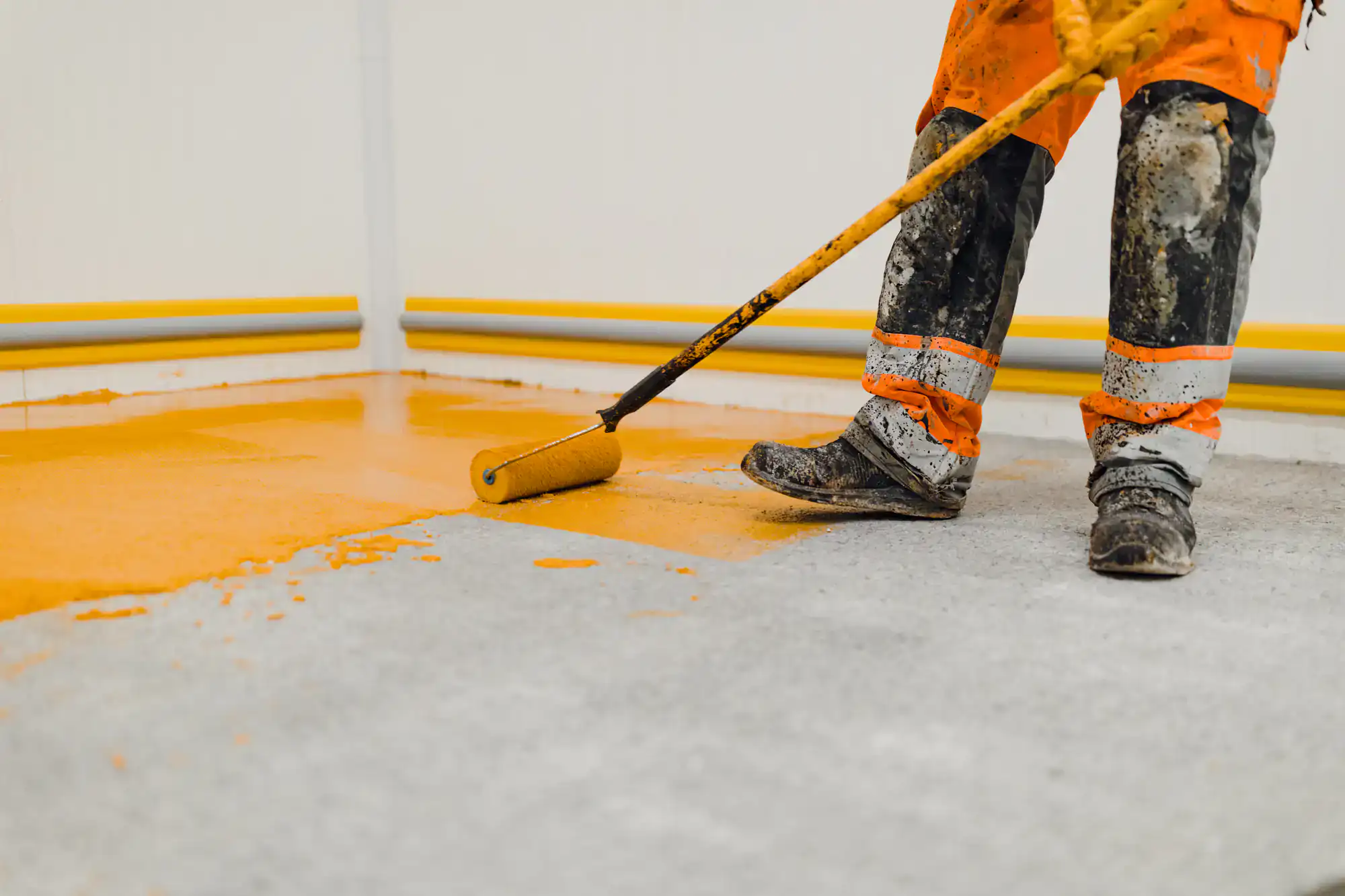
A professional installation starts before any product touches the floor. We inspect the concrete for cracks, previous coatings, moisture levels, and surface condition. Then it gets diamond-ground — not etched, not lightly scuffed, but mechanically profiled with industrial equipment so the surface is properly open and clean. Any cracks or damaged areas get repaired. If moisture testing shows vapor transmission above acceptable levels, a moisture-mitigating primer goes down first. That step alone is what separates a floor that lasts from one that doesn’t.
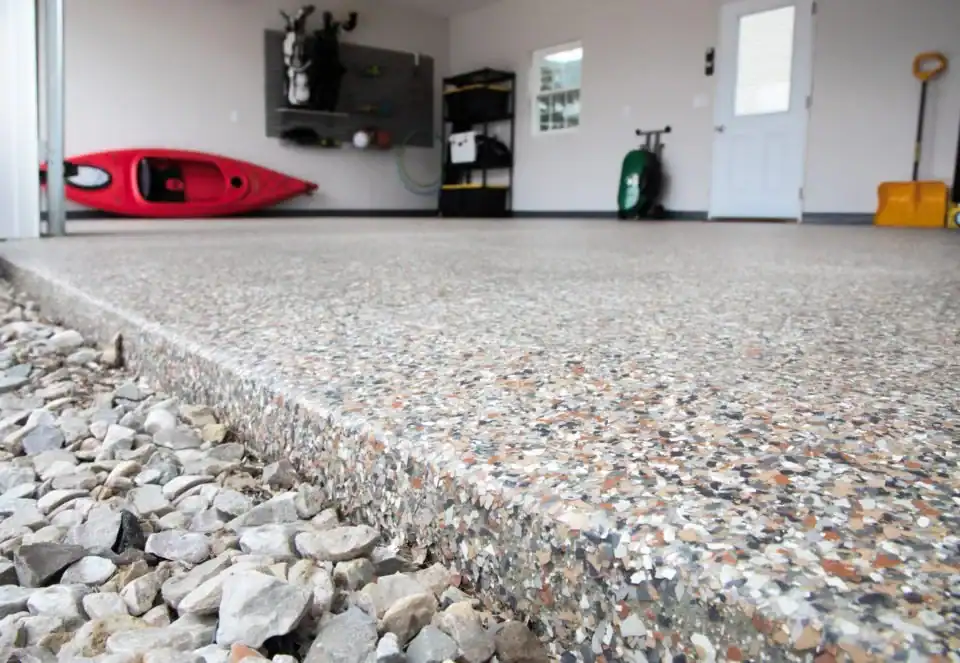
From there, the coating system gets applied in layers — typically a primer or basecoat, a decorative broadcast layer if you’re going with color flakes or a metallic finish, and a clear polyaspartic topcoat. Each layer needs to cure properly before the next one goes down. For most residential garages in Hartford County, the full process takes two to three days. We also offer PODS storage service for customers who need somewhere to put their garage contents during the installation — a practical detail that makes the whole process a lot less disruptive.
The result is a floor that’s sealed against moisture, resistant to road salt and vehicle chemicals, easy to clean, and backed by a 15-year warranty that specifically covers delamination and moisture failure. That warranty isn’t a marketing line. It’s the natural outcome of doing the prep work correctly. When a floor is properly ground, moisture-tested, primed, and coated with commercial-grade materials, it doesn’t fail — and we’re confident enough in that to put it in writing.
We’re a veteran-owned, locally owned business based in East Hartford. We’ve installed floors in homes and commercial facilities across Hartford County — and in major facilities like Costco, Amazon, and Foxwoods. We’re licensed by the Connecticut Department of Consumer Protection, and you can verify that at elicense.ct.gov before you ever call us.
The short version: the material matters, but the preparation matters more. A professional-grade epoxy and polyaspartic system installed on a properly ground, moisture-tested slab will outlast any DIY kit by a decade or more — especially in a Climate Zone 5A market like Hartford County where freeze-thaw cycling and road salt are just part of life.
If your floor has already peeled once, or if you’re starting fresh and want to do it right this time, the first step is having someone actually look at your slab. Not a phone quote — an on-site assessment that accounts for the age of the concrete, the moisture situation, and how you use the space.
We work with Hartford County homeowners and commercial clients across Connecticut. If you want a floor that doesn’t need to be redone in two years, reach out and we’ll take a look at what you’re working with.
Summary:
Article details:
Share: