Connecticut winters are brutal on bare concrete. Here's exactly what a professional garage floor epoxy coating involves — and why the process matters more than the product.
Most homeowners don’t think much about their garage floor — until they can’t ignore it anymore. The cracks spreading across the slab. The oil stain that won’t budge no matter what you try. The fine layer of concrete dust that coats everything within 10 feet. At some point, it stops being a minor annoyance and starts feeling like a project you’ve been putting off for too long.
If you’re in Hartford County, New Haven County, New London County, or Middlesex County, you already know what Connecticut winters do to unprotected concrete. This guide walks you through what a professional garage floor epoxy coating actually involves — step by step, no fluff — so you know exactly what you’re getting into before you make any decisions.
The term “epoxy coating” gets used loosely — sometimes to describe a $75 kit from a hardware store, sometimes to describe a multi-layer professional system that carries a 10-year insurance-backed warranty on our premium system. Those are not the same thing, and the difference matters enormously when you live somewhere with 50 inches of annual snowfall and roads soaked in de-icing salt from November through March.
At its core, a garage floor epoxy coating is a resinous system applied directly to concrete that bonds chemically with the slab and creates a hard, sealed surface. When we install it correctly, it repels oil, resists road salt, handles temperature swings, and holds up to daily vehicle traffic for well over a decade. Done wrong — or done with the wrong materials — it peels, yellows, and leaves you worse off than when you started.
Here’s the part most people don’t realize until after something goes wrong: the coating itself is almost secondary. What determines whether a garage floor epoxy coating lasts 15 years or 15 months is almost entirely what happens before the first drop of material hits the floor.
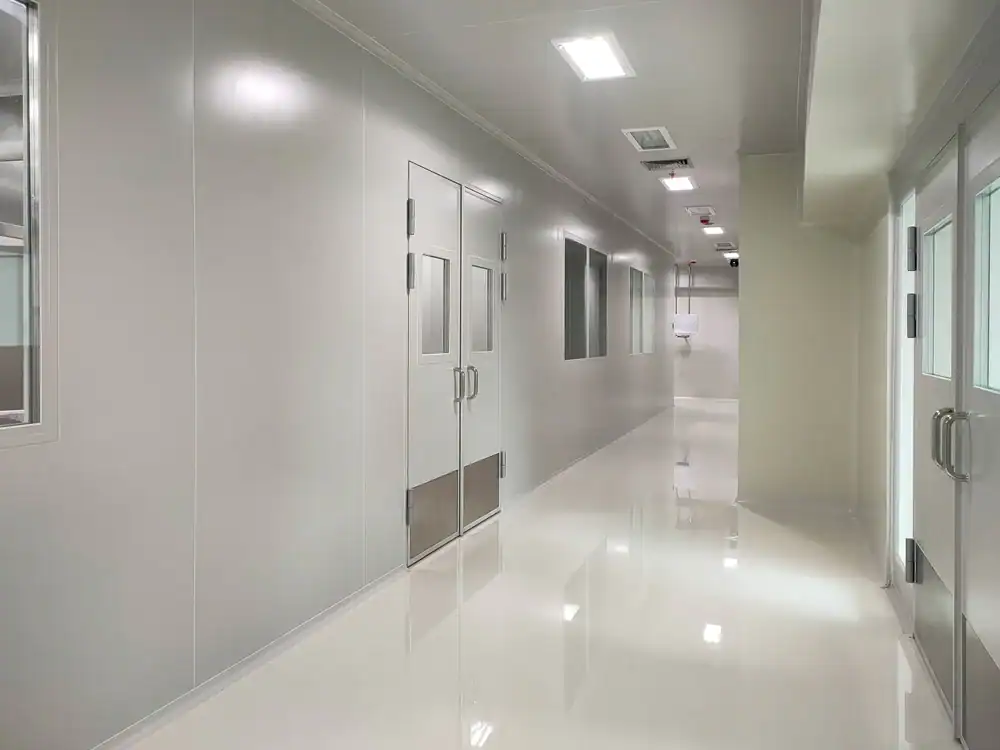
Our installation process starts with diamond grinding. This is mechanical equipment — not acid, not a pressure washer — that physically opens the concrete pores, removes the weak surface layer, strips existing sealers or paint, and creates the surface profile needed for a permanent bond. It’s the same standard used in pharmaceutical facilities and industrial plants. It’s also the step that most budget contractors skip, because it takes time and requires expensive equipment.
After grinding, we perform moisture testing. This one surprises a lot of homeowners. Concrete slabs hold moisture, and that moisture creates vapor pressure that pushes upward from below. When a coating goes down over a slab with elevated moisture and no vapor barrier, the pressure eventually wins — and the coating bubbles, blisters, or lifts. This is especially common in the Connecticut River corridor running through Hartford and Middlesex Counties, where soil moisture is persistently high. It’s also a real concern for homes near the Long Island Sound in coastal New Haven County and throughout New London County’s shoreline communities.
Once we address moisture, any cracks or spalled areas get repaired before a single coat goes down. This matters both structurally and aesthetically. Coating over an unrepaired crack doesn’t hide it — it telegraphs it right through the finished surface. Proper crack repair means the floor looks clean and performs cleanly.
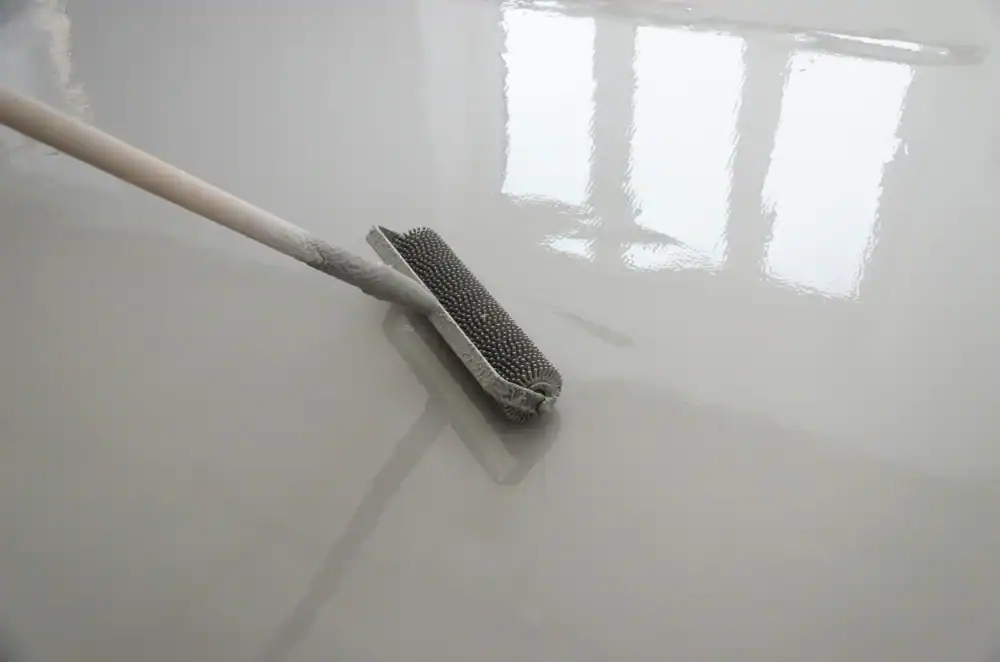
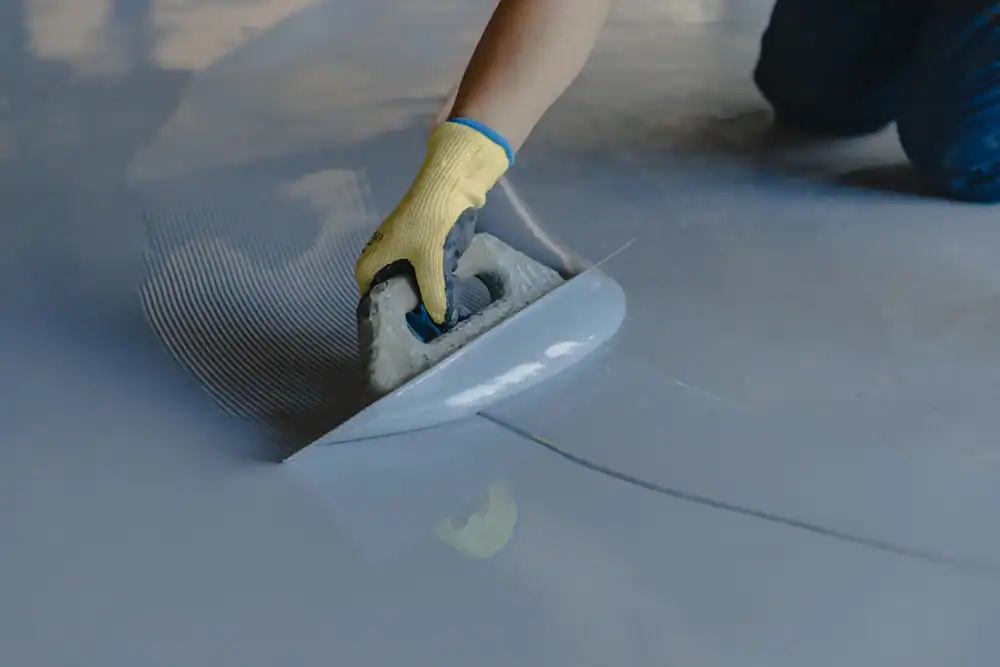
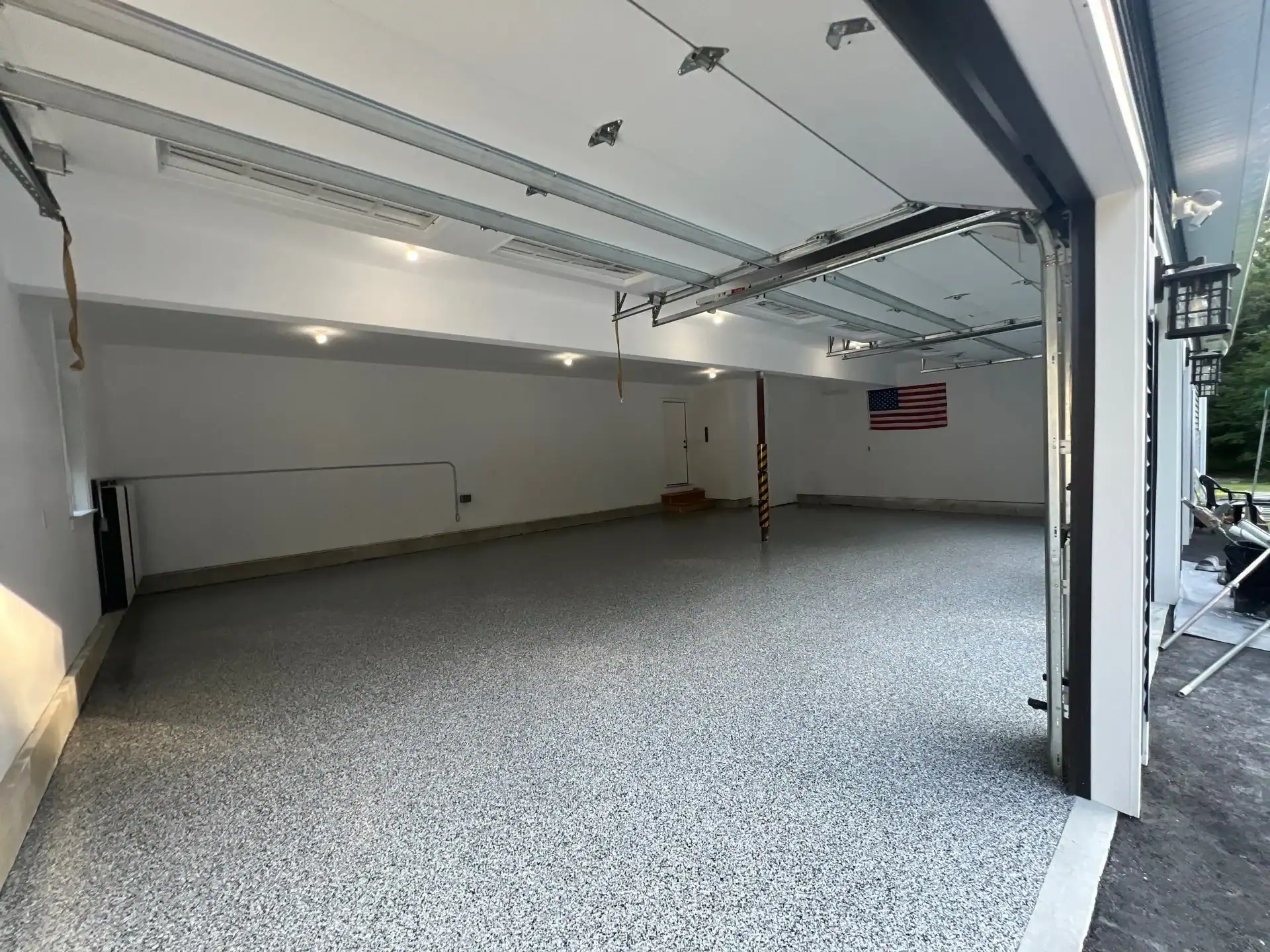
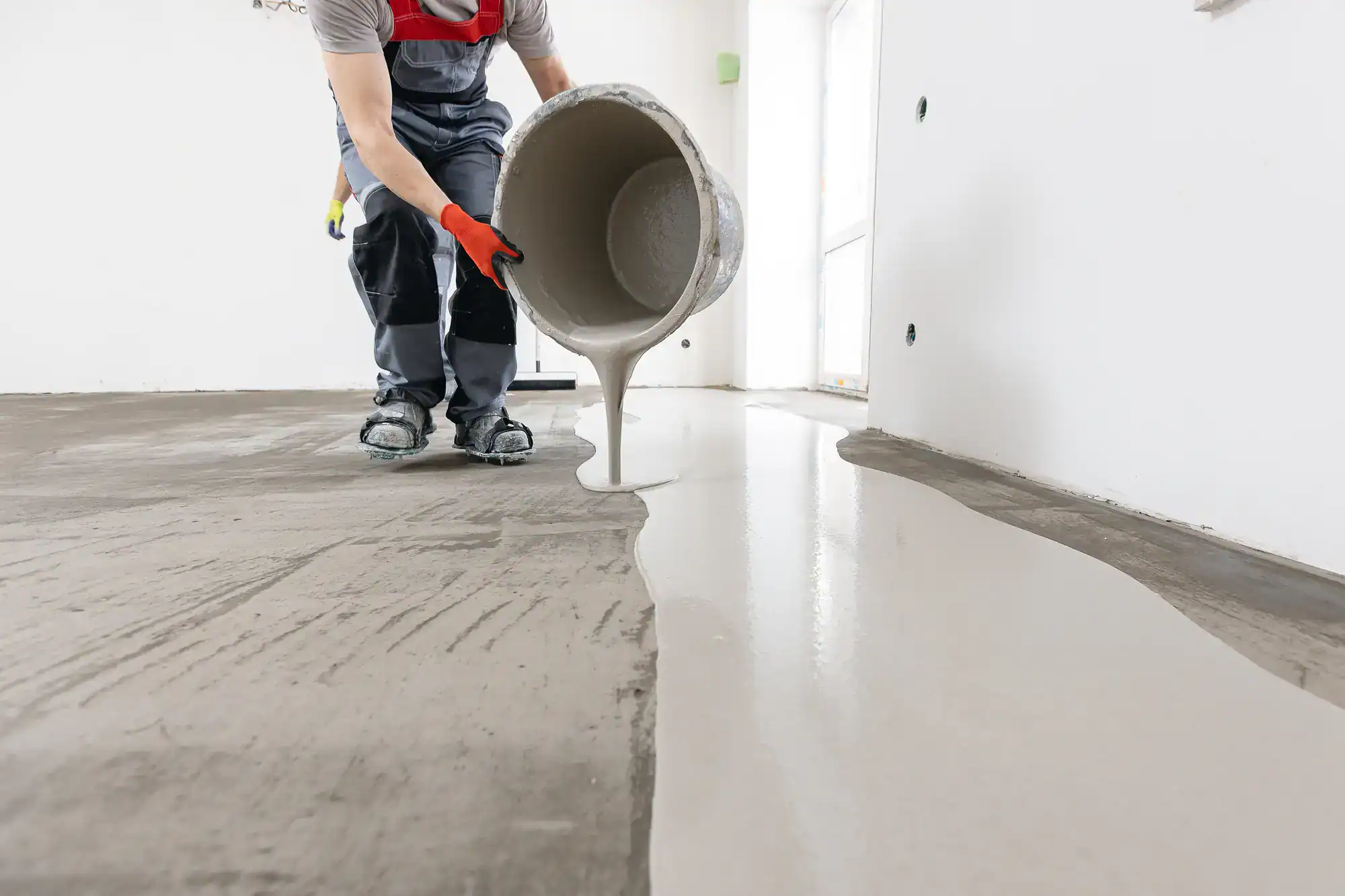
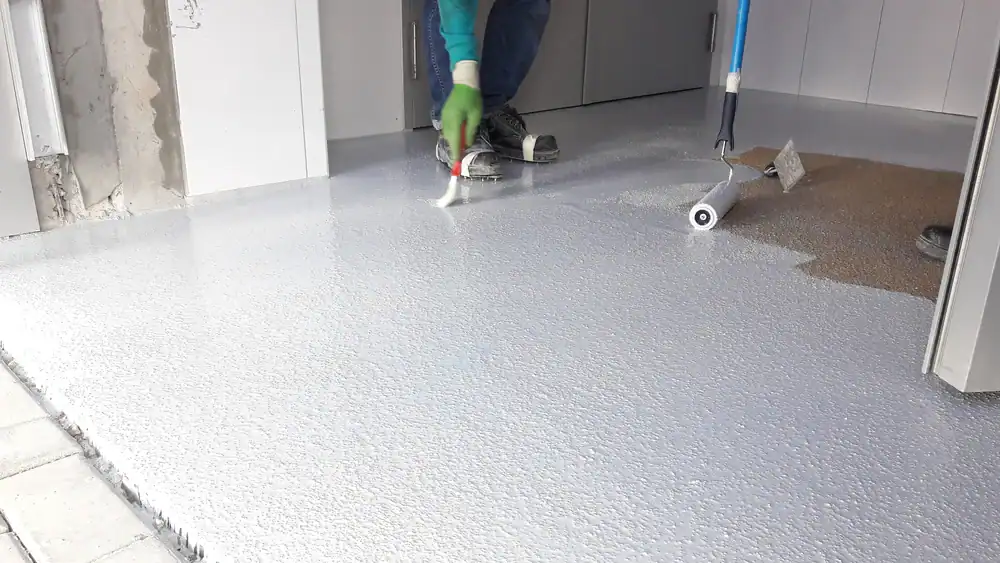
Only after all of that does the actual coating process begin — typically a primer or high-build base coat, a decorative vinyl flake broadcast across the wet surface, and a polyaspartic topcoat to seal everything in. That topcoat is UV-stable, which is why it won’t yellow the way traditional epoxy does when sunlight hits it through a garage window. The whole system, when applied correctly, is up to 300% stronger than bare concrete and around six times more durable than anything you’ll find in a big-box kit.
Most people searching for a garage floor epoxy coating are actually better served by our polyaspartic system — and in Connecticut’s climate, that distinction is worth understanding before you hire anyone.
Traditional epoxy is a solid product, but it has real limitations. It takes three to seven days to fully cure. It’s sensitive to temperature during application. Over time, especially with UV exposure, it yellows. And under the thermal cycling that Connecticut puts it through — hot summers, brutal winters, and everything in between — traditional epoxy can become brittle and start to fail at the edges or under hot tires.
Polyaspartic coatings are classified as aliphatic polyurea, which means they’re UV-stable by chemistry, not just by additive. They cure in hours rather than days, which is how we complete a professional installation in a single day and have vehicles back inside within 24 hours. They remain flexible under temperature swings, which matters when your garage goes from 5°F in January to 90°F in July. And they handle the “hot tire pickup” problem — where a heated tire literally peels a thin, improperly bonded coating off the floor when you back out of the garage — because they’re bonded at a depth that a thin coat simply can’t match.
For homeowners in Glastonbury, Simsbury, and West Hartford who park in attached garages that see the full range of Connecticut seasons, this isn’t a minor technical footnote. It’s the reason the floor either holds up or doesn’t. The same goes for homes in Old Saybrook and Westbrook along the Middlesex County shoreline, where the combination of coastal humidity and freeze-thaw cycling creates some of the most demanding conditions for any coating system in the state.
Want live answers?
Connect with a American Poly Floor expert for fast, friendly support.
Before committing to any project like this, most people have the same handful of questions. Not the ones on a contractor’s FAQ page written to make everything sound easy — the real ones that come up when you’re trying to figure out if this is actually worth it, whether it’ll hold up, and what happens if it doesn’t.
Here are the questions we hear most often, answered straight.
This is the question that matters most for anyone in Hartford County, New Haven County, New London County, or Middlesex County, and the honest answer is: a professionally installed polyaspartic system is specifically built for exactly this environment.
Connecticut roads are heavily salted. I-91 through Hartford, I-95 along the New Haven and New London County coastline, Route 9 through Middlesex County — all of it gets treated aggressively from the first freeze through the last thaw. That salt rides home on your tires and sits on your garage floor until it works its way into the concrete. Over years, it draws moisture deeper into the slab and breaks down the calcium bonds that hold concrete together. That’s why unsealed garage floors in Connecticut look dramatically worse than floors in drier climates — it’s not just age, it’s chemistry.
Our 100% solids polyaspartic coating creates a sealed, chemically resistant barrier that road salt simply cannot penetrate. Spills — whether it’s brine from a winter drive or motor oil from a weekend project — wipe up with a mop instead of soaking in permanently. The coating itself doesn’t degrade from salt exposure the way bare concrete does.
The freeze-thaw piece is equally important. When moisture gets into unprotected concrete and freezes, it expands. That expansion is what causes the spalling — the flaking, pitting surface that looks like the concrete is deteriorating from within. Once we seal the surface with our professional coating, moisture can’t infiltrate in the first place, and the freeze-thaw cycle loses its leverage. For homeowners in Middletown, Cromwell, and Portland along the Connecticut River, where soil moisture compounds the problem, this protection is especially meaningful. For coastal homeowners in Guilford, Madison, Branford, or Stonington, the added salt air factor makes a sealed, chemical-resistant surface even more critical year-round.
If you’ve already tried a kit and watched it peel, bubble, or lift under your tires, you’re not alone. It’s one of the most common experiences homeowners describe when they call us — and it’s almost never because they did something wrong. The kits themselves are the problem.
Hardware store epoxy kits are water-based, low-solids products. They’re designed to be applied over concrete that’s been acid-etched — a process that creates a mildly roughened surface but cannot remove existing sealers, deep contamination, or the weak cream layer on top of the slab. The result is a coating that bonds to the surface rather than into it. It looks fine for a few months. Then the tires get hot, or a particularly cold winter creates some movement in the slab, and the coating starts to lift.
Our professional installation is different at every single step. Diamond grinding creates a mechanical bond that acid etching cannot replicate. Moisture testing catches the vapor pressure problem before it becomes a delamination problem. Our materials — 100% solids polyaspartic systems — build significantly more thickness and hardness than anything in a consumer kit. And our multi-layer application (primer, flake broadcast, polyaspartic topcoat) creates a system rather than just a surface treatment.
The other thing worth knowing: removing a failed DIY coating before professional installation is one of the most labor-intensive and costly prep scenarios in the industry. The grinding takes longer, the surface profile is harder to achieve cleanly, and the overall job costs more than it would have if the floor had been done professionally from the start. That’s not said to make anyone feel bad about trying — it’s said because it’s genuinely useful information when you’re deciding between a $150 kit and an $8–$15 per square foot professional installation. The math looks different over a 10-year window.
One more thing that doesn’t get talked about enough: our professional installation comes with a 10-year insurance-backed warranty on our premium system. A kit from the hardware store comes with a receipt. For homeowners in New London County’s military communities around Groton, or the detail-oriented professional households in West Hartford and Farmington, that difference in accountability tends to be the deciding factor.
The process isn’t complicated once you understand it. Grind the surface properly, address the moisture, repair what needs repairing, and apply a coating system built for the conditions it’s actually going to face. That’s what separates a floor that still looks sharp in 2038 from one that’s peeling by next spring.
Connecticut’s climate doesn’t forgive shortcuts. The salt, the freeze-thaw cycles, the humidity rolling in off the Sound or up from the Connecticut River — all of it finds the weak points in a floor that wasn’t installed correctly. A polyaspartic system, applied over a properly prepared surface, eliminates those weak points entirely.
If your garage floor in Hartford County, New Haven County, New London County, or Middlesex County has been on your to-do list long enough, American Poly Floor is ready to help. One day of installation, 15 years of warranty coverage, and a floor that finally looks the way your garage should.
Summary:
Article details:
Share: