Basement project coming up in Hartford County? Here's what Connecticut building codes actually require — permits, moisture rules, and contractor licensing explained plainly.

If you’re planning a basement project in Hartford County — whether that’s finishing the space, addressing moisture, or upgrading the floor — you’ve probably wondered what the rules actually are. Do you need a permit? Does your contractor need to be licensed? What does the code say about moisture management?
These are fair questions, and the answers aren’t always easy to find. Government code documents are dense, municipal websites vary, and contractors don’t always volunteer this information upfront. We’ve put together this guide to walk you through what Connecticut building codes require for basement projects, what permits apply in Hartford County, and what you should know before hiring anyone to do the work.
Connecticut adopted the 2022 Connecticut State Building Code (CSBC) on October 1, 2022. It’s built on the 2021 International Residential Code (IRC) with Connecticut-specific amendments, and it applies to all permit applications filed from that date forward — including renovations, basement finishing projects, and alterations to existing structures.
For basement moisture management specifically, the code requires that construction be designed so that “accumulation, condensation, or freezing of moisture will not damage the materials.” That’s not a suggestion — it’s a baseline requirement. In practice, it means vapor retarders, proper drainage design, and moisture-resistant materials are all part of a code-compliant basement project, not optional upgrades.
Connecticut is classified as Climate Zone 5A under the 2021 IECC, which the CSBC references. That classification reflects what Hartford County homeowners already know: cold winters, humid summers, and significant freeze-thaw cycling. The code’s moisture requirements are designed around exactly those conditions.
Hartford County sits on a combination of clay-heavy soil, rock, and ledge — and much of the county runs along the Connecticut River valley, where alluvial soil and a high water table are the norm. Communities like East Hartford, Windsor, Wethersfield, and Glastonbury sit in or near the river’s floodplain. That geography matters because clay soil doesn’t drain well. Instead, it holds water and pushes it against basement walls and floors through hydrostatic pressure.
Add in the freeze-thaw cycling that comes with a Zone 5A climate, and you have conditions that are genuinely hard on basement slabs. Water that seeps in during a warm spell can freeze and expand inside concrete, widening cracks and accelerating deterioration. Moisture vapor — which is different from standing water — pushes up through the slab constantly, even when the floor looks dry.
This is why the CSBC’s moisture management requirements aren’t bureaucratic overkill. They exist because Hartford County’s climate and geology make moisture a real structural threat, not a cosmetic one. Approximately 12% of Hartford County properties face significant flood risk over the next 30 years. That number doesn’t include the far larger share of homes dealing with everyday moisture vapor transmission, which is the more common issue for basement floors.
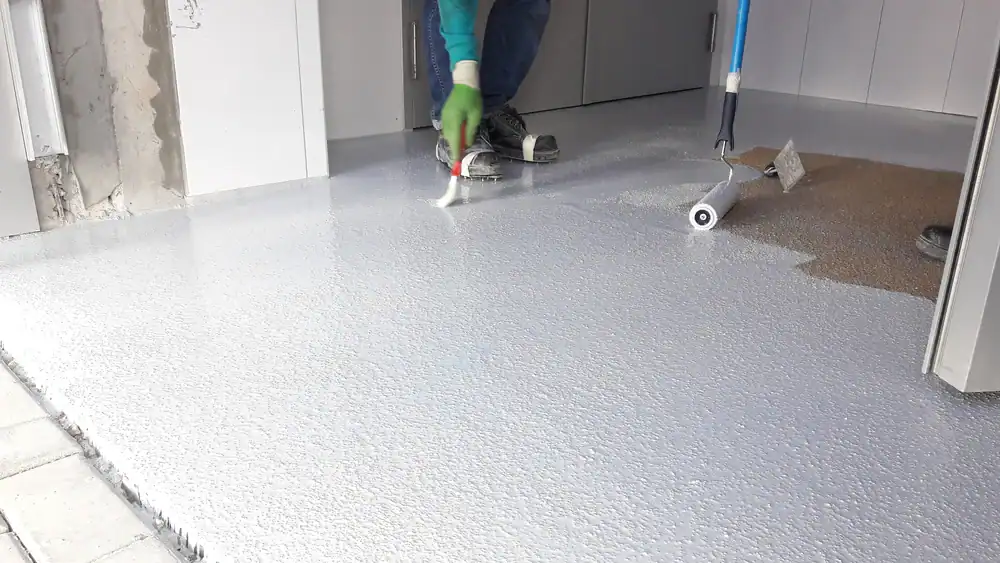
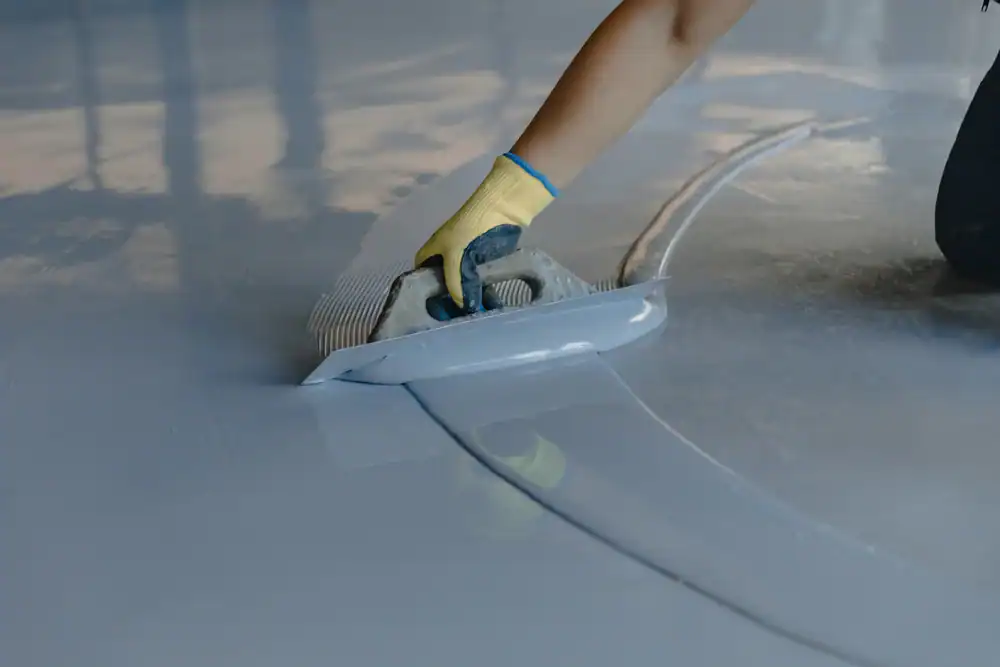
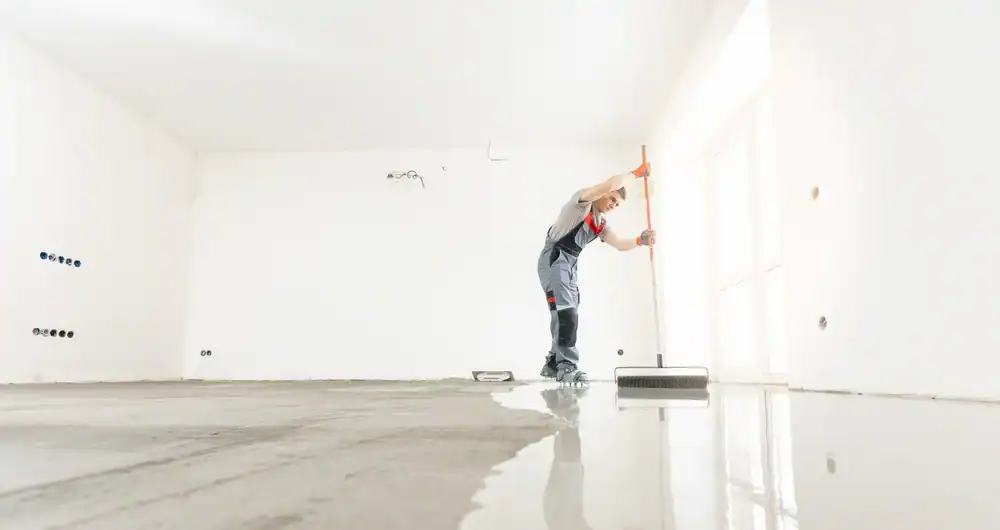
For floor coatings specifically, moisture vapor is the enemy. It’s what causes epoxy and polyaspartic coatings to bubble, delaminate, and peel — often within the first year. The fix isn’t complicated, but it has to be done before the coating goes down: moisture testing, followed by a vapor barrier primer where levels are elevated. That step is what separates a floor that lasts 15 to 20 years from one that fails before the next spring thaw.
We work in basements across Hartford County — whether in Simsbury, Glastonbury, or East Hartford — and moisture testing is part of every single job. It’s not a conversation we have after problems show up. It happens before the first coat goes down.
The 2022 CSBC addresses vapor retarders under the IRC’s foundation and wall assembly requirements. For below-grade construction, the code requires materials and assemblies that prevent moisture accumulation from damaging the structure. Vapor retarder performance is measured by permeance — specifically using the ASTM E96 water method (Procedure B) — and Class I and II vapor retarders are permitted on the interior side of assemblies in Climate Zone 5A.
What that means in plain terms: if you’re finishing a basement or installing a floor coating in Connecticut, the moisture management layer isn’t optional. The code’s intent is clear — moisture has to be managed, not ignored.
For concrete slab floors, the relevant question is whether moisture vapor is actively transmitting through the slab. In most Hartford County basements, the answer is yes — the combination of clay soil, seasonal water table fluctuation, and temperature differentials between the cool slab and warm interior air creates near-constant vapor drive. A vapor barrier primer applied directly to the concrete, before any coating, stops that transmission at the source.
This is different from a drainage system or a sump pump, which manage liquid water. A vapor barrier primer addresses vapor — the invisible moisture that moves through concrete even when there’s no visible water present. It’s a chemical layer, not a physical membrane, and when it’s applied correctly to a properly prepared surface, it creates a permanent bond that stops vapor transmission for the life of the floor.
The distinction matters because some contractors treat these as interchangeable. They’re not. A French drain handles hydrostatic water intrusion through walls and the slab perimeter. A vapor barrier primer handles the diffuse moisture vapor that moves through the slab itself. For a floor coating to perform correctly — and for it to comply with the spirit of Connecticut’s moisture management requirements — both issues need to be assessed and addressed appropriately.
If you’ve had a floor coating fail in a Hartford County basement, there’s a good chance vapor transmission was the culprit and nobody tested for it before the coating went down.
Want live answers?
Connect with a American Poly Floor expert for fast, friendly support.
Permit requirements for basement projects in Connecticut depend on the scope of work — and the answers aren’t always intuitive. The general rule is that any project involving structural changes, the creation of habitable space, or work on mechanical, electrical, or plumbing systems requires a building permit. That includes finishing a basement, adding a bathroom, or making structural repairs to foundation walls.
Surface-level work — like applying an epoxy or polyaspartic floor coating to an existing concrete slab — generally does not require a standalone permit. But if that coating is part of a larger basement finishing project that does require a permit, the overall project triggers the permitting process regardless of the individual components.
When in doubt, the safest move is to contact your local building department directly. Hartford County has 29 municipalities, each of which administers permits locally under the statewide 2022 CSBC.
Hartford County doesn’t have a single county-level permitting authority — each municipality runs its own building department under the umbrella of the 2022 Connecticut State Building Code. The City of Hartford processes permits through its Department of Licenses and Inspections. East Hartford has its own Inspections and Permits division. West Hartford, New Hartford, Glastonbury, Simsbury, and every other town in the county each have their own offices, their own application processes, and sometimes their own interpretations of when permits are required for specific project types.
That decentralization is worth knowing about before you start a project. A basement finishing project in Avon might have slightly different documentation requirements than the same project in Windsor or Canton. The underlying code is the same — the 2022 CSBC — but the local administration varies. Some municipalities have moved to online permit applications; others still require in-person submissions.
The Office of the State Building Inspector (OSBI), which oversees the statewide code program, is located at 450 Columbus Blvd. in Hartford — right in the heart of the county. If you’re unsure about the statewide code requirements, they’re the authoritative source. For local permit questions, your town’s building department is the right first call.
One thing that applies universally across Hartford County: if a permit is required for your project and you skip it, you’re creating a problem for yourself down the road. Unpermitted work can affect your homeowner’s insurance coverage, complicate a real estate sale, and in some cases require you to tear out completed work for inspection. The permit process exists to protect you, not just to generate fees.
A professional contractor should be able to tell you clearly whether your specific project requires a permit and help you navigate the application process. If a contractor tells you permits aren’t necessary for work that clearly requires one — or suggests skipping the permit to save time or money — that’s a significant red flag.
Connecticut doesn’t issue a general contractor license. Instead, the state uses a registration-based system administered by the Department of Consumer Protection (DCP). Under the Connecticut Home Improvement Act — Connecticut General Statutes Chapter 400, Sections 20-418 through 20-432 — any contractor performing residential work where the contract exceeds $200 must be registered as a Home Improvement Contractor (HIC) with the DCP.
That registration requirement covers flooring, waterproofing, painting, insulation, and most other work done on a residential property. It’s not limited to major structural projects. If someone is coming to your home in Hartford County to coat your basement floor or install a moisture barrier system, they are legally required to be a registered Home Improvement Contractor.
Registration requires the contractor to carry a minimum of $20,000 in general liability insurance and to renew annually. It also requires them to display their registration number in all advertising and to provide a written contract for every job — which is itself a legal requirement under Connecticut law. A written contract must be in place before any home improvement work begins.
You can verify any contractor’s HIC registration at the DCP’s online license lookup at portal.ct.gov/dcp. It takes about 30 seconds and tells you whether the contractor is currently registered and in good standing. It’s worth doing before you sign anything.
Connecticut also maintains a Home Improvement Guaranty Fund, which can provide up to $25,000 per eligible claim if a registered contractor fails to complete work or causes damage. That protection only applies if the contractor is registered — if you hire someone who isn’t, you have no access to the fund and limited legal recourse.
We’re a registered Home Improvement Contractor and a BBB-accredited business. Our registration number is available on request, and we include it in our documentation as required. We mention this not to check a box, but because we know that homeowners in Hartford County have been burned by contractors who skipped these steps — and we think you deserve to know exactly who you’re dealing with before any work begins.
Connecticut’s building codes for basement projects aren’t designed to make your life harder. They exist because Hartford County’s climate — the freeze-thaw cycles, the clay soil, the high water table along the Connecticut River valley — creates real moisture risks that unmanaged will damage your home over time. The code reflects that reality.
What matters most before starting any basement project is knowing what your project actually requires: whether a permit is needed, whether your contractor is legally registered, and whether moisture has been properly assessed before any coating or finishing material goes down. Those three things will determine whether your investment holds up or becomes a problem you’re dealing with again in two years.
If you have questions about basement floor coatings, moisture management, or what a code-compliant installation actually looks like in Hartford County, we’re based in East Hartford and have been doing this work in Connecticut for over 30 years. Reach out — we’re straightforward about what your project needs and what it doesn’t.
Summary:
Article details:
Share: