Not all garage floor coatings hold up to Connecticut winters. Here's what the specs actually mean — and how to pick the right system for your garage.

If your garage floor is cracked, stained, or shedding that fine layer of dust that reappears ten minutes after you sweep, you’re not imagining it getting worse — it probably is. Hartford County winters are hard on concrete. Freeze-thaw cycles, road salt tracked in from I-84 and I-91, and moisture pushing up through slabs that were poured fifty years ago — it adds up fast. The good news is there are coating systems designed specifically for this kind of punishment. We walk you through what polyurethane garage floor coatings are, how they compare to the alternatives, and what to look for when you’re ready to do something about it.
Polyurethane is a polymer-based coating that bonds to concrete and cures into a hard, flexible, chemical-resistant surface. Unlike paint, it doesn’t just sit on top — it penetrates and adheres at a molecular level, which is why it holds up where paint fails. The flexibility is the key performance trait. When Hartford County temperatures drop below freezing and your concrete slab contracts, a rigid coating cracks. Polyurethane moves with it.
It’s also UV stable, which matters more than people expect. Standard epoxy yellows and degrades with sun exposure. Polyurethane holds its color and gloss even in garages that get direct afternoon light. Chemical resistance is another practical advantage — oil drips, road salt residue, and the calcium chloride municipalities use on winter roads all get stopped at the surface rather than soaking into your concrete.
Polyaspartic coatings get talked about as if they’re a completely different product from polyurethane, but they’re actually part of the same family. Technically, polyaspartic is a specialized polyurea — and polyurea itself is a subgroup of polyurethane chemistry. So when you see “polyaspartic garage floor coating” marketed as the premium option, what you’re really looking at is the most refined expression of polyurethane technology available for residential use.
What makes polyaspartic stand out is its cure rate and performance ceiling. It cures fast enough that most residential garages are walk-ready within 24 hours and vehicle-ready within 48 to 72 hours. That’s a meaningful difference from traditional epoxy systems that require three to four days before you can pull a car back in. For Hartford County homeowners who use their garage every day, that turnaround matters.
The performance advantages go beyond speed. Polyaspartic topcoats are UV stable, maintain their gloss longer than standard epoxy, resist hot tire pickup — which is when a warm tire literally pulls a coating off the floor in sheets — and hold up through the temperature swings that define Connecticut seasons. A garage in Glastonbury or Simsbury can see temperatures below zero in January and above ninety in July. A polyaspartic-topped system handles that range without cracking, peeling, or going brittle.
We use polyaspartic as our preferred topcoat on residential garage installations throughout Hartford County because, in this climate, it’s simply the most reliable finish available. The chemistry was built for exactly these conditions — thermal stress, chemical exposure, and the kind of daily use a working garage sees.
“Premier” gets thrown around a lot in this industry, so it’s worth being specific about what it actually means when you’re evaluating a garage floor coating system. The coating material itself is only one part of the equation. What separates a system that lasts fifteen years from one that peels in eighteen months is almost always what happened before the first coat went down.
A premier garage floor coating starts with diamond grinding — not acid washing, not a light etch, but industrial grinding that opens the concrete’s pores and creates a mechanical bond. This is the same preparation standard used in pharmaceutical facilities and commercial warehouses. It’s not optional. Skipping it or substituting a lighter prep method is the single most common reason coatings fail, and it’s the step that budget contractors cut first.
Moisture testing comes next. In Hartford County, this step is non-negotiable. The Connecticut River runs through the heart of the county — through East Hartford, Hartford, Glastonbury, Wethersfield, Rocky Hill, and Windsor — and the soil moisture levels in these communities are elevated year-round. Moisture vapor pushes up through concrete slabs from below, and if a coating goes down over that without a proper vapor barrier primer, it will eventually delaminate. It’s not a question of if, it’s when.
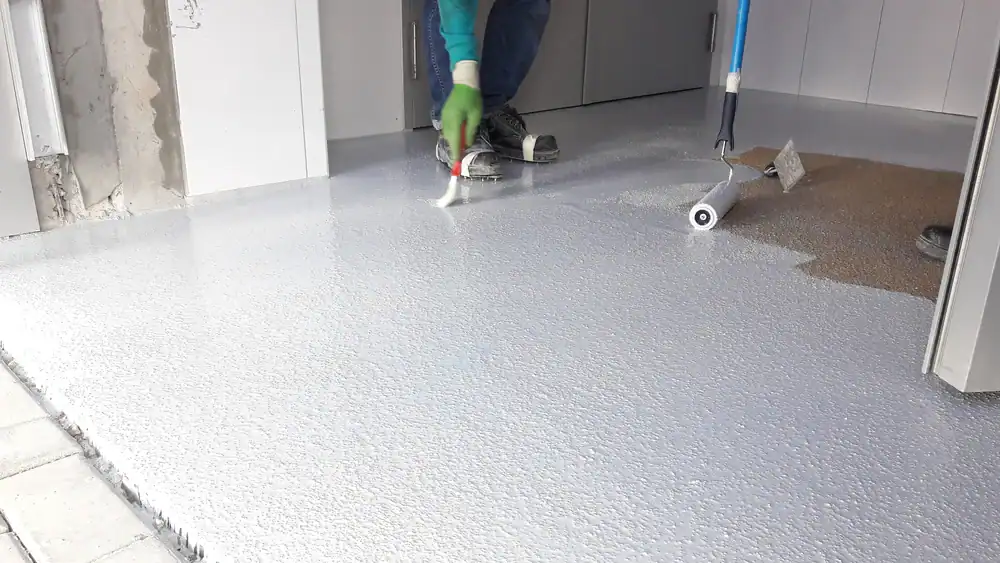
After grinding and moisture mitigation, a premier system layers a base coat, a decorative vinyl flake broadcast if you want texture and color, and a polyaspartic or polyurethane clear topcoat that seals everything and provides the chemical and UV resistance the floor needs. The result is a seamless, non-porous surface that cleans with a broom and a bucket of mild cleaner — not a weekend of scrubbing.
We back our residential installations with a 15-year warranty because this process, done correctly, genuinely produces a floor that lasts. Most companies in Connecticut offer one to two years. The difference isn’t luck — it’s preparation.
Want live answers?
Connect with a American Poly Floor expert for fast, friendly support.
Rubber flooring — whether that’s interlocking tiles, roll-out mats, or rubber-based paint — gets considered by a lot of homeowners because it’s accessible and DIY-friendly. It has real strengths: it’s cushioned underfoot, it’s removable if you change your mind, and it’s easy to install on a weekend. For a workout room or a light-use storage space, it’s a reasonable option.
For a working garage in Hartford County, though, the limitations add up quickly. Rubber isn’t seamless. Tiles and rolls have seams and edges where road salt, oil, and moisture can work their way underneath. In a climate with significant moisture vapor transmission — which describes most of Hartford County, especially near the river corridor — that trapped moisture becomes a problem. It sits under the rubber, keeps the concrete wet, and accelerates the surface deterioration you were trying to stop.
Chemical resistance is where the gap between rubber coating and polyurethane becomes most obvious for Hartford County homeowners. Connecticut municipalities use a combination of sodium chloride, calcium chloride, and magnesium chloride on winter roads. Calcium and magnesium chloride are significantly more corrosive than standard road salt — they’re the reason your concrete scales and pits faster than you’d expect. Rubber coatings and tiles don’t provide a sealed barrier against these chemicals. They sit on top of the concrete rather than bonding to it, which means the chemicals still reach the slab.
Polyurethane and polyaspartic systems bond directly to the concrete and cure into a continuous, non-porous surface. Road salt, oil, and de-icing chemicals hit the coating and stay there — they don’t penetrate. You wipe them up, or they wash away when you rinse the floor. The concrete underneath stays protected.
Durability over time is another real difference. Rubber tiles and rolls wear down, compress in high-traffic areas, and eventually need to be replaced. A properly installed polyurethane or polyaspartic system — one that was diamond-ground, moisture-tested, and applied by a certified installer — can last twenty years or more with minimal maintenance. The up-front investment is higher than a rubber tile kit from a home improvement store, but the math over a decade is not close.
For homeowners in West Hartford, Avon, or Farmington who are thinking about resale value, it’s also worth knowing that a professional garage floor coating adds an estimated five thousand to ten thousand dollars in perceived home value. Rubber tiles don’t move that number. A seamless, high-gloss polyaspartic floor does.
**How long does a polyurethane garage floor coating last?** With proper surface preparation and a quality polyaspartic topcoat, you’re realistically looking at fifteen to twenty-plus years. The preparation is the variable — a well-prepped floor with a certified coating system outlasts a poorly prepped floor with premium materials every time. That’s why we offer a 15-year residential warranty. It reflects what the system actually does when it’s installed correctly in Hartford County’s challenging climate.
**What causes garage floor coatings to peel?** Almost always, it’s one of three things: inadequate surface prep, ignored moisture, or the wrong materials for the environment. DIY kits from big-box stores are water-based formulas that weren’t designed for thermal shock or vapor pressure — they look fine for six months and then start lifting. In Hartford County, where freeze-thaw cycles and moisture vapor are both significant factors, skipping the prep and moisture mitigation steps is a near-guarantee of failure.
**Is polyurethane or epoxy better for a garage floor in Connecticut?** They’re often used together — epoxy builds thickness and provides color, polyurethane or polyaspartic goes on top as the protective finish layer. On their own, polyurethane and polyaspartic outperform standard epoxy as topcoats because they’re UV stable and more flexible in temperature extremes. Standard epoxy yellows under sunlight and can go brittle in sub-zero temperatures, both of which are real concerns in Hartford County winters.
**Do I need a moisture vapor barrier under my garage floor coating?** In most of Hartford County, yes. Homes near the Connecticut River corridor — East Hartford, Glastonbury, Wethersfield, Rocky Hill — face elevated soil moisture that pushes vapor up through concrete slabs year-round. Even in areas farther from the river, Connecticut’s humid climate means vapor transmission is a common issue. We test every floor before we coat it, and when moisture is present, we apply a penetrating vapor barrier primer before anything else goes down. It’s the step that makes the difference between a coating that lasts and one that doesn’t.
**How long does installation take?** Most residential garages in Hartford County are completed in two to three days. You can walk on the floor within twenty-four hours and bring your vehicle back in within forty-eight to seventy-two hours. That’s significantly faster than traditional epoxy systems, which typically require three to four days before vehicle traffic.
The coating itself matters, but it’s the complete system — preparation, moisture mitigation, material selection, and installation quality — that determines whether your floor holds up for two years or twenty. Hartford County’s climate doesn’t leave much margin for shortcuts. Freeze-thaw cycles, road salt, and aging concrete slabs all put real stress on whatever goes down, and systems that weren’t built for this environment show it quickly.
If you’ve had a coating fail before, or you’re tired of looking at a floor that’s embarrassing every time the garage door goes up, the answer isn’t a better kit from the hardware store. It’s a process that addresses the root causes — moisture, surface prep, and the right chemistry for Connecticut winters.
We’re based in East Hartford and serve homeowners throughout Hartford County. Reach out for a free assessment and we’ll tell you exactly what your floor needs — no guesswork, no pressure.
Summary:
Article details:
Share: