Most waterproofing fixes manage water after it's already inside. This guide explains why that's backwards — and what actually works in Hartford County basements.

If you’ve got a wet basement in Hartford County, you already know the pattern. It’s dry for weeks, then one heavy rain in April and you’re moving boxes off the floor again. Or maybe there’s no standing water — just that smell, and a floor coating that’s starting to bubble at the edges. Either way, something’s wrong, and you’ve probably wondered whether fixing it is actually worth it.
The short answer is yes — but only if the fix addresses the real problem. This page walks through how moisture gets in, what actually stops it, and how waterproofing connects directly to the long-term performance of any floor you put down there.
Hartford County isn’t a generic wet-climate region. The area sits on glacially deposited soils — a mix of clay-heavy till and sandy loam left behind by the last ice age. Clay holds water. Instead of draining away after a rainstorm, moisture lingers against your foundation walls for days, sometimes weeks, building up hydrostatic pressure that pushes through any crack or pore it can find.
Add to that the Connecticut River valley’s seasonal flooding risk, spring snowmelt hitting the ground all at once, and 20-plus freeze-thaw cycles every winter that slowly pry open micro-cracks in concrete — and you’ve got a set of conditions that punish foundations harder than most of the country. Homes in East Hartford, Glastonbury, Windsor, and along the Farmington River corridor deal with elevated water tables year-round, not just after storms.
There are a few different entry points, and they don’t all look the same. The most obvious is a crack — in the foundation wall, along the floor-wall joint, or running through the slab itself. These cracks start small, often invisible, and widen every winter as water freezes inside them and expands. In a pre-1960 home in West Hartford or Wethersfield, that process has been running for 60 or 70 years. What started as a hairline fracture is now a reliable leak every spring.
But visible cracks aren’t the only path in. Concrete is porous by nature, and moisture vapor moves through solid concrete without any crack at all. This is the problem that catches a lot of homeowners off guard — there’s no puddle, no obvious wet spot, just a persistent musty smell and, eventually, a floor coating that starts lifting at the edges. That’s vapor transmission, and it’s happening in basements all over Simsbury, Farmington, and Canton whether homeowners know it or not.
The third entry point is poor drainage around the foundation itself. If your gutters are dumping water near the house, if the ground slopes toward the foundation instead of away from it, or if your downspouts are too short, you’re concentrating water exactly where you don’t want it. Clay soil makes this worse because it doesn’t let that water move away quickly — it just holds it there, pressing against your walls.
Understanding which of these is your actual problem matters a lot, because the fix is different for each one. A sump pump helps if water is pooling on the floor, but it does nothing for vapor transmission through the slab. A topical sealer might slow surface moisture temporarily, but it won’t hold against hydrostatic pressure. And patching a crack without addressing the drainage issue that’s causing it is just buying time.
The most common waterproofing approach in Hartford County — interior drainage channels, a sump pump, and a dehumidifier — works by collecting water after it enters and removing it. That’s not waterproofing in the true sense. It’s water management. The water still gets in; you’re just moving it out faster than it accumulates. When the pump fails during a power outage — which is exactly when major storms knock out electricity — you find out how much that system was actually doing.
Topical sealers and “waterproof paint” have the same fundamental problem. They sit on the surface of the concrete. When moisture pressure builds up behind the wall and pushes outward, it takes the sealer with it. You’ve seen this — the paint bubbling and peeling off a basement wall a year or two after it was applied. That’s not a product failure, exactly. It’s a physics problem. Pressure from behind will always win against something applied to the surface.
What actually works is a system that stops moisture inside the material itself, not on top of it. We use INFILLCRETE, a penetrating waterproofing compound that goes into the concrete and reacts chemically within the wall to close the microscopic pathways that water and vapor use to move through. There are no solvents, no harsh chemicals — it’s safe for homes with kids and pets — and because it reacts inside the concrete rather than coating the surface, there’s nothing for hydrostatic pressure to push off. The barrier becomes part of the wall.
This matters especially in Hartford County, where the combination of clay soil, seasonal groundwater pressure, and aging foundations means that surface-level fixes get tested hard every single spring. A system that works with the concrete rather than against it is the only one that holds up over time.
Want live answers?
Connect with a American Poly Floor expert for fast, friendly support.
Most contractors treat waterproofing and flooring as two separate jobs. You call a waterproofing company, then later you call a flooring company. The problem with that sequence is that the flooring company often doesn’t know — or doesn’t ask — what’s happening beneath the slab before they install.
Moisture vapor moves upward through concrete. If it isn’t properly managed before a floor coating goes down, it will push that coating up from underneath. The result is bubbling, peeling, and delamination — sometimes within months of installation. This is one of the most common reasons epoxy floors fail, and it’s almost always preventable.
ASTM F2170 is the industry standard for measuring moisture inside a concrete slab — not just on the surface, but deep within the material where the real moisture condition lives. It uses in-situ relative humidity probes inserted into the slab itself, giving a true picture of what’s happening below the surface rather than just what’s evaporating off the top.
Before we install any floor coating, we run this test. It’s not optional, and it’s not a formality — it’s the only way to know whether the slab is actually ready to receive a coating. An older method, the calcium chloride test, only measures surface evaporation. It misses what’s happening deeper in the slab and has led to a lot of failed floors that looked fine on test day and started peeling six months later.
For Hartford County homeowners, this matters more than it might in a drier climate. Connecticut’s seasonal humidity, combined with the groundwater pressure that builds up in spring and early summer, means basement slabs are often holding more internal moisture than they appear to on the surface. A basement in Glastonbury or Windsor that looks and feels dry in October might read very differently on an ASTM F2170 test — and that difference is what separates a floor that lasts from one that doesn’t.
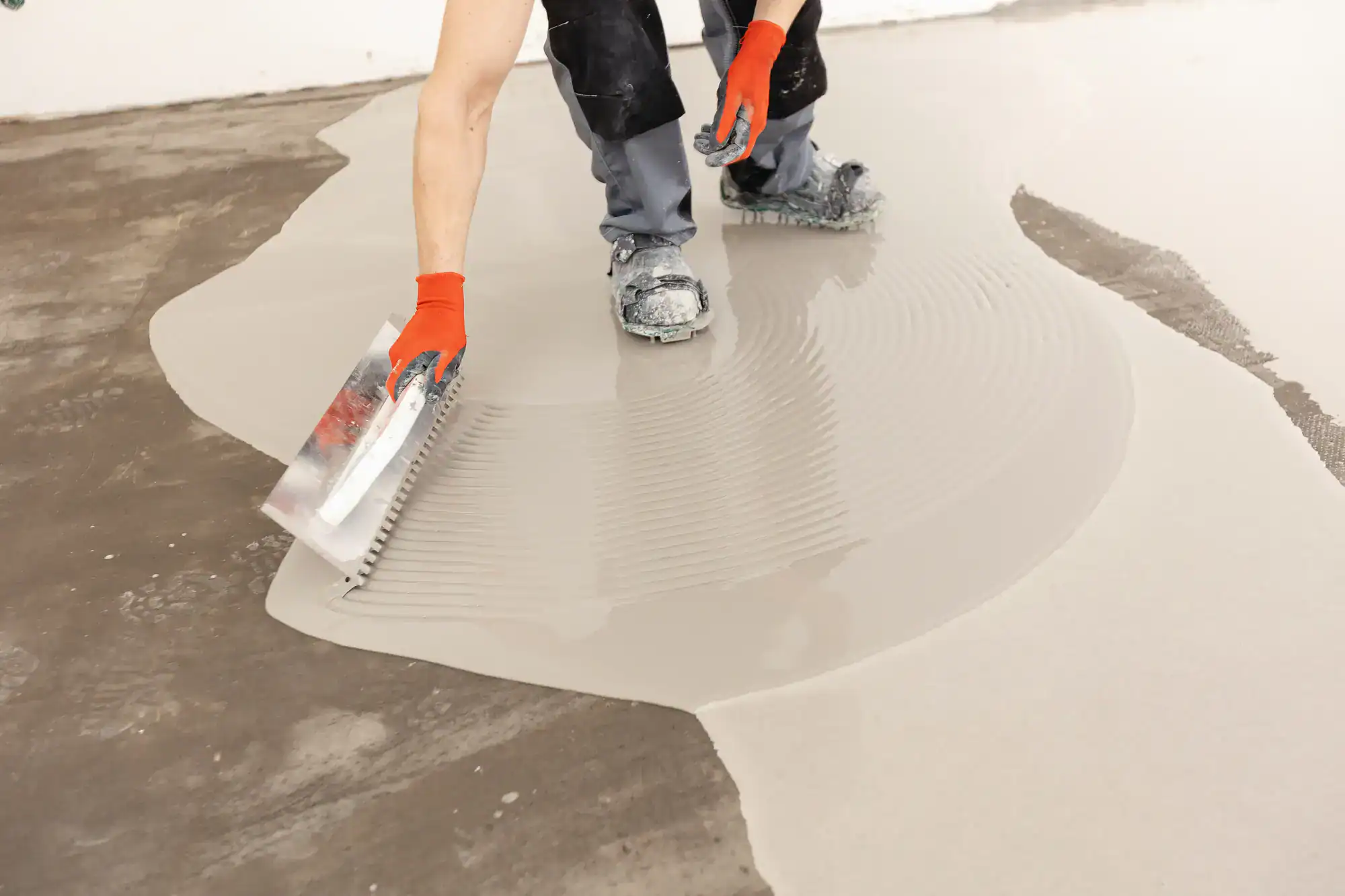
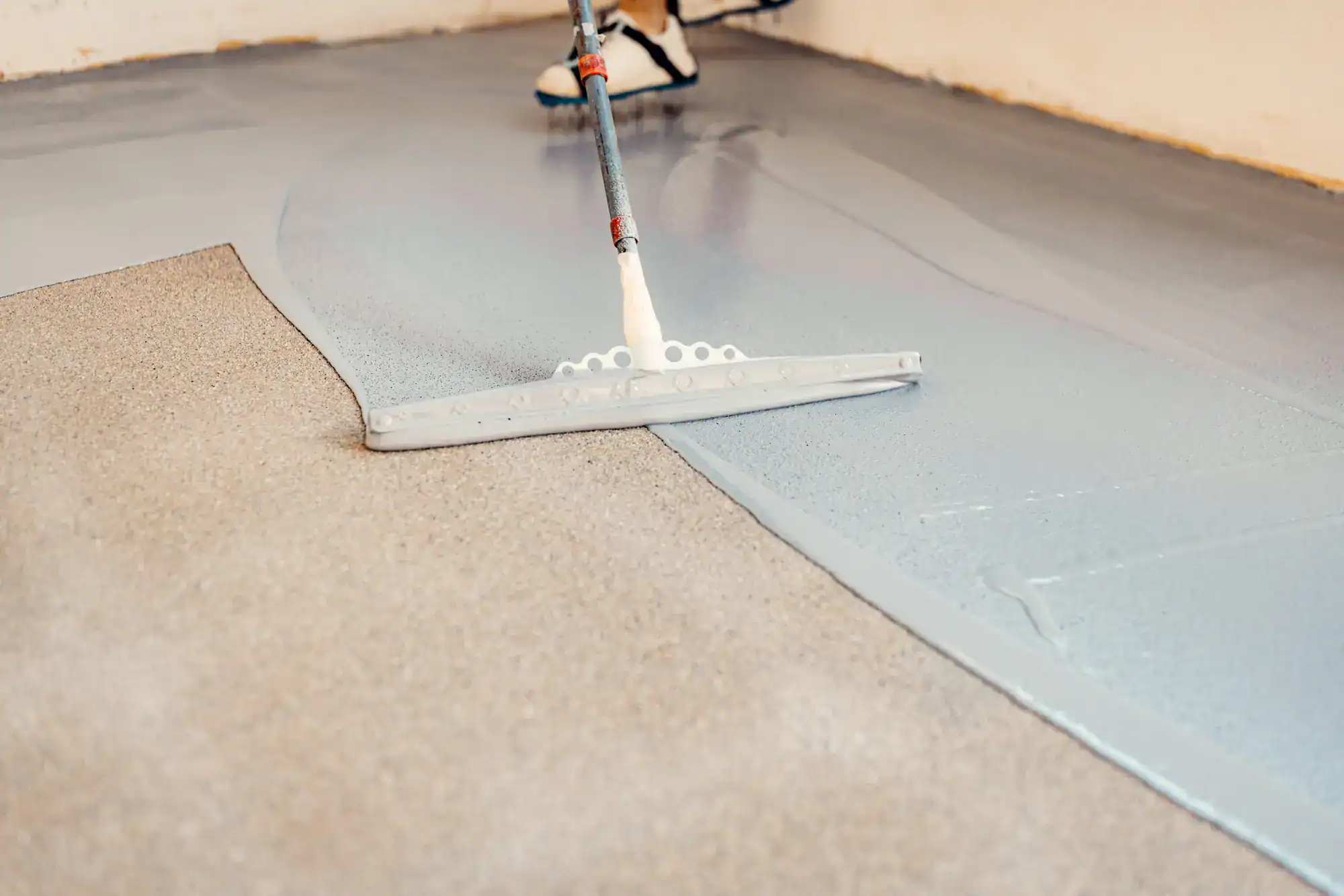
We also apply a moisture vapor barrier as part of every flooring installation — a specialized primer that permanently stops vapor transmission before the base coat goes down. It’s a step that adds time and cost, and it’s also the reason our floors don’t come back to us with delamination problems. Skipping it is how cheaper installs go wrong.
A flooded basement is an emergency, but the damage it causes doesn’t end when the water gets pumped out. Concrete is absorbent. After a significant water event — a spring flood along the Connecticut River, a sump pump failure during a nor’easter, or a backed-up drain during a heavy July storm — the slab can hold elevated moisture levels for weeks or months. If a floor coating goes down during that window, it’s going to fail.
Beyond the floor, untreated moisture creates conditions for mold growth. Basements with ongoing moisture problems develop mold or fungus, and because most HVAC systems pull air from the basement, that mold doesn’t stay contained below grade. It circulates through the house. For families with young children or anyone with respiratory sensitivities, this is a real health concern — not a hypothetical one.
The sequence matters: address the water source first, let the slab dry and test it properly, apply a vapor barrier, then install the floor. Rushing any part of that process to save time or money tends to cost more in the end — either in a failed floor that needs to be torn out and redone, or in remediation costs if mold establishes itself in the framing or insulation.
We offer emergency response services for exactly this reason. When a basement floods, the decisions made in the first 48 to 72 hours significantly affect what the remediation and restoration process looks like. Getting the moisture assessment done early — before a floor is reinstalled or walls are closed back up — is the difference between a clean repair and a recurring problem.
For homeowners in Enfield, East Hartford, or anywhere along the Hockanum River corridor who’ve dealt with repeat flooding, the goal isn’t just to clean up after the next event. It’s to make sure the next event doesn’t get through the wall in the first place.
Hartford County’s combination of aging housing stock, clay-heavy soil, and seasonal groundwater pressure makes basement moisture a genuine structural issue — not just an inconvenience. The homes most affected are often the ones with the most character: pre-war colonials in West Hartford, mid-century ranches in Wethersfield, older colonials in Simsbury and Canton. These are valuable homes, and protecting them starts below grade.
The right approach stops moisture before it enters, tests the slab before anything goes on top of it, and treats waterproofing and flooring as one connected system rather than two separate jobs. That’s how you get a basement that stays dry, a floor that holds up, and a space you can actually use without worrying every time the forecast shows rain.
If you’re dealing with a wet basement, a failed floor, or just want to get ahead of the problem before finishing your space, we’re based in East Hartford and serve homeowners throughout Hartford County. Reach out and we’ll take a look at what’s actually going on — and tell you honestly what it’s going to take to fix it.
Summary:
Article details:
Share: