Skipping moisture testing is the number one reason epoxy floors fail. Here's what the test actually involves — and why it matters more in Hartford County than most places.
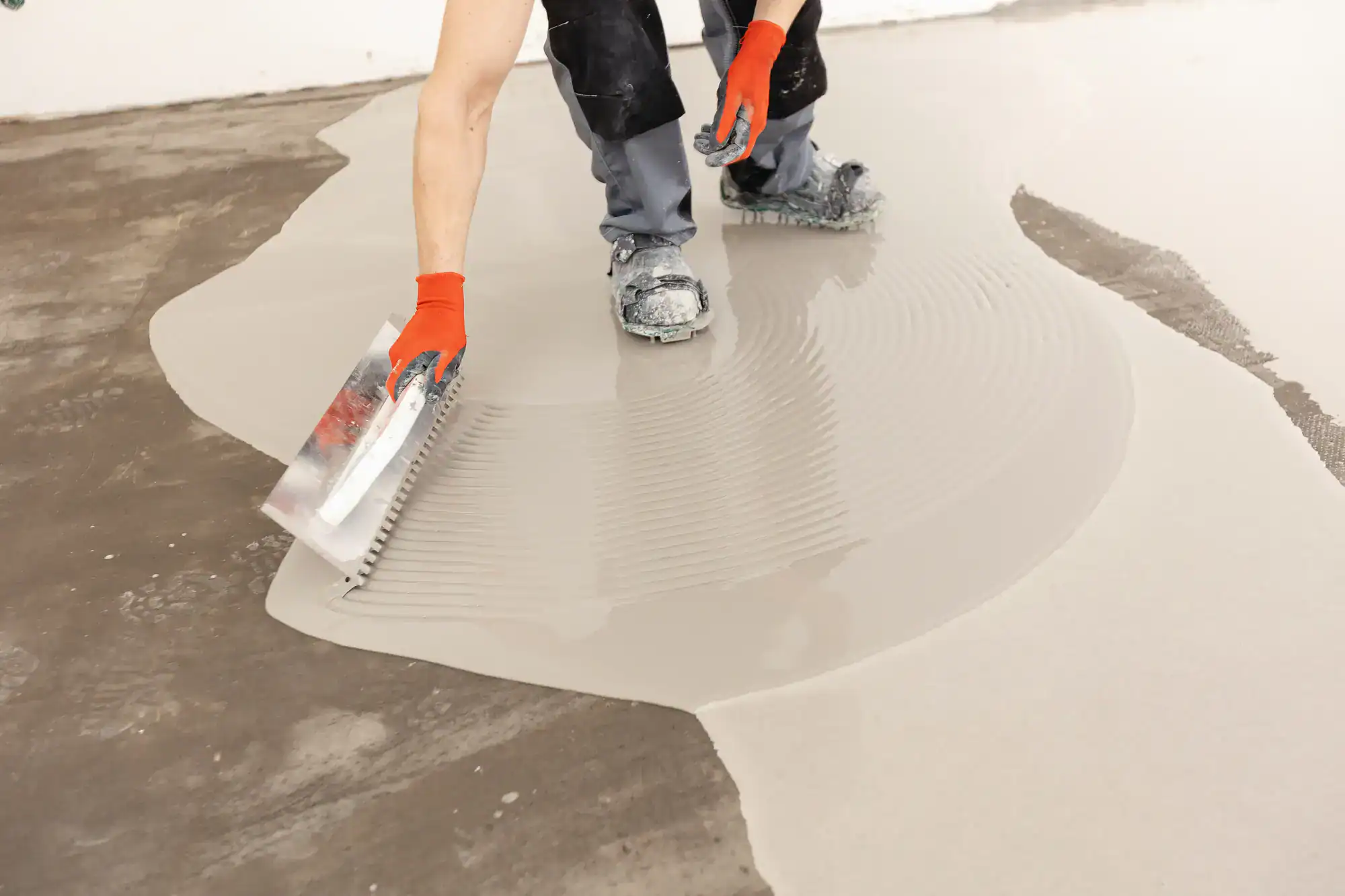
Here’s something most people don’t find out until after their floor starts peeling: up to 80% of epoxy coating failures trace back to moisture — not the coating itself. The coating was probably fine. The problem was what was underneath it, and nobody checked.
Concrete moisture testing exists specifically to catch this before it becomes your problem. But the majority of contractors — residential and commercial alike — skip it entirely. Either they don’t have the equipment, don’t know the standard, or they’re banking on the fact that you won’t know the difference until they’re long gone.
If you’re in Hartford County and you’re thinking about putting a new floor down, this is the one thing worth understanding before you start.
Concrete looks solid. It isn’t. At a microscopic level, it’s full of interconnected capillaries — tiny channels that move water vapor from inside the slab up toward the surface, constantly. A slab that looks bone dry on top can be pushing moisture vapor upward at levels that will destroy an epoxy coating from the inside out.
That’s what moisture testing measures — not whether the surface feels damp, but what’s actually happening inside the slab. And the reason it matters so much is that once a coating goes down over a slab with elevated internal moisture, the outcome is predictable: blistering, bubbling, delamination. Usually within six to twelve months.
ASTM F2170 is the standard established by the American Society for Testing and Materials for measuring relative humidity inside a concrete slab. It’s been the recognized method since 2002, and most major epoxy and flooring manufacturers now require it — or something equivalent — before their warranty applies. Skip it, and you’re not just taking a risk. You’re voiding the manufacturer’s coverage before the floor is even finished.
The process itself is more involved than most people expect. It starts with drilling holes into the concrete slab — not on the surface, but down to 40% of the slab’s total depth. That specific depth isn’t arbitrary. Research has shown it’s the point that most accurately reflects the moisture level the entire slab will stabilize at once it’s sealed. Probe too shallow and you get a reading that’s artificially low. That 40% depth is where the real number lives.
Once the holes are drilled and lined with sleeve inserts, calibrated relative humidity probes are placed inside and left to acclimate. They need a minimum of 24 hours before a reading is taken — the probe has to equilibrate with the slab’s internal environment, not just the ambient air. Rushing that step produces inaccurate data.
Coverage matters too. The standard calls for at least three sensors in the first 1,000 square feet, with one additional sensor for each additional 1,000 square feet after that. There also needs to be at least one reading within three feet of each exterior wall, because moisture levels near the perimeter often differ from the center of the slab. A single reading in the middle of a 2,000-square-foot warehouse floor tells you almost nothing useful.
Once the readings are in, the threshold for most epoxy systems is a relative humidity of 75–80% or lower. Above that, a standard coating system will eventually fail. It’s not a question of if — it’s a question of when.
The calcium chloride test — formally ASTM F1869 — has been around longer and is still used in the field. It works by placing a dish of calcium chloride on the concrete surface, sealing it under a plastic dome for 60–72 hours, and then measuring how much moisture the salt absorbed. That gives you a Moisture Vapor Emission Rate, or MVER, expressed in pounds per 1,000 square feet per 24 hours.
The problem is that it only measures what’s happening at the surface. It doesn’t tell you what’s going on inside the slab — which is exactly where the moisture driving most failures originates. It’s also significantly affected by ambient temperature and humidity at the time of the test. Run it on a cold morning in February versus a humid afternoon in July, and you can get meaningfully different results from the same slab.
Sherwin-Williams and several other major manufacturers have moved toward recommending ASTM F2170 specifically because the in-situ RH test is more stable and more predictive. It’s not that calcium chloride testing is useless — it still has a place as a screening tool — but it shouldn’t be the only method used, and it shouldn’t be treated as equivalent to an in-situ reading.
When a contractor tells you they “tested for moisture,” it’s worth asking which method they used, how many test points they ran, and what the actual numbers were. If they can’t answer those questions specifically, the test probably wasn’t done to any recognized standard. That’s a problem, because once a floor fails, the only fix is full removal and reapplication. There’s no patch for a coating that’s delaminated across an entire slab. The cost of doing it right the first time is a fraction of doing it twice.
Want live answers?
Connect with a American Poly Floor expert for fast, friendly support.
Hartford County sits in the Connecticut River valley, which creates conditions that make moisture testing genuinely non-negotiable — not just good practice. The region has elevated water tables, clay-heavy soils that hold moisture, and hydrostatic pressure that pushes upward through slabs year-round. That’s before you factor in the seasonal swings.
Spring snowmelt combined with March and April rain saturates the ground around foundations throughout Hartford County. Summer humidity regularly runs above 70–80% outdoors. Then winter brings 20 to 30 freeze-thaw cycles that widen micro-cracks in concrete and open new pathways for vapor to travel. It’s a year-round cycle, and it doesn’t stop just because the floor looks fine.
A significant portion of Hartford County’s housing stock was built between 1945 and 1975 — a period when sub-slab vapor barriers weren’t standard practice. In communities like West Hartford, Wethersfield, New Britain, and East Hartford, it’s common to find concrete slabs poured directly over compacted gravel or soil with no plastic membrane underneath. Moisture from the ground migrates directly into the slab, continuously, with nothing to stop it.
This isn’t a seasonal issue. It’s a structural one. The slab is in constant contact with the moisture in the soil beneath it, and capillary action pulls that moisture upward. The surface may feel dry to the touch in August, but the internal relative humidity can still be well above the 75–80% threshold that most epoxy systems require. Without testing, there’s no way to know.
We’ve worked on floors in Glastonbury, Simsbury, and Manchester where the homeowner had no idea their slab had a moisture issue until a previous coating failed. In every case, the fix was the same: proper testing, a professional-grade vapor barrier primer applied to the concrete before any topcoat, and then the coating system on top of that. The floors have held. The ones installed without that step didn’t.
The vapor barrier primer isn’t a workaround or a patch — it’s a permanent solution. It bonds directly to damp concrete, stops vapor transmission at the surface, and gives the topcoat something stable to adhere to. For older Hartford County slabs, it’s often not optional. It’s just part of doing the job correctly.
Moisture testing is the diagnostic step. But it’s not the only preparation work that matters before a coating is applied. If the slab has cracks, spalls, or pitting — and most Hartford County slabs do, given the freeze-thaw cycles — those need to be addressed with a proper concrete patch epoxy repair before anything else goes on top.
Cracks that get coated over don’t disappear. They telegraph through the coating, collect moisture, and expand with temperature changes. A crack that looked cosmetic in October can cause a visible failure by March. The right approach is to fill every crack and spall with a compatible epoxy patching compound, let it cure fully, and then grind the surface to a consistent profile before applying any primer or topcoat.
That grinding step matters more than most people realize. Diamond grinding — not acid etching — is what creates the surface profile that epoxy actually bonds to. Grinding removes laitance, contamination, and the weak surface layer of the concrete, opening the pores mechanically and giving the coating a real anchor. Acid etching is a chemical process that’s inconsistent, affected by existing contamination, and generally doesn’t create an adequate profile for a commercial-grade system. In Hartford County garages, where road salt residue is tracked in from November through March, grinding is the only way to ensure the surface is actually clean and ready.
This is the preparation sequence that makes a long-term warranty possible: test for moisture, address elevated readings with a vapor barrier primer, repair every crack and spall with epoxy patching compound, grind to the correct surface profile, and then apply the coating system. Each step depends on the one before it. Skip any of them and the whole system is compromised — not immediately, but inevitably.
Summary:
Article details:
Share: